
 Google
 Yelp
 Facebook
 Twitter
 ChEnected
286234 Using Components in the Bag, Student Assemble and Run Simple Experiments in Undergraduate Lecture Course On Process Dynamics and Control
Using Components in the Bag, Student Assemble and Run Simple Experiments in Undergraduate Lecture Course on Process Dynamics and Control
Pál Tóth and Mikhail Skliar
Chemical Engineering, University of Utah
Last year, we completely transformed the instruction in an undergraduate class on Process Dynamics and Control from the traditional approach, consisting of lectures and homework assignments – which occasionally include computer simulations to test the designed controllers, etc. – to a teaching paradigm that emphasizes project-based learning. The subject of process dynamics and control is difficult to teach because of the breadth of covered topics, reliance on concepts expressed in a fairly formal manner, and the need to teach students how to relate abstract concepts to the outcome of practical designs. The undergraduate students often view this senior level course as an abstract exercise in mathematics, and usually have difficulty applying what they have learned to the actual process control. It was clear for a long time that to bridge the theory and practice of process control, this course would benefit from the addition of experimental projects. However, all previous attempts at introducing experiments into this lecture course were only marginally successful. For example, a few years ago we introduced projects that used professionally designed educational experiments only to find out that time sharing of the same equipment located in our instructional laboratory (Senior Lab) is difficult and the value to learning based on a “pre-packaged” experiment was not that high. This “experiment with experiments” was scrapped the year after it was tried.
Our new approach is a concept of “experiments in a bag.” In this approach, groups of three students receive a Ziploc bag of components, including a low cost microcontroller, resistor, thermistor, transistors, etc., and are asked to put together their own experiments, which are small enough to carry in a backpack and run at any continent time and location after connecting the experiment to a laptop. It is assumed that students have no experience in prototyping electronic systems but are capable of following basic bread boarding instructions, such as those given at
http://implicit.che.utah.edu/Teaching/4203/GuideAssignment1.htm. Students are asked to assemble a simple circuit shown in Fig. 1 which describes a thermal control experiment in which the temperature of resistor R2 is measured using thermistor R4. As part of the assignments, students are asked to: (1) using the provided driver, establish the communication between the microcontroller, which serves to acquire data and control an average current through R2 using pulse-width modulation, and their Matlab code; (2) calibrate the thermistor to provide temperature measurements of R2; (3) acquire test data and identify the response models of the experiment, and (4) design and test simple temperature controllers for the process.
Our initial experience with the introduction of experiments into this traditional lecture course is very positive and sets an example for future development of lecture courses with incorporated experimental components. The ability for the student to have an experiment that they implement themselves, carry in their backpacks, and run at any convenient time and place are the key contributing factors to the success. The students' own assessment of this new approach was remarkably positive, despite a substantially higher workload needed to complete experimental assignments.
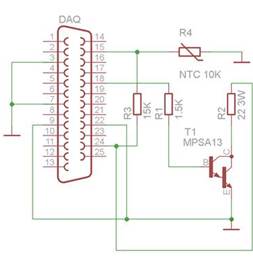
Figure 1: Schematic of the student-assembled thermal control experiment
See more of this Group/Topical: Education Division