
 Google
 Yelp
 Facebook
 Twitter
 ChEnected
286471 Reactive Extraction of Nicotinic Acid Using Tri-n-Octylphosphine Oxide (TOPO) Dissolved in a Binary Diluent Mixture
Reactive Extraction of Nicotinic Acid using Tri-n-Octylphosphine Oxide (TOPO) Dissolved in a Binary Diluent Mixture
Sushil Kumar1* Dipaloy Datta1 and B V Babu2
1Department of Chemical Engineering
Birla Institute of Technology and Science (BITS), PILANI – 333031 (Rajasthan), INDIA
*Corresponding Author:
E-mail: sushilk2006@gmail.com; skumar@bits-pilani.ac.in
Phone : +91-1596-245073 Ext 215; Fax: +91-1596-244183
Homepage: http://universe.bits-pilani.ac.in/pilani/skumar/profile
Abstract
Nicotinic acid (pyridine-3-carboxilic acid) is a water-soluble vitamin and precursor to coenzymes (NADH, NAD+, NADP+, and NADPH) which serves an important role in the redox reactions taking place inside the human living cells for the metabolism activity. Niacin helps in both DNA repair and formation of steroid hormones in the adrenal gland. A deficiency of niacin can cause pellagra, a serious disease that has paralyzed mankind for centuries. Also, a mild deficiency slows down the metabolism of the body, causing decreased tolerance to cold (Kumar and Babu, 2009). The production of organic acids by biochemical fermentation route is comparatively a clean and a green technology. The biosynthesis process produces nicotinic acid at a lower rate and also the concentration of the acid in the fermentation broth is found to be very low. Therefore, to make the fermentation route efficient and effective, there is a need to develop novel fermentation processes and efficient separation techniques. The reactive extraction with higher distribution coefficient is proposed to be an efficient and eco-friendly primary separation process (Kertes and King, 1986; Kumar and Babu, 2008).
Phosphorus-bonded, oxygen containing extractants have a phosphoryl group and a stronger Lewis basicity than those of carbon-bonded, oxygen-containing extractants. Phosphorus-bonded, oxygen-containing extractants can only co-extract small amounts of water and show low solubilities in water. When organophosphorus extractants are used, the solvation has a higher specificity (Kertes and King, 1986). These extractants are dissolved in organic diluents (ketones, alcohols, hydrocarbons) to provide appropriate physical properties (density, viscosity, etc.,) to the extractant-diluent system. The diluents are categorized in two groups based on their activity: (i) inactive (inert) diluents, and (ii) active diluents (modifiers). The presence of polar functional groups in the modifiers enables them to act as better solvation medium for the acid-extractant complex by the formation of hydrogen bond. Also, a modifier enhances the extracting power of organophosphoric extractant as compared to an inert diluent in the extraction of organic acids (Mariya et al., 2005; Yankov et al., 2004).
The present work is aimed to
intensify the recovery of nicotinic acid using reactive extraction with tri-octyl
phosphine oxide (TOPO) in a diluent mixture
consisting of an active and an inactive diluent [MIBK + kerosene (1:1
v/v)]. The aqueous solutions of nicotinic acid are prepared in the concentration
range 0.02 to 0.12 mol/L
using distilled water. Organic solutions
are prepared by varying the concentration of TOPO (0.1 and 0.5 mol/L)
in the mixture of MIBK + kerosene (1:1 v/v). MIBK is used as the active diluent
(modifier). Kerosene is used as inactive diluent to control density and
viscosity of the organic phase. The extraction equilibrium
experiments are carried out with equal volumes (20 ml) of the aqueous and
organic solutions in conical flasks of 100 ml and shaken at 100 rpm for 8 hours
in a temperature controlled reciprocal shaker bath (HS 250, Remi
Labs, India) at constant temperature (298 K). After attaining equilibrium, the
mixture of aqueous and organic phases is kept for separation in separating
funnel (125 ml) for 2 hrs at 298 K. After separation of both phases, the
aqueous phase acid concentration is analyzed by titration using NaOH solution of 0.01 N with phenolphthalein as an
indicator and also by UV-Vis Spectrophotometer (Evolution 201, Merck, India at
262 nm). The acid concentration in the organic phase is calculated by mass
balance. The equilibrium pH values of
aqueous solution are measured by a digital pH-meter
(PCT 40, ArmField Instruments, UK).
The experimental data are analyzed by calculating distribution coefficient (KD = Corg/Caq),
degrees of extraction [E = KD / (1 + KD)] and loading ratios (Z = Corg/

To determine the physical extraction parameters (partition coefficient = P and dimerization constant = D), the following equation is fitted linearly in the Origin 8.0 (software package).

The values of

The equilibrium chemical extraction experiments for the recovery of nicotinic acid is carried out using TOPO dissolved in MIBK + kerosene (1:1 vv). The extraction degree decreases with an increase in acid concentration in the aqueous phase. This may be due to the lower amount of TOPO used in the initial organic phase, and TOPO concentration is found to be a limiting parameter for the extraction. Generally, for a high initial acid concentration, the distribution coefficient (KD) may decrease with an increase in the acid concentration in aqueous solution using TOPO with diluent mixture. The distribution coefficients (KD) and degree of extraction (E) are found to increase with an increase in TOPO concentration (0.10 to 0.50 mol/L). TOPO/diluent system favors the formation of ‘not overloaded' complexes of polar acid-TOPO structures with the Z factors restricted mainly between 0.032 and 0.684. With TOPO (0.365 mol/L) dissolved in MIBK + kerosene (1:1 v/v), the maximum value of KD is to be 4.168 for an acid concentration of 0.02 mol/L.
The experimental results are also
interpreted in terms of the distribution coefficient of acid by chemical
extraction (

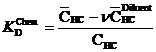
where ν is the volume fraction of diluent mixture.
The overall distribution coefficient (


The Z values less than 0.5 indicate a formation of (1:1) acid-TOPO complex in the organic phase. Therefore, with assumption of (1:1) acid-extractant complexes in the organic phase, the following model equations of reactive extraction mechanism are developed incorporating the effect of physical extraction.

The m is the loading of acid in organic phase by diluent mixture.

The plots of

References
(1) Kertes, A. S.; King, C. Extraction Chemistry of Fermentation Product Carboxylic Acids. Biotechnol. Bioeng. 1986, 28, 269-282.
(2) Kumar, S.; Wasewar, K.L.; Babu, B.V. (2008) Intensification of Nicotinic Acid Separation using Organophosphorous Solvating Extractants: Reactive Extraction. Chem. Eng. Technol. 31, 1584-1590.
(3) Kumar, S., Babu, B.V. (2008) Process intensification for separation of carboxylic acids from fermentation broths using reactive extraction, J. Fut. Eng. Technol. 3, 19.
(4) Kumar, S.; Babu B. V. Process Intensification of Nicotinic Acid Production via Enzymatic Conversion using Reactive Extraction. Chem. Biochem. Eng. Q. 2009, 23, 367-376.
(5) Mariya, M., Albet, J., Molinier, J., Kyuchoukov, G. Specific Influence of the Modifier (1-Decanol) on the Extraction of Tartaric Acid by Different Extractants. Ind. Eng. Chem. Res. 2005, 44, 6534-6538.
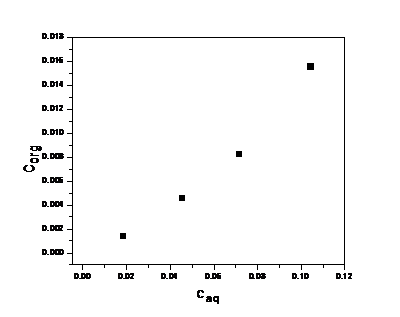
Figure 1. Physical equilibria for extraction of nicotinic acid at 298 K
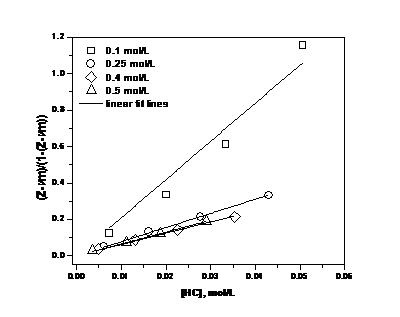
Figure 2. Equilibrium complexation constant (KE) determination for extraction of nicotinic acid at 298 K with TOPO in MIBK + kerosene (1:1 v/v)
See more of this Group/Topical: Separations Division