
 Google
 Yelp
 Facebook
 Twitter
 ChEnected
287901 Morphological Transitions of Capillary Bridges in a Slit Pore Geometry
Morphological transitions of capillary bridges in a slit pore geometry
David Broesch and Joelle Frechette
Chemical and Biomolecular Engineering Department, Johns Hopkins University
Abstract
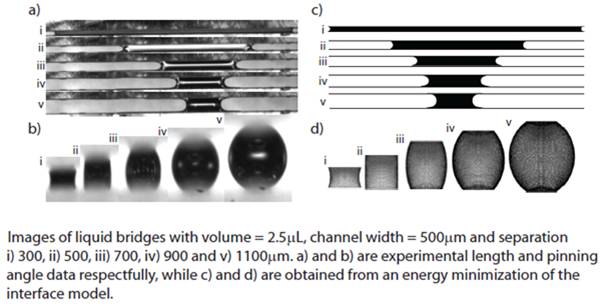
Investigations of capillary bridges are traditionally limited to the idealized geometry of an axisymmetric bridge between spheres or between a sphere and a plate. As capillary forces are employed to drive micro- and nanoscale assembly between complex objects, such as in flip chip technology, there is a need to better understand the shape (and associated forces) of capillary bridges in complex geometries. Here we investigate the morphological evolution of non-axysymetric capillary bridges in a slit-pore geometry. In our experimental system the liquid bridges are formed between two hydrophobic surfaces patterned with hydrophilic strips. The aspect ratio of the capillary bridges (length/width) is varied from 2.5 to more than 100 by changing the pore geometry or the fluid volume. As the separation between the surfaces increases (aspect ratio decreases), we observe a large increase in the mean curvature of the bridge. More specifically, we see that the mean curvature of the bridges change sign (goes from negative to positive for larger pore height). In addition we found a general scaling for which all the curves mapping the morphological evolution collapse. We also simulated our experiments using Surface Evolver and observed quantitative agreements with our experiments. Finally, we show that the morphology diagrams obtained from our 3D analysis are considerably different from those in the simpler 2D model presented in the literature.
See more of this Group/Topical: Engineering Sciences and Fundamentals