
 Google
 Yelp
 Facebook
 Twitter
 ChEnected
289056 Naphthenic Acids in Oils with Different Contents of Asphaltenes
Naphthenic acids in oils with different contents of asphaltene
Fenglou Zou, Huang Zeng, Simon I. Andersen
Schlumberger, DBR Technology Center, T6N 1M9 Edmonton, Canada
Carboxylic acids (RCOOH), also known as naphthenic acid in the oil field industry, is characterized by the presence of at least one carboxyl group (-COOH). They are widespread compounds, occurring in sediments and petroleums. Due to the structural characteristics, naphthenic acids are considered as natural surfactants in crude oil and believed to play a part in oil viscosity, emulsion stability, reservoir wettability, and enhanced oil recovery by alkaline flooding as well as corrosion. Therefore the knowledge of acid content and acid structure may have a significant practical application potential. The acid content in crude oils varies. One may speculate on the relationship between crude API, asphaltene content and the content of acids. As such there is currently no indication in the open literature of a straight relation.
Two oils (A and B) containing different asphaltene contents were extracted with either ion exchange resins (IER) or water. A (4% asphaltene), has higher acid concentration than B (14% asphaltene). Obviously higher asphaltene content does not mean necessarily higher acid concentration. Figure 1 compares the speciation of acid composition of the two oils using 2D GC/MS after methylation. B contains more diacids and straight chain acids but less aromatic acids and cyclic acids. The water extraction was found to yield completely different acid distributions when compared to the IER extracted. Both mono and diacidic compounds were detected. The diacids with two carboxylic acid groups could have structure building potential leading to increased non-Newtonian behaviour. Straight chain acids are known to act as surfactants at interfaces. More diacids were found in B compared to A implying that higher asphaltene content could indicate more complexity in the acids. Data from a range of oils will be presented.
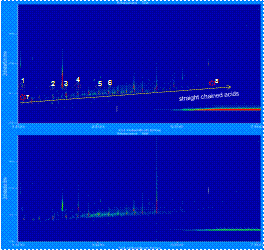
Fig. 1: Comparison of ion (m/z = 59) chromatograms of oil B 14% asp. (top) with oil A 4% asp. (bottom). 1: ethandioic acid, dimethyl ester, 2: butanedioic acid, dimethyl ester, 3: pentanedioic acid, dimethyl ester, 4: hexanedioic acid, dimethyl ester, 5: octanedioic acid, dimethylester, 6:nonanoic acid, dimethyl ester 7: C4H9COOH, 8: C28H57COOH
See more of this Group/Topical: Energy and Transport Processes