
Introduction: A tissue engineered pancreatic substitute constitutes a promising cell-based insulin therapy for achieving tight glycemic regulation in diabetes patients. In particular, non-beta cells genetically engineered to secrete insulin can address the major issues of immune rejection and donor cell availability through their potential autologous nature. The objective of this study was to generate a recombinant system of luminescent and insulin-secreting intestinal L-cells that allows treatment of diabetic mice and direct monitoring of the graft over time. Recombinant insulin-secreting GLUTag-INS cells were previously generated by stably transfecting murine intestinal endocrine GLUTag cells with human B10 insulin [1]. Although insulin secretion was achieved, in vivo therapeutically relevant levels were not obtained [2]. Further genetic engineering via transduction with a lentivirus containing the wild-type human insulin gene followed by a GFP reporter gene, generated cell line GLUTag-eINS with enhanced insulin secretion and promise for therapeutic application. As these cells constitute allogeneic therapy in diabetic mice, we are pursuing cell microencapsulation in alginate material as a protective barrier against in vivo immune rejection. In addition, we are investigating luciferase incorporation for non-invasive monitoring via bioluminescence of in vivo graft survival.
Materials and Methods: Sequential lentiviral transductions were performed on GLUTag-INS cells: the first contained the wild-type insulin gene followed by a GFP reporter gene, and the second contained the luciferase reporter gene. Fluorescence-activated sorting was employed to enrich the transduced population to 98% fluorescence; bioluminescence images and signals were captured with the IVIS Lumina (Xenogen). Insulin concentrations in secretion tests were measured by radioimmunoassay (Millipore, MA). Cell microencapsulation was performed in 3.3 wt% alginate (FMC Biopolymer, Norway) cross-linked with barium using an electrostatic droplet generator [3].
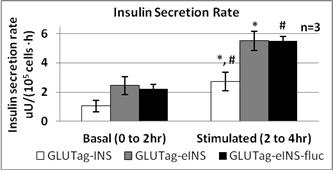
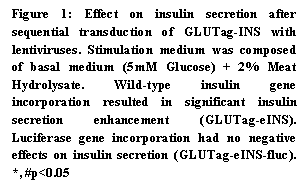
Results and Discussion: The first lentivirus transduction generated the enhanced cell line GLUTag-eINS and significantly improved insulin secretion from GLUTag-INS, making them promising for therapeutic application. The second lentivirus transduction generated the cell line GLUTag-eINS-fluc with no negative effects on insulin secretion (Figure 1). Strong bioluminescence signal of 1.5-1.8x10⁸ photons/(s∙cm2∙sr) was obtained from GLUTag-eINS-fluc monolayers in 12-well plates and was stable upon expansion and passaging.
Insulin secretion from GLUTag-eINS cells in barium alginate microcapsules was comparable to that from cell monolayers; a protective barrier can therefore be provided without impeding insulin secretion. Bioluminescence signal from microencapsulated GLUTag-eINS-fluc cells was also similar to monolayers, thus offering promise for in vivo monitoring capabilities. In vivo experiments with microencapsulated GLUTag-eINS-fluc cells are currently in progress in normal mice at subtherapeutic levels as a first step in characterizing this new system toward in vivo efficacy studies.
Conclusion: A system of recombinant luminescent and insulin-secreting intestinal L-cells can potentially serve as a pancreatic substitute for the treatment of diabetic animal models, as well as offer the ability for direct monitoring of graft survival over time.
References:
1. Bara, H. and A. Sambanis, Insulin-secreting L-cells for the treatment of insulin-dependent diabetes. Biochem Biophys Res Commun, 2008. 371(1): p. 39-43.
2. Bara, H., P.M. Thule, and A. Sambanis, A cell-based approach for diabetes treatment using engineered non-beta cells. J Diabetes Sci Technol, 2009. 3(3): p. 555-61.
3. Goh, F. and A. Sambanis, In vivo noninvasive monitoring of dissolved oxygen concentration within an implanted tissue-engineered pancreatic construct. Tissue Eng Part C Methods, 2011. 17(9): p. 887-94.
See more of this Group/Topical: Food, Pharmaceutical & Bioengineering Division - See also TI: Comprehensive Quality by Design in Pharmaceutical Development and Manufacture