
Monitoring Emulsion Polymerization Processes
by Means of Ultra-Sound Velocity Measurements
Heiko Brandt, Dominik Sühling, Sebastian Engell, TU Dortmund, Germany
Introduction
Emulsion polymerization is an important industrial (semi-) batch process for the production of latices, which are used as adhesives or in paints. To drive the process to its economic optimum, the desired polymer properties must be achieved at an as high as possible reaction rate maintaining tight temperature control and respecting safety constraints. This can only be achieved by model based control, which requires the knowledge of the process state. In this work the usability of sound velocity measurements to determine the process state is analyzed.
In a homopolymerization process the measurement of the jacket and reactor temperature combined with a qualitatively good energy balance is sufficient to monitor the reaction progress using classical heat balance calorimetry. This can be combined with an open loop observer for the monomer hold up and is widely applied in polymerization processes, e.g. by (Gugliotta et al, 1994), (de Buruaga et al, 1997), or (Vicente et al, 2001). Today instead of calorimetry a state estimator is often applied as it offers the opportunity to combine information from different measurement devices, to filter the measurement noise and to estimate unknown process parameters at the same time. Examples are the application of an extended Kalman Filter by e.g. (Gesthuisen et al, 2004), who estimated the heat of reaction as well as the heat transfer coefficient, or a high gain observer used by (Sheibat-Othman and Othman, 2006), who estimated the overall reaction rate.
In a copolymerization process the measurement of the temperatures enables only to determine the overall reaction rate, i.e. the sum of all monomer reaction rates. But as the copolymer composition is an important polymer property, for its control it is necessary to determine the individual monomer consumptions. An individual measurement of the monomer consumption is possible e.g. by the application of online gas chromatography. This was successfully shown by (Dimitratos et al, 1989) and (Urretabizkaia et al, 1994). But it is not used much in industry due to the infrequently available and delayed data in addition to the necessary sampling device. Another direct measurement method for the individual monomer consumption is spectroscopy, often being (Near) Infrared Spectroscopy (N)IR or Raman Spectroscopy. This method offers not only the opportunity to determine the individual monomer hold up directly, but may also be used to measure e.g. the particle size distribution. Examples for the application of spectroscopy are given in (Elizalde et al, 2005) or (Santos et al, 2008). For a more frequent industrial use, the necessary effort to obtain a calibration model, the need of maintenance, and the high investment cost are problematic up to now.
Beside direct measurements, indirect measurements exist that can provide information about the monomer concentrations. Examples are densimetry and ultra-sound velocity measurements. The first one has been applied e.g. by (Canegallo et al, 1994), but it was claimed by (Vicente, 2001) to be not robust enough for further application. The usability of ultra-sound velocity measurements as a second independent measurement is analyzed in this work. As a first step towards the application to a copolymerization process, we investigate the monitoring of the reaction progress of a styrene homopolymerization reaction. Two different models for the computation of the ultra-sound velocity in aqueous dispersions are studied experimentally and compared.
Ultra-Sound Velocity
Ultra-sound velocity (c) is a simple and cheap measurement that is sensitive to changes in the different monomer concentrations due to the big difference in c of monomers and polymers. As the ultra-sound velocity of a medium is mainly characterized by its properties on the molecular level, detailed modelling of c becomes very complex. For liquids the sound velocity can be described according to (Urick, 1947) by the simple relation:

where  represents the effective density and
 the effective adiabatic compressibility of
the medium. According to (Siani et al, 1999), this equation remains valid for
suspensions as long as the operation takes place in the Long-Wavelength Regime,
meaning that the sound wavelength is much larger than the polymer particles. As
the densities as well as the adiabatic compressibility are temperature
dependent, the sound velocity is likewise sensitive to temperature changes. For
the computation of the effective parameters and , two models are compared in this work. (Mauntz,
2010) assumed them to be linear combinations with respect to the volume
fractions
 of water (w), monomer (M)
and polymer (Pol):

(Siani et al, 1999) assumed the parameters to be linear combinations with respect to the volume fractions of the different phases involved being droplets (d), polymer particles (p) and water phase (w). They also included three adjustable parameters (jcr, b, jMG) in a compressibility model for the polymer particles to take care of nonlinear effects:


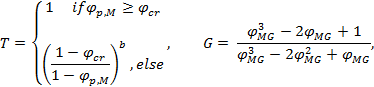

with jp,M ,jp,pol as the volume fractions of monomer, respectively
polymer in the particle phase. The adjustable parameters do not have a direct
physical meaning. The idea of introducing  is to summarize effects due to a possible
glass transition and the idea of introducing
 is to summarize all other nonlinear
effects.
Experimental Validation
Independent of the chosen approach to model the ultra-sound velocity, the experimental procedure to determine its temperature dependency consists of three major steps:
· determine the ultrasound-temperature calibration curve for the monomer,
· determine the ultrasound-temperature calibration curve for different emulsifier-water mixtures and fit a data driven response surface model (e.g. a second order polynomial function),
· determine the ultrasound-temperature calibration curve of the final lattice with known composition.
With the temperature dependent densities of water, monomer and polymer taken from literature their compressibilities can be determined from the recorded calibration curves at each measurement point by means of Uricks law. While the model of (Mauntz, 2010) requires to fit the individual compressibility points to a temperature dependency curve, the model of (Siani etal, 1999) requires in addition the run of a complete polymerization process to estimate the adjustable parameters by solving an optimization problem:

For given measurements , the volume fraction of the monomers is
computed by solving an optimization problem that minimizes the difference
between the measured and calculated sound velocity using the conservation of
mass and the known volumes fed up to this point in time:
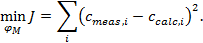
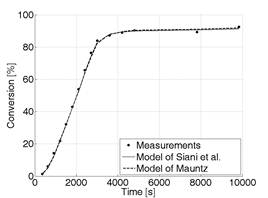
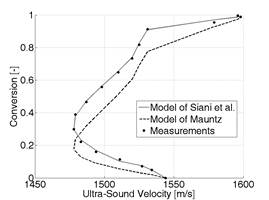
For some polymerizations both approaches work well (see Figure 1) while for others only the model of (Siani et al, 1999) represents the data well when the free parameters are readjusted to the recipe (see Figure 2).
Figure 1: Conversion-Time curve for styrene polymerization 1 (low solid content)
|
Figure 2: Conversion-Ultra-Sound Velocity curve for styrene
|
We will demonstrate the use of ultra-sound velocity measurements in combination with calorimetry to monitor the reaction progress in an emulsion polymerization.
References
1. Gugliotta, L.M. et al, Estimation of conversion and copolymer composition in semicontinous emulsion polymerization using calorimetric data, Polymer, Vol. 36, No. 10, 1995
2. de Buruaga, I.S. et al., Nonlinear Control for Maximum Production Rate of Latexes of Well-Defined Polymer Composition, Ind. Eng. Chem. Res., Vol. 36, 1997
3. Vicente, M. et al, Simultaneous Control of Copolymer Composition and MWD in Emulsion Copolymerization, AIChe Journal, Vol. 47, No. 7, 2001
4. Gesthuisen, R. et al, Hierarchical Control Scheme for Time-Optimal Operation of Semibatch Emulsion Polymerizations, Ind. Eng. Chem. Res., Vol 43, 2004
5. Sheibat-Othman N. and Othman, S., Control of an Emulsion Polymerization Reactor, Ind. Eng. Chem. Res., Vol. 45, 2006
6. Dimitratos, J. et al, Control of Product Composition in Emulsion Copolymerization, Polymer Reaction Engineering, K.H. Reichert and W. Geiseler, V.C.H.: New York, p. 33, 1989
7. Urretabizkaia, A. etal, On-Line Terpolymer Composition Control in Semicontinous Emulsion Polymerization, AIChe J., Vol. 40, 1994
8. Canegallo, S., Composition Control in emulsion copolymerization. II. Application to binary and ternary systems, Journal of Applied Polymer Sciences, Vol. 54, 1994
9. Elizalde, O. et al. Monitoring Emulsion Polymerization Reactors: Calorimetry Versus Raman Spectroscopy, Ind. Eng. Chem. Res., Vol 44, 2005
10. Santos, J.C. et al, Comparison of techniques for the determination of conversion during suspension polymerization reactions, Brazilian Journal of Chemical Engineering, Vol. 25, 2008
11. Urick, R.J., A sound velocity method for determining the compressibility of finely divided substances, Journal of Applied Physics, Vol. 18, 1947
12. Siani, A. et al, Procedure for Calibrating an Ultrasonic Sensor for Online Monitoring of Conversion in Latex Reactors, J. Appl. Polym. Sci, Vol. 72, 1999
13. Mauntz, W., A Contribution to Observation and Time-Optimal Control of Emulsion Co-Polymerization Reactions, Dissertation, TU Dortmund, 2010
See more of this Group/Topical: Computing and Systems Technology Division