
Ceria can undergo phase transformation from its stable stoichiometric ratio at ambient conditions to a lower oxygen content material with increasing temperature and decreasing oxygen partial pressure, while preserving its fluorite structure (Fm-3m). However at a critical O/Ce ratio of 1.5, the hexagonal structure (P3/m1) of ceria becomes more prevalent.1,2 The transition from a stoichiometric to non-stoichiometric ceria creates oxygen vacancies along with cerium atoms with a reduced oxidation state.3,4 Such characteristics make ceria a promising material for catalytic reactions.1,5 One such case is the application of ceria in the Water-Gas Shift (WGS) reaction, where metals supported on ceria exhibit higher activities compared to no ceria support or a different support material.6,7,8 Our work probes an atomic level understanding of the nature of ceria over a wide range of temperature and pressure conditions using Density Functional Theory (DFT) and First Principle Thermodynamics (FPT). The most stable ceria (111) surface9,10 is modeled using a periodic 2x2 supercell image, as shown in Figure 1. More than 25 configurations of oxygen concentrations are considered to determine the stable phases in a wide temperature pressure region. This is the first ever comprehensive first principles investigation to predict the phase transition of ceria under various operating conditions.
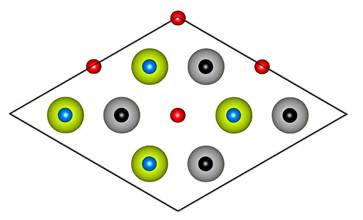
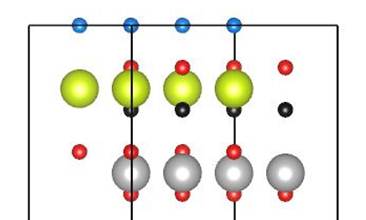
Left: Top view and Right: Side view of the ceria (111) plane. Blue: adsorbed oxygen; red: surface oxygen; black: sub-surface oxygen; green: surface cerium; and grey: cerium in the second layer.
References
1. Trovarelli, A. “Catalytic properties of ceria and CeO2-containing materials” Catalysis Reviews 38 (1996): 439-520.
2. Zinkevich, M et al. “Thermodynamic modelling of the cerium–oxygen system.” Solid State Ionics 177 (2006): 989-1001.
3. Nolan, M. et al. “Oxygen vacancy formation and migration in ceria” Solid State Ionics 177 (2006): 3069-3074.
4. Torbrügge, S. et al. “Evidence of subsurface oxygen vacancy ordering on reduced CeO2(111)” Physical Review Letters 99 (2007): 1-4.
5. Rao, G and Mishra, B. “Structural, redox and catalytic chemistry of ceria based materials.” Bulletin of the Catalysis Society of India 2 (2003): 122-134.
6. Wheeler, C. et al. “The water–gas-shift reaction at short contact times.” Journal of Catalysis 223 (2004): 191-199.
7. Hilaire, S. et al. “A comparative study of water-gas-shift reaction over ceria supported metallic catalysts” Applied Catalysis 215 (2001): 271-278.
8. Gorte, R. and Zhao S. “Studies of the water-gas-shift reaction with ceria-supported precious metals” Catalysis Today 104 (2005): 18-24.
9. Nolan, M. et al. “The electronic structure of oxygen vacancy defects at the low index surfaces of ceria” Surface Science 595 (2005): 223-232.
10. Désaunay, T. et al. “Modeling basic components of solid oxide fuel cells using density functional theory: Bulk and surface properties of CeO2.” Surface Science 606 (2012): 305-311.
See more of this Group/Topical: Catalysis and Reaction Engineering Division