
Cobalt molybdenum sulfide-type mixed alcohol catalysts were synthesized via calcination of precipitated bulk sulfides and studied with temperature programmed decomposition analysis. Precursors containing aqueous potassium were also considered. Precipitates thermally decomposed in unique events which released ammonia, CO2, and sulfur. Higher temperature treatments led to more crystalline and less active catalysts in general with ethanol productivity falling from 203 to 97 g-(kg-cat)-1-h-1 when the calcination temperature was increased from 375 to 500°C. The addition of potassium to the precursor led to materials with crystalline potassium sulfides and good catalytic performance. In general, less potassium was required to promote alcohol selectivity when added before calcination. At calcination temperatures above 350 °C, segregated cobalt sulfides were observed, suggesting that thermally decomposed sulfide precursors may contain a mixture of molybdenum and cobalt sulfides instead of a dispersed Co-Mo-S type of material.
Table 1. Catalyst thermal history, surface area, and elemental analysis
| Elemental composition (atom %)
| ||||||||
Catalyst
| Max. decomp. T (°C) | Dwell time @ max. T (min)
| K added
| BET surface area (m2-g-1)
| Co
| Mo
| S
| K
| Ratio S:(Mo+Co) |
1
| 500
| 60
| N
| 16.7
| 8.5
| 26.1
| 65.4
| 0
| 1.9
|
2
| 475
| 15
| N
| 11.7
| 8.8
| 22.7
| 68.5
| 0
| 2.2
|
3
| 375
| 45
| N
| 21.1
| 9.1
| 23.1
| 67.8
| 0
| 2.1
|
4
| 475
| 15
| Y
| 8.4
| 9.8
| 18.3
| 64.4
| 7.5
| 2.3
|
5
| 380
| 60
| Y
| 37.4
| 7.9
| 22.4
| 63.9
| 5.8
| 2.1
|
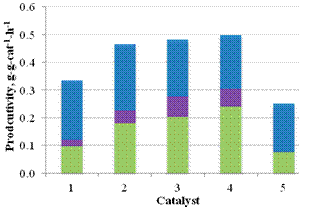
Figure 1. Performance of catalysts 1-5 in Table 1. Green = ethanol, purple = propanol, blue = methanol. Data was collected at 325 °C, pCO = pH2 = 4.8 MPa, 6000 NTPL-(kg-cat)-1-h-1.
See more of this Group/Topical: Catalysis and Reaction Engineering Division