
Triacetic acid lactone (Figure 1, 1), 5,6-dihydro-4-hydroxy-6-methyl-2H-pyran-2-one (Figure 1, 2), and 4-hydroxy-6-methyltetrahydro-2-pyrone (Figure 1, 3) are 2-pyrones that we have recently shown to be compounds derived from biomass that may serve as intermediates for the production of biorenewable chemicals. Using 1 as the feedstock, we have demonstrated that a diverse range of commercially valuable end products and chemical intermediates (e.g., 2 and 3) may be obtained through various thermal and catalytic strategies.
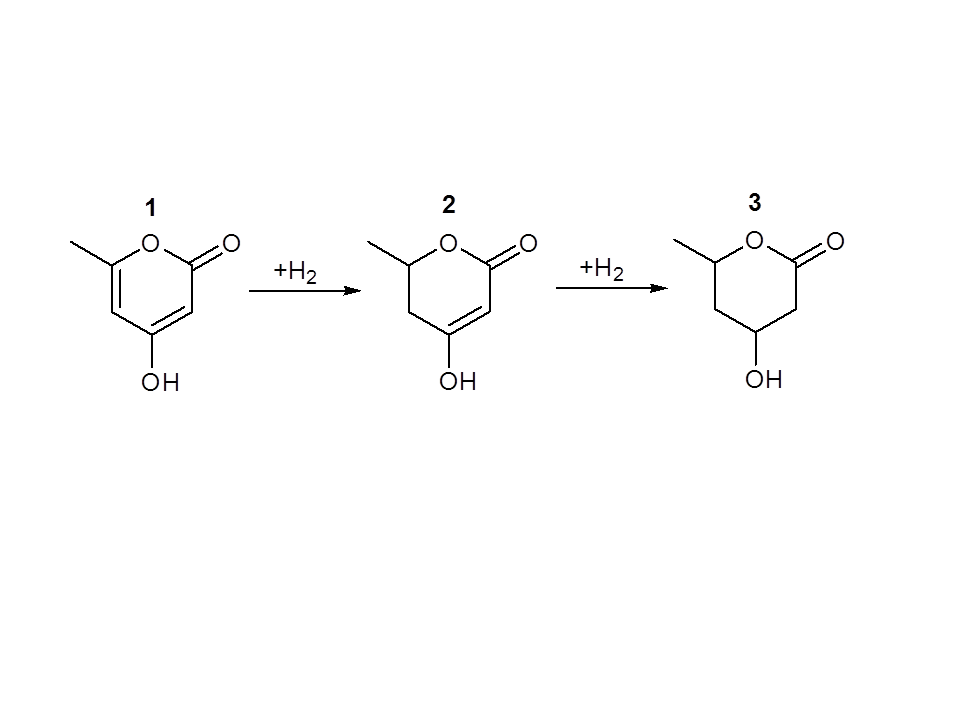
Figure 1. 2-pyrones studied: triacetic acid lactone (1); 5,6-dihydro-4-hydroxy-6-methyl-2H-pyran-2-one (2); 4-hydroxy-6-methyltetrahydro-2-pyrone (3).
The molecular structures of these 2-pyrones differ from one another by varying degrees of unsaturation in the pyrone ring, and we have found that they display different reactivities to ring-opening and decarboxylation under identical reaction conditions. Significantly, we have observed the thermally-activated ring-opening and decarboxylation of both 1 and 2 in liquid water at relatively low reaction temperatures (< 373 K) without the aid of a catalyst. Also, it was found that while 3 does not undergo ring-opening and decarboxylation under the reaction conditions employed, 3 selectively dehydrates to form parasorbic acid. The apparent activation energy barriers for the thermally-activated ring-opening and decarboxylation of 1 and 2 in liquid water were measured to be 58 ± 12 kJ mol-1 and 42 ± 18 kJ mol-1 (95% confidence intervals), respectively. While acidic conditions appeared to promote the ring-opening and decarboxylation of 2 with water or tetrahydrofuran as the solvent, the reactivity of 1 was unchanged in the presence of an acid catalyst in either solvent.
Results from density functional theory calculations suggest that both 1 and 2 first undergo keto-enol tautomerization to form β-ketone intermediates prior to ring-opening. The ring-opening of 1 likely proceeds through the nucleophilic attack of water on the C=C bond at the 5 position in the ring, forming a β-keto acid which subsequently decarboxylates through a six-membered cyclic transition state. It is further proposed that the tautomer of 2 undergoes ring-opening and decarboxylation through a two-step retro-Diels-Alder (rDA) reaction, proceeding through a zwitterionic intermediate. Based on these proposed mechanisms, it is suggested that some degree of unsaturation of the ring is necessary to enable initial keto-enol tautomerization and subsequent ring-opening and decarboxylation of these 2-pyrone structures to occur. Significantly, the presence of a C=C bond in the 4 position in the pyrone ring appears to be particularly significant in that this functional group allows for 2-pyrones to ring-open and decarboxylate through rDA. Using 4,6,6-trimethyl-3,6-dihydro-2H-pyran-2-one as a probe molecule, we further demonstrate experimentally that similar to the experimental results obtained for 2, this structure undergoes ring-opening and decarboxylation in the presence of liquid water without the aid of a catalyst, showing that rDA occurs independent of the nature of the functional group at the 4 position in the ring.
Accordingly, we establish general reactivity rules for 2-pyrones and provide molecular-level relationships to elucidate the factors that influence ring-opening and decarboxylation chemistry. These mechanistic insights provide guidance for the selective conversion of reactants structurally analogous to 1, 2, and 3 for example, in terms of solvent selection and reaction conditions (e.g., temperature, acidity) for the production of targeted chemicals.
See more of this Group/Topical: Catalysis and Reaction Engineering Division