
Simulation of Propylene Carbonate as Solvent for
Electrochemical Double-layer Capacitors
X. You, L. R. Pratt, and N. Pesika
Abstract Propylene carbonate (PC) is a
popular choice of solvent for electric double-layer capacitors (EDLCs).1,2
Despite recent encouraging simulations of EDLCs3 based on carbon
nanotube forests, thorough testing of the required force-field features has not
been available. Recent work3,4 shows that the modeled liquid PC completely wets a planar graphite
surface (contact angle,


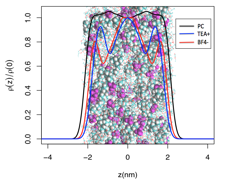
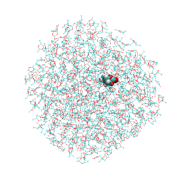
FIG: (left) Interfacial density profiles and simulation geometry for slab calculation of 1000 PC with 85 tetraethylammonium and 85 tetrafluoroborate at 300K. Compared with pure PC (surface tension = 40.8erg/cm2), the ionic material increases the surface tension to 41.5erg/cm2. (right) Simulation configuration of a droplet with 600 PC molecules.
1. Yang, L., Fishbine, B. H., Migliori, A., and Pratt, L. R. J. Am. Chem. Soc, 131, 12373 (2009).
2. Yang, L., Fishbine, B. H., Migliori, A., and Pratt, L. R. J. Chem. Phys. 132, 044701 (2010).
3. W. Zhang, G. G. Hoffman1, L. R. Pratt1, N. Pesika1, K. M. Aritakula2 and S. W. Rick2(1Tulane University, 2University of New Orleans 2012)
4. "Simulation of Propylene Carbonate as Solvent for Electrochemical Double-layer Capacitors", Hoffman, G. G., Mariano, R., Pesika, N., Pratt, L. R., Rick, S. W., and X. You (Proc. LA EPSCoR RII LA-SiGMA 2011 Symp.), p 101-104.
5. Powles, J. G., Fowler, R. F., and Evans, W. A. B. Chem. Phys. Letts. 76, 289 (1983).
See more of this Group/Topical: Engineering Sciences and Fundamentals