
Intracrystalline (or intraparticle) diffusion within porous materials is widely studied for its useful and important applications in molecular separation, heterogeneous catalysis, membrane technology, fuel cells, soil mechanics and petroleum engineering to name but a few. The well known automotive catalytic converter makes use of a catalytic monolith reactor in a ‘honeycomb' configuration to oxidise carbon monoxide and unburned hydrocarbons while reducing oxides of nitrogen. Understanding the intracrystalline diffusion that occurs within the washcoat and substrate material of monolith supported catalysts is vital to the modeling and scale-up of reactors and consequently affects both performance and cost effectiveness of such systems.
The purpose of this paper is to report on the measurement of the intracrystalline diffusivity in the washcoat of monolith samples using Flux Response Technology (FRT). In previous studies, we have shown the versatility of the FRT method in measuring in situ adsorption, reaction and desorption processes in flow reactors. The FRT apparatus is an extremely sensitive tool which allows the measurement of flowrate changes of the order of 10-2 μl/min. By applying the Zero Length Column (ZLC) method to the analysis of concentration perturbation induced ad- and desorption transients recorded by the FRT technique, accurate rates of diffusion within washcoats can be arrived at.
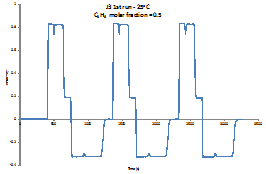
Shown in Figure 1a is an example of a flux response profile obtained for a cordierite sample coated with a washcoat of alumina/CeZrOx when subjected to repeated concentration perturbations of propane in helium. For the investigation of diffusivities within the washcoat of the cordierite samples, it is necessary to monitor the release of the adsorbed species (C3H8 in this instance) into the effluent stream in order to apply the ZLC analysis. The signal of the DPT pressure responses in the flux response profile have been shown to be directly proportional to the amount of probe molecules ad/desorbed onto or from the surface of the porous adsorbent.
(a) | (b) |
| | |
ZLC
response curves (nonlinear
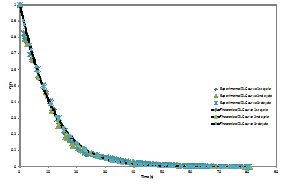
regression) were fitted to experimental, dispersion corrected FRT data (shown in Figure
1b) and allow the
extraction of effective diffusivities of propane within the washcoat. At 25oC an effective
diffusivity of 7.04 × 10⁻¹⁰ m2/s was
determined for the above sample which
agrees well with published data measured by other macroscopic
techniques. In
particular, it is reassuring to observe that the calculated activation energy for
propane diffusion in alumina/CeZrOx compares well to that predicted by Granato et
al. based on theoretical molecular dynamics simulations of propane
diffusion in 13X, and pulse field gradient nuclear magnetic resonance (PFG-NMR)
data by Schwartz et al. The results also compare
well to the values of Sun et al. who
employed a Wicke-Kallenbach type method using a zeolite membrane and report diffusivities of propane
in silicalite in
the temperature
range
between 30 to 70oC
as 4-6  10-10
m2/s (Table 1).
It has been observed that propane diffusivity in 13X is much smaller when measured with the ZLC approach as compared to PFG-NMR and it has been suggested that this may be due to the PFG-NMR technique returning intra-crystalline diffusivities whereas ZLC experiments result in the observation of combined diffusion and desorption processes.
We will show that with FRT these two processes can be compared and contrasted in one experiment by analysing the dispersion corrected adsorption and desorption transients in the FRT profile.
Table 1. Comparison of Diffusivities and Activation Energies | ||||
Reference | Method | Temperature (K) | D (m2s-1) | Ea (kJ/mol) |
Granato et al. (2010) | MD simulations | 373 | 2.9 ×10⁻⁹ | 7.9 |
Schwartz et al. (1995) | PFG-NMR | 307 | 7.0 ×10⁻¹⁰ | 7.9 |
Sun et al. (1996) | Wicke-Kallenbach | 298-334 | 5.0 ×10⁻¹⁰ | 8.0 |
This work | FRT-ZLC | 373 | 1.4 ×10⁻⁹ | 6 |

See more of this Group/Topical: Separations Division