
Why DFT fails in describing adsorption of open-shell systems? A combined multiconfigurational and model Hamiltonian study of cobalt adsorption on graphene
In contrast to molecular closed-shell adsorbates or light monovalent impurities, theoretical investigation of adsorption of transition metal (TM) compounds is more challenging due to the presence of strong electron correlations. The results of the commonly used density functional therory (DFT) are usually controversial and strongly depend on the parametrization of the exchange-correlation functional. Motivated by the deficiency of the DFT in the description of TM adsorption on semimetallic surfaces, we present a scheme that can be used for their systematic investigation. As a test case we investigate the adsorption of Co adatom on graphene.
As a first step in this study, we apply the multiconfigurational complete active space self-consistent field formalism (CASSCF) in order to take into account the effects of electron correlations in a systematic way. By using this method it is possible to obtain accurate potential energy (PE) curves for different electronic states of a TM atom as well as binding energies. In Fig.1 three most important PE curves for the Co/graphene system are shown. The total adsorption energy curve of the TM atom is not typical for the adsorption of closed-shell adsorbates. Upon approaching the surface, the ground-state electronic structure undergoes several transitions, giving rise to two stable states: 3d74s2 (high-spin) and 3d94s0 (low-spin). In both cases the adsorption is weak (Eads < 0.35 eV) in contrast to the strong binding, predicted by DFT studies (1-2 eV) [1].
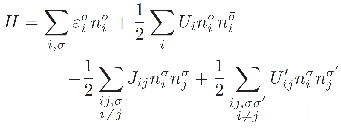
In order to more deeply understand the adsorption of Co on graphene, we map the CASSCF results onto a mean-field model. To this end, we consider a simple Hamiltonian:
where
the first term describes the one-electron contribution, while the
rest part corresponds to electron-electron interactions. The
parameters Ui,
U'ij,
and Jij
determine intraorbital and interorbital Coulomb interactions as well
as interorbital exchange interaction (Hund's rule coupling),
respectively. The
energies obtained at the CASSCF level for different electronic
configurations allow us to extract information on the magnitude of
these parameters.
In Fig.2 we show the calculated electron-electron interaction parameters as functions of the Co--graphene distance. The exchange coupling parameters Jsd and Jdd are almost constant and do not change over the entire range of distances. In contrast, the Coulomb repulsion Udd significantly decreases as the atom comes closer to the surface. From the correspondence between the Udd parameter and the particular electronic configurations of Co, it can be concluded that the interconfigurational transitions in the adsorption of Co on graphene are attributed to the reduction of the Coulomb repulsion in the Co 3d shell.
In the regime of small U our results, with respect to the Co state (3d9s0), are similar to that obtained by DFT using the standard LDA (GGA) functional [1,2]. On the other hand, the results of intermediate U (3d8s1) are comparable with the GGA+U [3] or hybrid functional calculations [4]. Being significantly dependent of U, the DFT results are applicable only to a certain range of adsorption distances, whereas the total adsorption energy curve cannot be described without external parameters. Inability to describe the total potential energy curves for TM atoms on graphene within the DFT scheme leads to difficulties in determination of binding energies. Another point that prevents DFT from giving accurate binding energies is the lack of non-local dispersion interactions in standard exchange-correlation functionals. With the present approach these problems can be widely overcome.
References
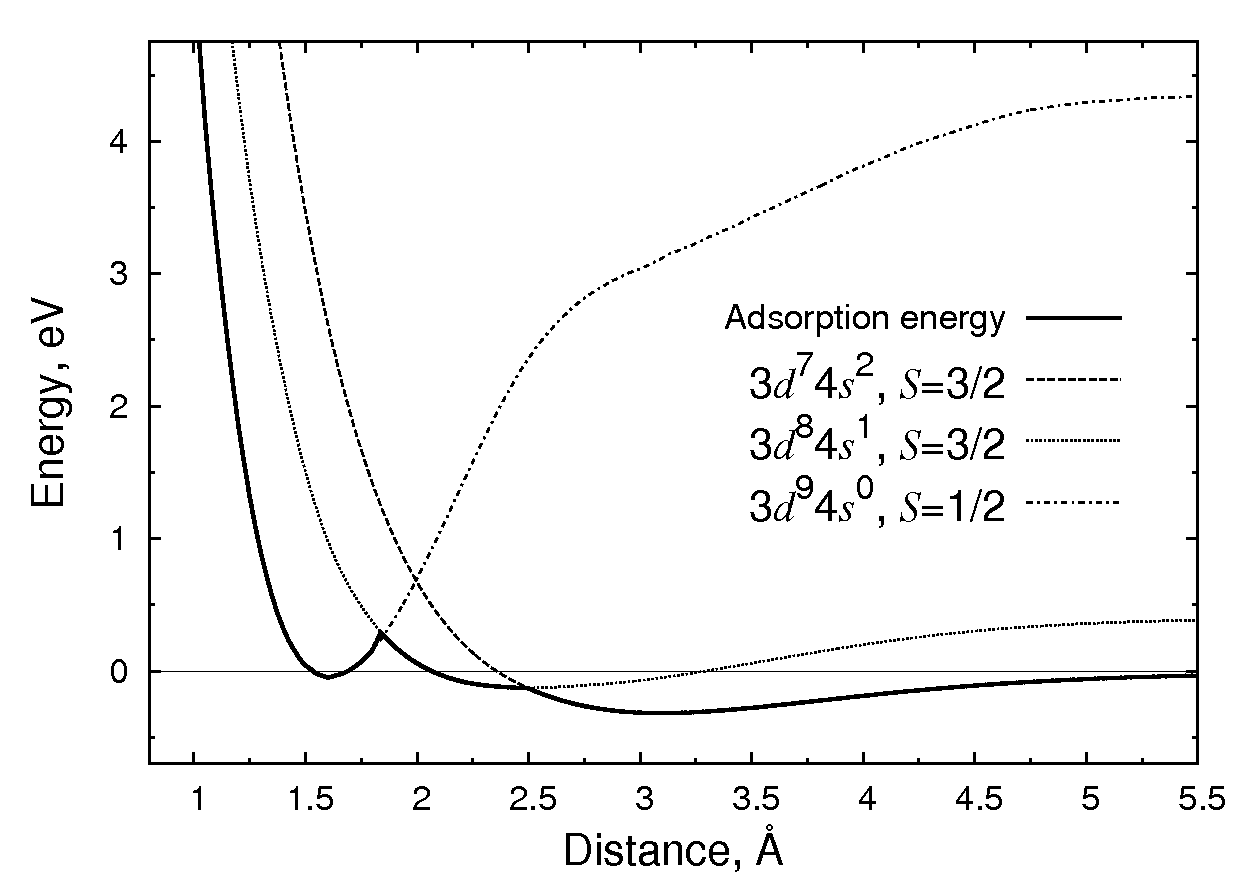
Fig.
1. Potential energy curves obtained for different electronic
configurations of Co on graphene.
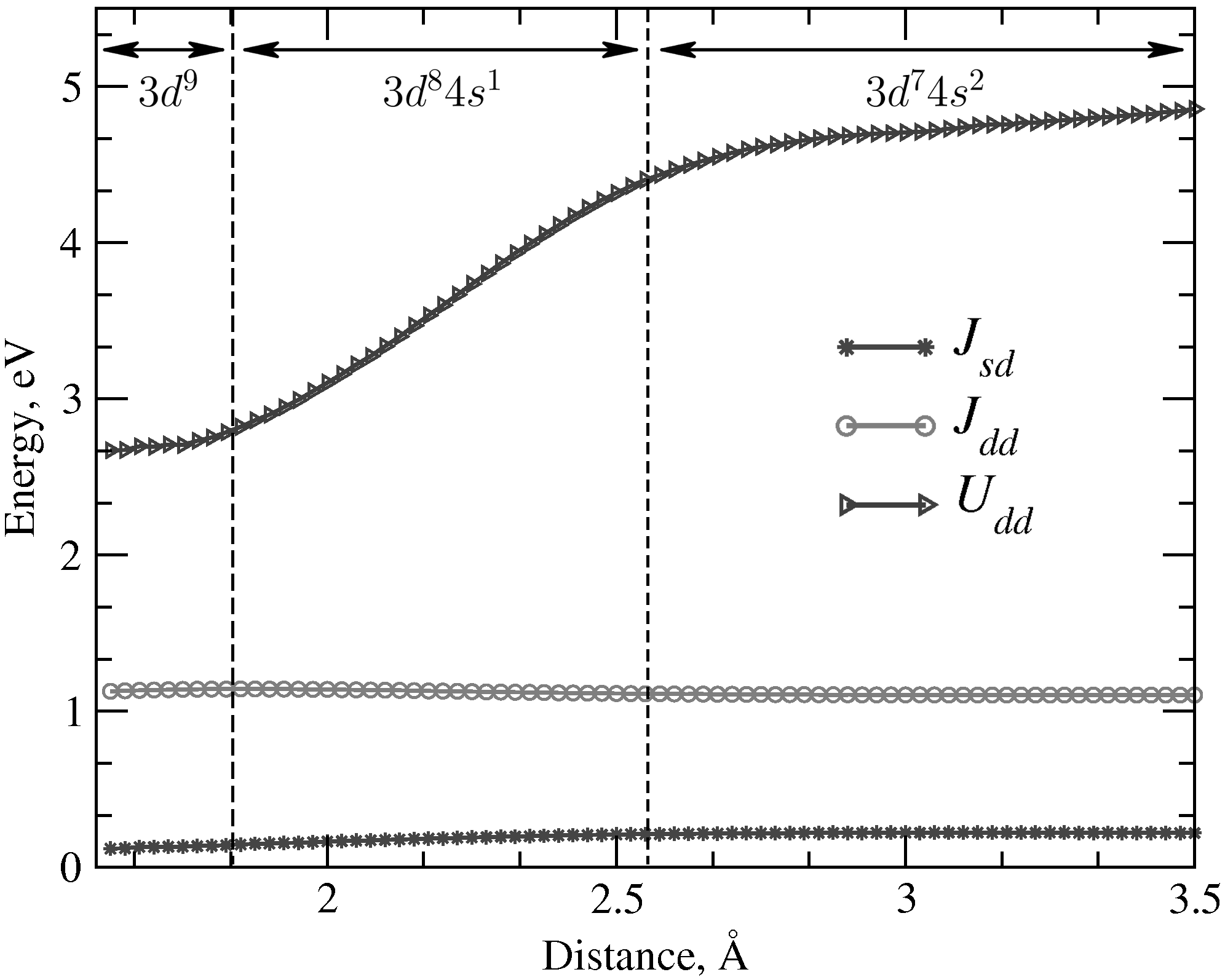
Fig.
2. Electron-electron interaction parameters for Co on graphene as a
function of distance.
See more of this Group/Topical: Separations Division