
Introduction: Leukocyte adhesion to the inflamed vascular endothelium is initiated by the capture and rolling of cells on E- and P-selectin expressed on the endothelial cells. Here, sialo-fucosylated glycans, such as sialyl Lewis-X (sLeX), expressed on leukocytes act as the selectin ligand. Such glycans are primarily synthesized in the Golgi by the action of glycosyltransferases, a family of enzymes that constitute ~1% of the human genome. The current paper applies RNAi strategy to determine the human α2,3 sialyltransferases responsible for the synthesis of P-, L- and E-selectin ligands on leukocytes. The data reveal that, in humans, ST3Gal-IV is the dominant enzyme responsible for the synthesis of selectin-ligands against all members of the selectin family.
 Materials
and Methods: We studied all three
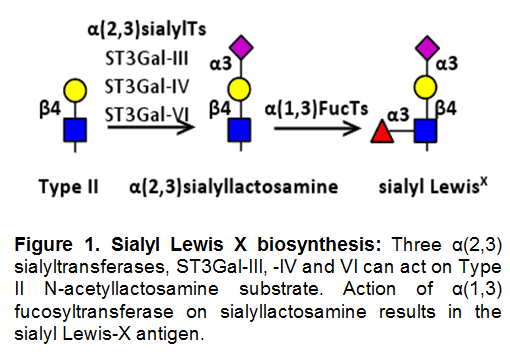
leukocyte-specific, human α2,3 sialyltransferases, ST3Gal-III, -IV and -VI, that attach sialic acid residues to the N-Acetyl Lactosamine or LacNAc substrate
(Galβ1,4GlcNAc) (Figure 1). ShRNA that suppress these enzyme expression by >85% were
determined. Methods to introduce these constructs into hard-to-transfect
leukocytes (HL-60 promyelocytic cells) were developed
using lentivirus. RT-PCR confirmed gene silencing in
leukocytes. A variety of fluorescent reporters and drug selection markers were
introduced to ensure stable gene knock-down in these cells. Stable single
(ST3Gal-III¯ HL-60, ST3Gal-IV¯ HL-60, ST3Gal-VI¯ HL-60) and dual
(ST3Gal-III¯-IV¯ HL-60, and ST3Gal-IV¯-VI¯ HL-60) HL-60 knockdown cells were
created. Glycan structure analysis on these cells was performed using antibody
staining and flow cytometry. Microfluidic cell
adhesion assays measured selectin dependent cell rolling function. Results were
compared to primary neutrophils isolated from ST3Gal-IV-/- knock-out
mice.
Results and Discussion: The ST3Gal knock-down cell lines displayed distinct cell surface glycans and rolling pheonotypes. Silencing ST3Gal-IV substantially reduced cell surface CLA/HECA-452 (cutaneous lymphocyte antigen) and sLeX expression. ST3Gal-III has a modest role in reducing the CLA epitope while ST3Gal-VI upregulated this epitope. In this regard, while the CLA epitope is primarily found on leukocyte PSGL-1 (P-selectin glycoprotein ligand-1), sLeX is more ubiquitously expressed on other molecular entities also. Thus, all enzymes ST3Gal-III, -IV and -VI appear to regulate the glycan structure on PSGL-1 and also other molecular entities. When these cells were perfused over either IL-1β stimulated HUVEC monolayers or cells bearing E-selectin (selectin associated with inflammation) or P-selectin (involved in platelet-neutrophil interactions) or L-selectin (involved in lymphocyte homing and leukocyte-leukocyte interaction), different enzymes were observed to contribute to different selectin-ligand interactions. E-selectin mediated binding was exclusively dependent on ST3Gal-IV. Silencing this gene abolished leukocyte rolling and adhesion on stimulated HUVEC and E-selectin bearing substrates. This observation is in marked contrast to ST3Gal-IV-/- mice where ST3Gal-IV only partially reduces leukocyte rolling. Human ST3Gal-IV also played a dominant role in P-selectin dependent adhesion, unlike mice where this gene had a partial effect. Human ST3Gal-IV and ST3Gal-VI in tandem regulated leukocyte interaction with substrates bearing L-selectin.
Conclusions: Knocking down ST3Gal-IV alone is sufficient to abolish E and P-Selectin mediated leukocyte recruitment in human systems. This is markedly different from murine systems where granulocytes from ST3GalIV-/- mice only display partial reduction in selectin-ligand binding activity. Overall, human ST3Gal-IV may be a viable target for anti-inflammatory therapy since it alters leukocyte interaction with endothelial cells and platelets.
See more of this Group/Topical: Food, Pharmaceutical & Bioengineering Division - See also TI: Comprehensive Quality by Design in Pharmaceutical Development and Manufacture