
Due to the increasing energy demand and the diminishing petroleum reserves, the production of biofules and chemicals from biomass have attracted increasing attentions. Recently, multiple catalytic methods have been used to transform carbohydrates into chemical compounds. 5-hydroxymethylfurfural (HMF), which could be converted from carbohydrates (Roman-Leshkov et al., 2007), is an important platform chemical with many potential applications in energy field and chemical industry. HMF and its derivatives could be converted into a great many of chemicals, such as diesel fuel additives, alternative fuels and bioderived chemicals (Chheda et al., 2007). Althrough very good works have been done, efficient methods for HMF production are still needed for successful commercialization of HMF to make overall costs be competitive with petroleum-based chemicals.
In this work, a new process of formic acid-catalyzed dehydration of carbohydrates into HMF in water/butanol media was developed (Fig. 1a). We investigated the effects of formic acid concentration, reaction temperature and reaction time on the fructose conversion and HMF yield. According to the experiment results, it is found that fructose is in the aqueous phase, while formic acid and HMF are dominantly in the organic phase. The main conclutions are drawn as follows: 1) The application of formic acid in aqueous/butanol media as catalyst led to high yield of HMF (Fig. 1b). In this reaction, the addition of formic acid and n-butanol limited the side reaction such as HMF rehydration and removed HMF from the reactive aqueous medium rapidly, thus increased the efficiency of fructose dehydration and the yield or selectivity of HMF. 2) As increasing formic acid concentration, the HMF yield gradually increased and then decreased after reaching a maximum value. Higher reaction temperature and longer reaction time would increase the fructose conversion, but there was no significant influence when it was in the range of 170∼190°C and over 70min. 3) Fig 1c presented the HMF yields transformed from different sugar feedstocks at 170°C for 70min. Very low HMF yield was achieved from glucose. Compared to the reaction of fructose, the lower HMF yields transformed from inulin and sucrose were 54.0% and 36.1%, rseparately. 4) A HMF yield of 69.2% with 98.3% fructose conversion was achieved under the optimum conditions: 2.5mol/L formic acid concentration, 170°C and 70min. The application of this reaction system has prospects for commercial application due to high yield of HMF, less corrosion and convenient downstream separation.
(1) Chheda, J.N., Huber, G.W., Dumesic, J.A. (2007) Liquid-phase catalytic processing of biomass-derived oxygenated hydrocarbons to fuels and chemicals. Angew Chem Int Edit, 46(38), 7164-7183.
This work was supported by the Program for New Century Excellent Talents in Chinese University (NCET-08-0386), the 863 Program of China (2008AA10Z318), the Natural Science Foundation of China (20976125; 31071509; 51173128) and Tianjin (10JCYBJC05100), and the Program of Introducing Talents of Discipline to Universities of China (No. B06006).
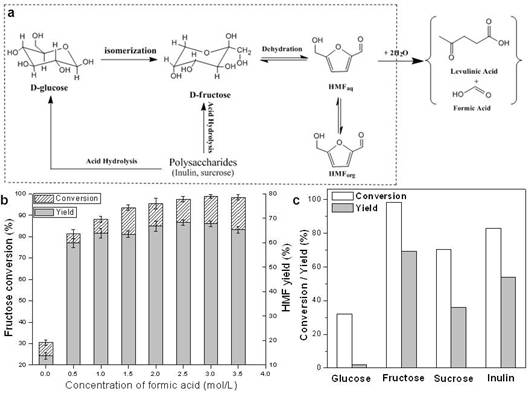
Figure 1 Dehydration of fructose to HMF. a) A typical reaction scheme for HMF production from mono- and poly-saccharides, b) Effect of formic acid concentration on fructose conversion and HMF yield, c) Dehydration of several sugar feedstocks to HMF in aqueous/organic media with formic acid as catalyst.
See more of this Group/Topical: Catalysis and Reaction Engineering Division