
 Google
 Yelp
 Facebook
 Twitter
 ChEnected
300220 Supercritical Water Oxidation: the Next Generation Process to Incineration
SUPERCRITICAL WATER OXIDATION AS THE NEXT GENERATION IN HAZARDOUS WASTE TREATMENT
Bushra Al-Duri1[*], Faihan Alsoqyani1 and Iain Kings1
1 School of Chemical Engineering, University of Birmingham, Edgbaston – Birmingham B15 2TT, UNITED KINGDOM. Email: B.Al-Duri@bham.ac.uk
Supercritical water oxidation (SCWO) is an advanced technology, which represents a suitable alternative to incineration for the destruction of chemically stable wastes. SCWO is an intense, efficient and highly rapid process that converts hazardous hydrocarbons to benign gases and liquid water, with no emissions (dioxins, NOx and SOx), and no ashes; eliminating the problem of landfill. Compared to wet air oxidation it is multifold more rapid and more efficient as it takes place in a one-phase environment, based on the special properties of supercritical water [1].
Nitrogen (N) containing hydrocarbons are frequently encountered in wastes. Their abatement is specifically challenging due to formation of the recalcitrant ammonia the reason why, this work investigates the SCWO of N, N dimethyl formamide (DMF); and aliphatic hydrocarbon found in chemical industries. This work focuses on the finding that under the same operating conditions alcohol addition improves the conversion of organics and nitrogen towards benign gases[2]. SCWO of DMF in the presence of isopropyl alcohol (IPA) is investigated under a range of temperatures (673 – 800K), oxidant ratios (0.8 – 3SR), initial DMF concentrations (5 – 20mM) and different IPA/DMF ratios. Results are presented in the form percentage organics removal, and ammonium yield and total liquid nitrogen yield. It shows the positive effect of alcohol addition on the SCWO process.
The reaction kinetics is also investigated, showing that the activation energy of 65 kJ/mol is significantly lower in the presence of IPA than without (155 kJ/mol). The reaction rate constants and global rate expression, showing the reaction order is also given by:
-rA=3.15x10⁷ exp64,9958.314TTOCO20.297
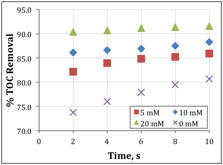
Figure 1: SCWO of 10mM DMF at 673K, 1SR adding 5, 10 and 20mM IPA.
[1] Verianshyah B. & Kim J. D.; Journal of Environmental Sciences, 19 (2007) 513–522.
[2] Oe T; Suzugaki H; Naruse, I; Quitain A. T; Daimon H & Fujie K; Ind. Eng. Chem. Res., 46 No. 11 (2007) 3566–3573.
See more of this Group/Topical: Environmental Division