
 Google
 Yelp
 Facebook
 Twitter
 ChEnected
303932 Abatement of Greenhouse Gases Into Methanol in a Ntp-DBD Reactor - Effects of Experimental Parameters
Abatement of Greenhouse gases into Methanol in a NTP-DBD reactor
- Effects of Experimental Parameters
Abstract: Direct conversion of natural gas to liquid products such as methanol and formaldehyde has been receiving a great attention [1, 2]. However, converting methane (CH4) to methanol (CH3OH) with desired selectivity is difficult as in general, the oxidation proceeds to complete to carbon oxides (CO or CO2) and water in conventional methods [2]. On the other hand, utilization of nitrous oxide (N2O), as a co-reactant for CH4 conversion appears to be very promising. Methane conversion by N2O may also beneficial due to potential green-house nature of these two reactants (The GWP for CH4, N2O is 21 and 280 times more heat-trapping than that of CO2). In recent years, industrial applications of non-thermal plasma (NTP) generated under ambient conditions has been receiving a great interest [3-5]. NTP generated by electrical discharges under ambient conditions has specific advantages like mild operating conditions, as NTP is composed of energetic electrons that may initiate the reaction, ions, excited atoms, radicals and meta stable ions. These energetic electrons initiate the chemical reactions in gas phase. With this back ground, the present study is aimed at co-processing of two green house gases CH4 and N2O for the production of oxygenated products like methanol and formaldehyde.
Influence of feed gases proportion on oxidation of methane (CH4) with nitrous oxide (N2O) has been studied in dielectric barrier discharge (DBD) plasma operated under ambient conditions (Fig.1). Plasma reactor was powered by a high voltage AC generator (Yaskawa varispeed F7 AC inverter upto 40 kV and 50 Hz). The gas mixture was controlled by a set of mass flow controllers (Aalborg-USA). CH4 (10 vol% diluted in Ar) and N2O (5 vol% diluted in Ar) gases were introduced into the reactor. At the reactor outlet gas analysis was made with an online gas chromatograph (Varian 450-GC), whereas an on-line GC-MS (Thermo Fischer) was used to identify the by-products. Typical results indicated the formation of methanol (CH3OH), formaldehyde (HCHO), hydrogen (H2), carbon monoxide (CO) and carbon dioxide (CO2).
The important findings of the present study may be summarized as
NTP is effective in direct decomposition of N2O into N2 and O that will be alter converted to O2 in the absence of a catalyst.
Increasing CH4/N2O molar ratio in the feed gases favors the reagents conversion and consequently promotes the formation of each by product.
Co-processing CH4 and N2O produces CH3OH and HCHO, however, the selectivity to these products is rather low.
Water vapor has a positive effect on selectivity.
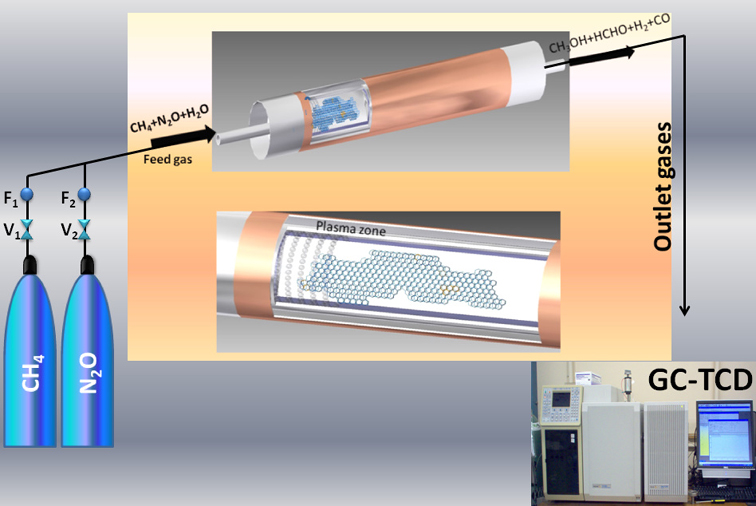
Figure 1. Schematic representation of NTP-DBD reactor for oxidation of methane (CH4) with nitrous oxide (N2O)
References:
1. [1] L.B. Han, S. Tsubota, T. Kobayashi, M. Haruta, Formation of methanol by the gas-phase partial oxidation of methane under normal pressures, J. Chem. Soc. Chem. Commun. (1995) 93--94.
[2] L.M. Zhou, B. Xue, U. Kogelschatz, B. Eliasson, Partial oxidation of methane to methanol with oxygen or air in a non-equilibrium discharge plasma, Plasma Chem. Plasma Process. 18 (3) (1998) 375--393.
[3] K. Okazaki, S. Hirai, T. Nozaki, K. Ogawa, K. Hijikata, Plasma chemical reactions at atmospheric pressure for high efficiency use of hydrocarbon fuels, Energy 22 (2--3) (1997) 369--374.
[4] Sk. Mahammadunnisa, E.L. Reddy, P. M. K. Reddy and Ch. Subrahmanyam., A facile approach for direct decomposition of nitrous oxide assisted by nonthermal plasma, Plasma Processes and Polymers. (DOI: 10.1002/ppap.201200114)
[5] Sk. Mahammadunnisa, P. M. K. Reddy, and Ch. Subrahmanyam., dry reforming assisted non-thermal plasma catalytic reactor, ACS Energy & Fuels (dx.doi.org/10.1021/ef302193e).
See more of this Group/Topical: Sustainable Engineering Forum