
 Google
 Yelp
 Facebook
 Twitter
 ChEnected
304484 Fluorescence Properties of CMC/Eu Nanocomposites in Different Phs
CMC/Eu nanocomposites were synthesized successfully by reacting with Eu3+ and CMC(70°æ, 15min) in waterbath. The FTIR results indicated the reaction between carboxyl groups in CMC and Eu3+, and SEM results showed that the particles of CMC/Eu nanocomposites were sphere and particle sizes were around 100 nm. In addition, effect of pHs on the fluorescence properties of CMC/Eu nanocomposites was complicated (see Figure). The emission spectra had red shifts with increasing pH. The fluorescence intensities of the materials in lower pHs were significantly stronger than that of materials in higher pH. It might result from the degradation of ligand CMC in strong alkaline condition.
Acknowledgement: Supported by the National 973 project under Grant No. 2010CB732201, the National Natural Foundation of China under Grant No 31270617 and the Opening Project of State Key Laboratory of Polymer Materials Engineering (Sichuan University) under Grant No. KF201301.
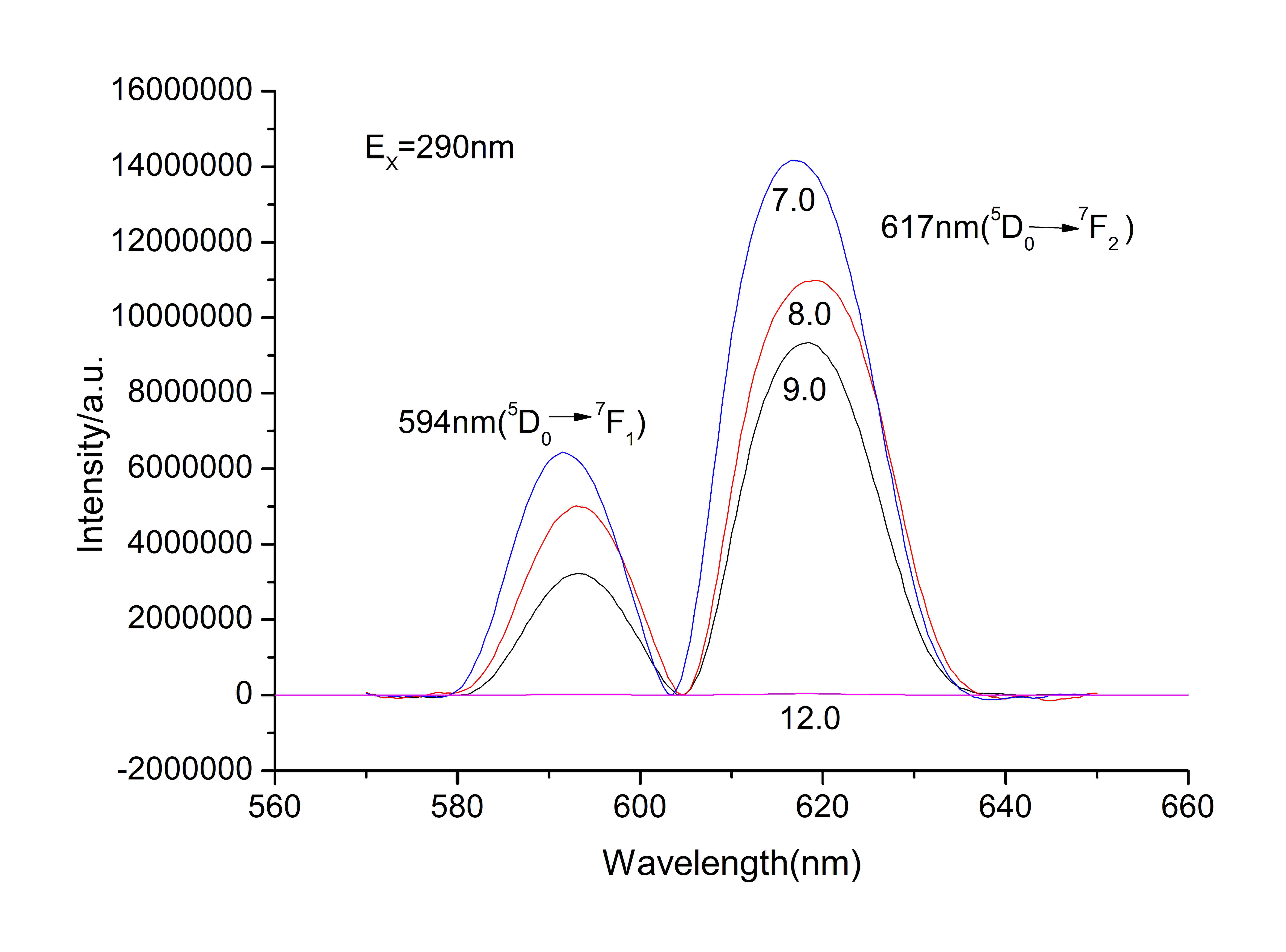
Figure. Emission spectra of CMC/Eu nanocomposites synthesized in different pHs.
See more of this Group/Topical: Forest and Plant Bioproducts Division - See also ICE