
 Google
 Yelp
 Facebook
 Twitter
 ChEnected
305614 Measuring Methods for Non-Conventional Natural Gas Recovery
Introduction
Research for sustainable energy supply from conventional and non-conventional sources, energy conversion and storage as well as CO2 sequestration is of increasing importance in context of problems related with global warming and high energy prices. These energy related processes do usually involve high pressures, high temperatures, corrosive and/or toxic substances.
As a result of that measuring instruments for investigating and improving these processes are required to provide reliable results even under these severe conditions. Gravimetric analyzers equipped with magnetic suspension balances (MSB) can be used for different kinds of measurements – for example thermogravimetric, ad- or absorption, solubility, phase equilibrium – in an extremely wide temperature and pressure range, even with corrosive, toxic and explosive reaction gases and vapors.
Applications
In the presentation an overview about recent research activities of our international customers in the field of energy supply using MSB instruments will be given. The following applications will be discussed particularly:
Coal bed methane recovery and CO2 sequestration
During the coalification process, significant amounts of CH4 are generated and retained permanently. The chemistry and the micro-structural features inherited from the original biomass confer to coal a large internal surface area, suggesting that sorption is indeed the main storage mechanism of gas in coal seams. Thus, the ad- and desorption properties of CH4 on coal samples under geological pressure and temperature conditions are important measures for the development of coal bed methane recovery processes and can be measured with MSB instruments. As an example CH4 adsorption data at two temperatures on a coal sample is provided in the following diagram [1].
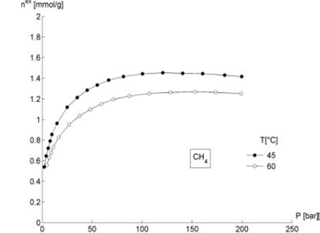
Diagram 1: CH4 adsorption data at two temperatures on a coal sample as function of the pressure [1].
Coal bed methane recovery combined with CO2 sequestration:
It has been suggested, that the recovery of coal bed methane might be enhanced by injecting CO2 in the coal seam. Through an in situ adsorption/desorption process the displaced methane is produced and the adsorbed CO2 is permanently stored. This process is called enhanced coal bed methane (ECBM) recovery. For proving the process and determining the necessary data gas mixture adsorption data have to be measured on the coal samples. MSB instrument equipped with gas mixing and dosing systems can perform such measurements and provide reliable gas mixture adsorption data. As an example the excess adsorption of the gas mixture CH4/CO2 with two different compositions is shown in the next diagram [2].
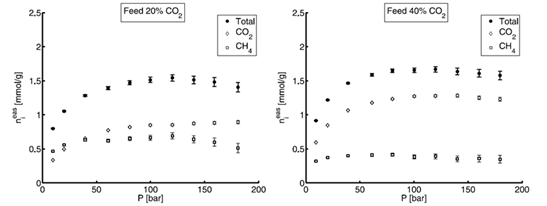
Diagram 2: Adsorption data of CH4 and CO2 mixtures with two different feed compositions a coal sample [2].
Shale gas recovery
Although the recovery of non-conventional resources of natural gas – so called shale gas – is controversially discussed in Germany, this application is intensively researched in other parts of the world. Critical for the efficiency and the environmental effects are the agents used currently for the hydraulic fracturing. During this process a liquid mixture is pumped into the geological structure and generates cracks and porosity which leads to improved diffusivity for the natural gas. Additives in the mixture are used to maintain the cracks and porosity even when the liquid is displaced by the gas. These additives are potentially toxic and may migrate into ground water reservoirs. A research topic currently is to generate the required improved diffusivity by using other fracturing agents. One of the potential substances is highly pressurized CO2. We have developed especially for this research a highest pressure MSB which allows studying the mass change of complete geological bore cores under pressures up to 700 bar. A number of these instruments were installed recently in China. First results for the temperature dependent adsorption of CH4 on a rock sample are given in the figure below.
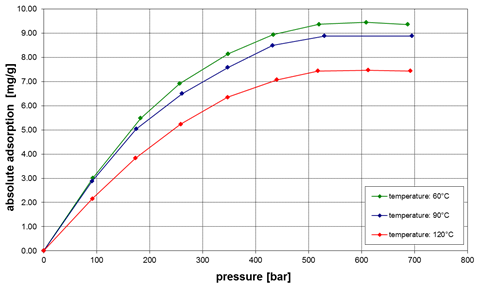
Diagram 3: CH4 adsorption data on a Chinese shale sample up to highest pressures of 700 bar at three temperatures.
Summary
In the presentation several examples of measurements in the above application fields will be presented. The typical experimental setup, procedure of measurements and results – mainly generated by our customer's in their laboratories - will be presented and discussed.
Literature
[1] S. Ottiger, R. Pini, G. Storti, M. Mazzotti, R. Bencini, F. Quattrocchi, G. Sardu and G. Deriu, Environmental Progress, Vol.25 (2006), No.4
[2] S. Ottiger, R. Pini, G. Storti and M. Mazzotti, Adsorption, Vol. 14 (2008)
See more of this Group/Topical: Separations Division