
 Google
 Yelp
 Facebook
 Twitter
 ChEnected
308250 System-Wide Modeling of HCCI Engine With After-Treatment
System-Wide Modeling of HCCI Engine with After-Treatment
C N Pratheeba[a] and Preeti Aghalayam[b]
Department of Chemical Engineering,
Indian Institute of Technology Madras, Chennai - 600036, India
Automotive engines are synonymous with power and emissions. The stringent norms imposed by legislations drive the design of IC engines. Typical engine-out emissions contain unburned fuel, CO, CO2, particulate matter and NOx. Many after treatment methods help in curtailing emissions and adhering to emission norms. Engine design also has a major role in reducing emissions. With more stringent emission norms, optimal operation can only be envisaged when the engine and the after-treatment device are considered in conjunction. This paper focuses on system-wide transient models for HCCI engines with the after-treatment options being Exhaust Gas Recirculation (EGR) and Selective Catalytic Reduction (SCR) unit.
EGR refers a part of the exhaust stream is recycled to the engine along with air-fuel intake1. EGR helps in NOx reduction by reducing the peak in-cylinder temperature and air required for combustion. The engine-out NOx is then selectively reduced using NH3 in a catalytic converter to yield N2, this is known as Selective Catalytic Reduction (SCR). This operates at lower temperatures than its SCNR (Selective Non Catalytic Reduction) counterpart, and thus presents many advantages.
In this work, the Engine + Aftertreatment Device units are to be simulated using the commercial reaction analysis software called DARS. The engine model chosen to represent HCCI is a Stochastic Reactor Model in DARS.
A zero dimensional stochastic model is used for modelling the HCCI engine. The Stochastic model is conceived as a probability density function (PDF) consisting of a discrete number of particles. The number of particles is a measure of the accuracy and computational load.
The mass density function (MDF) is the discretized form of PDF, contains the user-defined number of particles. The number of particles is a measure of accuracy and computational load. The transient MDF is assumed to be a partially stirred tank reactor with the following equation containing the flow, source and mixing terms2:
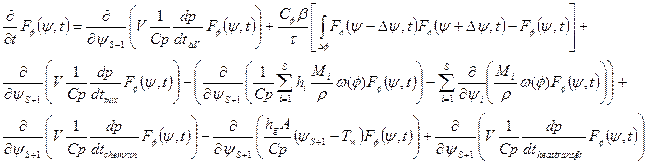
The terms in the above equation represent change due to piston movement, mixing, chemical reaction and heat transfer, respectively.
The conservation equations for the SCR3 (including intrinsic catalytic reaction and external mass transfer resistance) are as follows:
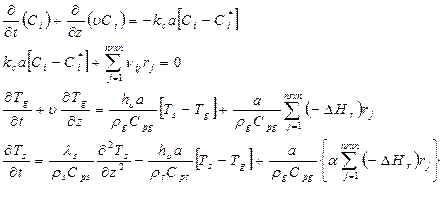
The above equations are Partial Differential Equations (PDEs). They are solved in DARS using the operator splitting technique. The initial conditions that are to be specified for the engine module are the fuel and the oxidant concentration. The engine physical parameters and its rpm, Woschni's heat transfer coefficients, the number of particles for MDF and percentage of EGR are specified. The kinetics used here is the microkinetic combustion model for n-heptane developed by Zeuch et al 4 – consisting of 121 species and 381 reversible reactions.
The SCR model requires the engine-out exhaust and ammonia dosage to be specified as inlet condtions. The reduced kinetics for the intrinsic reaction, developed by Tsinoglou and Koltsakis5 will be used here.
The solutions of the above HCCI equations yield the concentration profiles, temperature and pressure profiles as a function of Crank Angle Displacement (CAD), at engine-out. The profiles are validated with experimental data with similar engine parameters. The exhaust profiles with and without EGR are compared, first.
Presented in Figure (1) are the NOx profiles from the engine out emissions, obtained in our preliminary simulations. The mole fractions of NOx in the engine-out exhaust are plotted for different EGR namely 0%, 5% and 10%. The case of No-EGR has significant NOx in the exhaust stream. Even the 5% EGR reduces NOx considerably. This is due to the reduction in In-cylinder peak temperature as shown in Table (1). In-cylinder Peak Pressure variation is insignificant, though a boost compressor can be added for making up the lost pressure head, if required.6
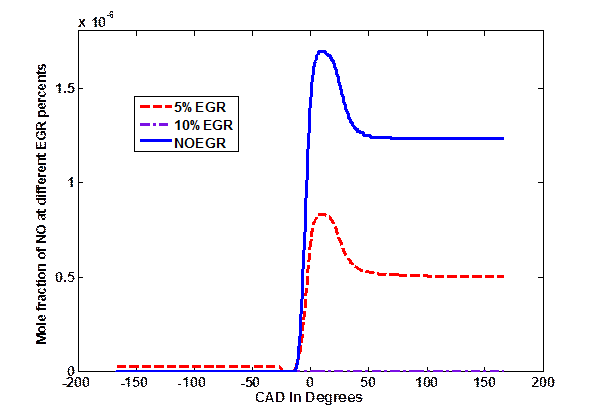
Fig 1. Comparison of NOx Profiles Vs CAD at various EGR fractions
Table 1: In-cylinder Peak Temperature and Pressure Vs EGR
| Temperature in kelvin | Pressure in Mpa |
0 % EGR ( No EGR) | 1833 | 10.44 |
5 % EGR | 1795 | 10.27 |
10% EGR | 1609 | 10.14 |
In the next step, the transient engine-out profiles will be used as inlet profiles for the SCR device, and by solving the SCR equations, profiles of various species of relevance in the tail-pipe will be evaluated. Independent validations of the Engine & SCR units will be undertaken as well.
The integrated approach proposed above has the potential to provide clues for better engine operation and optimal control of tail-pipe emissions. Since the HCCI engine can be a possible candidate for achieving very low concentrations of NOx when coupled with after treatment options, such modeling efforts will have good benefits for the future.
Keywords:
Emissions, Exhaust Gas Recirculation, Selective Catalytic reduction.
References:
1. Heywood JB. Internal Combustion Engine Fundamentals, Mc Graw Hill; 1988.
2. DARS Manual Book 3 Engine In-cylinder Models. 2012
3. Kaisare NS, Lee JH, Fedorov AG. Hydrogen generation in a reverse flow microreactor: 1. Model formulation and Scaling. AIChEJ. 2005; 51, 8: 2254-2264.
4. Zeuch T, Moreac G, Ahmed SS, Mauss FA. Comprehensive skeletal mechanism for the oxidation of n-heptane generated by chemistry-guided reduction. Combust Flame 2008; 1555: 651-674.
5. Tsinoglou D, Koltsakis G. Modelling of the selective catalytic NOx reduction in diesel exhaust including ammonia storage. P I Mech Eng D-J Aut. 2007; 221: 117 - 133.
6. http://www.dieselnet.com/tech/engine_egr_control.php
See more of this Group/Topical: Environmental Division