
 Google
 Yelp
 Facebook
 Twitter
 ChEnected
310646 Effect of the Pore Structure of Zeolite On Pyrolytic Behavior of Low-Density Polyethylene(LDPE)
Effect of the pore structure of zeolite on pyrolytic behavior
of low-density polyethylene(LDPE)
Li Yang*, Chen Wang, Jialin Cai, Daoni Pan, Qinwei Gao
Jiangsu Key Lab of Biomass-Based Green Fuels and Chemicals,
Nanjing 210037, China
College of Chemical Engineering, Nanjing Forestry University,
Nanjing 210037, China
* Corresponding author at: College of Chemical Engineering, Nanjing Forestry
University, Nanjing 210037, China. Tel.: +86-25-85427635; fax: +86-25-85418873.
E-mail address: haxia2010@gmail.com (Li Yang, Assistant Professor).
Abstract
Polyethylene is by far the world's most used plastic, which brings huge environment problem as waste. Among the various plastic waste recycling methods, feedstock recycling is becoming a alternative for recovering valuable gasoline or diesel-range hydrocarbons. Pyrolysis of polyolefins is a good method, which can produce paraffins, olefins, and aromatics [1-10]. Catalytic pyrolysis of polymer wastes has been widely studied to improve gasoline yield. During catalytic pyrolysis, the solid polymer melts and disperses into the catalysts. Surface reaction produces very complex compounds. As a result of this complex process, product distributions reflect characteristics of the catalysts related to their pore systems and chemical compositions. In general, the carbon atom number distribution of products obtained from catalytic pyrolysis is narrower in comparison with the distribution produced by non-catalytic pyrolysis.
In this work, HZSM-5, H-beta, and H-Y zeolite catalysts with varying pore size was used to catalytically pyrolyze LDPE. The effect of type of zeolite, reaction temperature, the mass ratio of catalyst to LDPE, and amount of Brönsted acid sites on the product yields and the component of liquid was also investigated. The composition of liquid fractions, variations with the carbon number and compound type, and the yields of the most important compounds were analyzed by GC-MS and NMR. The pyrolysis process was also investigated by TG-DTG technique and the zeolites were characterized by IR spectra of pyridine adsorption and NH3-TPD.
Tab.1 shows the yield of gas, liquid, and coke produced from catalytic pyrolysis of LDPE using H-ZSM-5, H-beta, and H-Y as catalysts. As can be seen, H-beta catalyst gave a higher yield of liquid, but three catalysts produced a little coke. It should be noted that non-catalytic pyrolysis of LDPE only produced wax (the yield > 90%). Zeolite catalysts such as H-ZSM-5 has Brönsted acid sites and micro-pores, promoting the cracking of C-C of LDPE into small molecular.
Table 1 The yield of gas, liquid, and coke produced from catalytic pryolysis of LDPE a
Yield | H-beta + LDPE | H-Y + LDPE | H-ZSM-5 + LDPE |
Gas | 42.5 | 65 | 61 |
Liquids | 55 | 30 | 35 |
coke | 2.5 | 5 | 4 |
a-The reaction condition: the mass ratio of catalyst to LDPE is 1:4; the reaction was carried out in N2 flow in a quartz fix-bed reactor; The yield s of liquid and coke were determined by weight, while the gas yield was determined by means of an overall mass balance.
Table 2 presents the relative percentages of olefins, paraffin, and aromatics of liquid obtained from catalytic pyrolysis of LDPE. It can be seen that three liquid products all contain olefins, paraffins, and aromatics. However, H-ZSM-5 catalyst gets the highest yield of aromatics with the content being 61.47%. One of the possible interpretations is that H-ZSM-5 has better shape selectivity and higher aromatization performance than those of H-Y and H-beta. Fig.3 depicts that the distribution of the carbon number of aromatics in the liquid product. It can be seen that the carbon number of the aromatics is mainly range from 6 to 11 due to the shape selectivity of micropore zeolite. The aromatic components include toluene, o-, m-, p-xylene, ethylbenzene, tri-methyl benzene, etc. It should be noted that the pyrolysis of LDPE catalyzed by three catalysts produced a little naphthalene. H-ZSM-5 got the highest xylene yield compared with two other catalysts due to the pore size of HZSM-5 favoring the formation of xylene.
Table 2 The relative percentages of olefins, paraffin, and aromatics of liquid produced from catalytic pyrolysis of LDPEa
Contents | H-beta + LDPE | H-Y + LDPE | H-ZSM-5 + LDPE |
olefins | 32.87 | 35.96 | 12.04 |
paraffin | 39.67 | 21.48 | 26.49 |
aromatics | 27.46 | 42.56 | 61.47 |
a-the liquid components were performed by Agilent GC-MS 7890A-5975C with a quadrupole detector and a HP-5MS capillary column (30 m °Á 0.25 mm i.d., 0.25 mm film thickness).
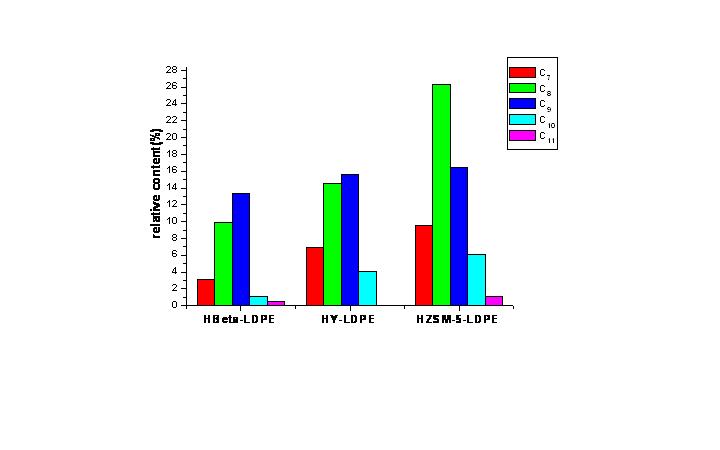
Figure 1 The distribution of the carbon number of aromatics in the liquid obtained from catalytic pyrolysis of LDPE on H-beta, H-Y, and H-ZSM-5.
In summary, these results show that zeolite catalyst could effectively promote the degradation of LDPE to valuable aromatic compounds. H-ZSM-5 got the high aromatic yield of 61.47% and the high xylene yield of 26% because its pore size and structure favors the formation of aromatics.
References
[1] M.S. Renzini, U. Sedran, L.B. Pierella, H-ZSM-11 and Zn-ZSM-11 zeolites and their applications in the catalytic transformation of LDPE, Journal of Analytical and Applied Pyrolysis, 2009, 86:215-20.
[2] G. Elordi, M. Olazar, G. Lopez, M. Amutio, M. Artetxe, R. Aguado, J. Bilbao, Catalytic pyrolysis of HDPE in continuous mode over zeolite catalysts in a conical spouted bed reactor, Journal of Analytical and Applied Pyrolysis, 2009, 85:345-51.
[3] A. Marcilla, M.I. Beltran, R. Navarro, Thermal and catalytic pyrolysis of polyethylene over HZSM5 and HUSY zeolites in a batch reactor under dynamic conditions, Applied Catalysis B-Environmental, 2009, 86:78-86.
[4] G. Elordi, G. Lopez, R. Aguado, M. Olazar, J. Bilbao, Catalytic pyrolysis of high density polyethylene on a HZSM-5 zeolite catalyst in a conical spouted bed reactor, International Journal of Chemical Reactor Engineering, 2007, 5.
[5] A. Marcilla, A. Gomez-Siurana, F. Valdes, Catalytic pyrolysis of LDPE over H-beta and HZSM-5 zeolites in dynamic conditions - Study of the evolution of the process, Journal of Analytical and Applied Pyrolysis, 2007, 79:433-42.
[6] A. Marcilla, A. Gomez-Siurana, F. Valdes, Catalytic cracking of low-density polyethylene over H-Beta and HZSM-5 zeolites: Influence of the external surface. Kinetic model, Polymer Degradation and Stability, 2007, 92:197-204.
[7] I. Torre, J.M. Arandes, P. Castano, M. Azkoiti, J. Bilbao, H. Ignacio de Lasa, Catalytic cracking of plastic pyrolysis waxes with vacuum gasoil: Effect of HZSM-5 zeolite in the FCC catalyst, International Journal of Chemical Reactor Engineering, 2006, 4.
[8] A. Durmus, S.N. Koc, G.S. Pozan, A. Kasgoz, Thermal-catalytic degradation kinetics of polypropylene over BEA, ZSM-5 and MOR zeolites, Applied Catalysis B-Environmental, 2005, 61:316-22.
[9] G. Elordi, M. Olazar, M. Artetxe, P. Castano, J. Bilbao, Effect of the acidity of the HZSM-5 zeolite catalyst on the cracking of high density polyethylene in a conical spouted bed reactor, Applied Catalysis a-General, 415:89-95.
[10] A. Coelho, L. Costa, M.M. Marques, I.M. Fonseca, M.A.N.D.A. Lemos, F. Lemos, The effect of ZSM-5 zeolite acidity on the catalytic degradation of high-density polyethylene using simultaneous DSC/TG analysis, Applied Catalysis a-General, 413:183-91.
See more of this Group/Topical: Catalysis and Reaction Engineering Division