
 Google
 Yelp
 Facebook
 Twitter
 ChEnected
310657 Optimal Operation Strategy for Batch Vacuum Evaporation Process By Iterative Dynamic Programming
A vacuum evaporation technique is widely used in the food, bio, pharmacy, and semiconductor industries. The vacuum evaporation processes concentrate liquid at lower temperature by lowering the boiling point of the liquid in the vacuum condition. By operating at lower temperature, the vacuum evaporation process prevents the thermal decomposition of the liquid and alleviates the corrosion problems of the materials. However, the vacuum evaporation process lowers the dew point of the generated steam as well as the boiling point of the liquid. Because the lowered dew point of the steam reduces the mean temperature difference in the condenser, the driving force for the heat transfer is reduced in the low pressure condition. For this reason, the condenser size is dramatically increased or the evaporation rate is limited in the general vacuum evaporation process [1,2]. This is a very important issue in the some processes of handling the corrosive liquid such as a strong acid. Because the corrosion-resistant materials are very expensive, the condenser becomes the most important unit. Generally, the vacuum evaporation process is performed in the batch mode. Because the steam generation rate and the mean temperature difference are changed in the batch operating mode, the condenser area requirement also varies depending on the operating time. The condenser must be designed to meet the maximum condenser area requirement among the whole operation time. The maximum condenser area requirement is determined by the depressurizing curve and the heating curve. In this research, we suggest an optimal operation strategy to minimize the condenser area in a batch vacuum evaporation process for sulfuric acid purification. This process concentrates dilute sulfuric acid drained from the semiconductor wafer cleaning. We established the discrete-time dynamic model of the sulfuric acid purification process using pilot plant data. The objective function is to minimize the maximum condenser area requirement among the whole operation time. The manipulated variables are operating pressure and heat supply according to the operation time. Because this problem is highly nonlinear and dynamic programing, we developed an iterative dynamic programming algorithm to solve it. By using this characteristic of the minimizing the maximum problem, this problem is converted to maximizing the mean temperature difference and eliminating the peak point of condenser area requirement. Through the optimal operation strategy, the system was depressurized as slowly as possible within a range that the temperature never exceed the maximum temperature limit (190°C). Simultaneously, the heater duty was controlled to generate the optimal amount of the steam in response to the operating pressure change. That means large amount of the steam is generated at high pressure condition and small amount of the steam is generated at low pressure condition. To validate the effect of it, the optimal operation was compared with a conventional operation which is depressurizing quickly and supplying constant heat duty as shown in figure 1. As a result, this optimal operation strategy showed the great reduction of the condenser area and the operation time. In case of the operation time is fixed to 100 min, the condenser area was reduced from 11.6 m2 to 2.9 m2. In case of the condenser area is fixed to 10 m2, the operation time was reduced from 117 min to 54 min.
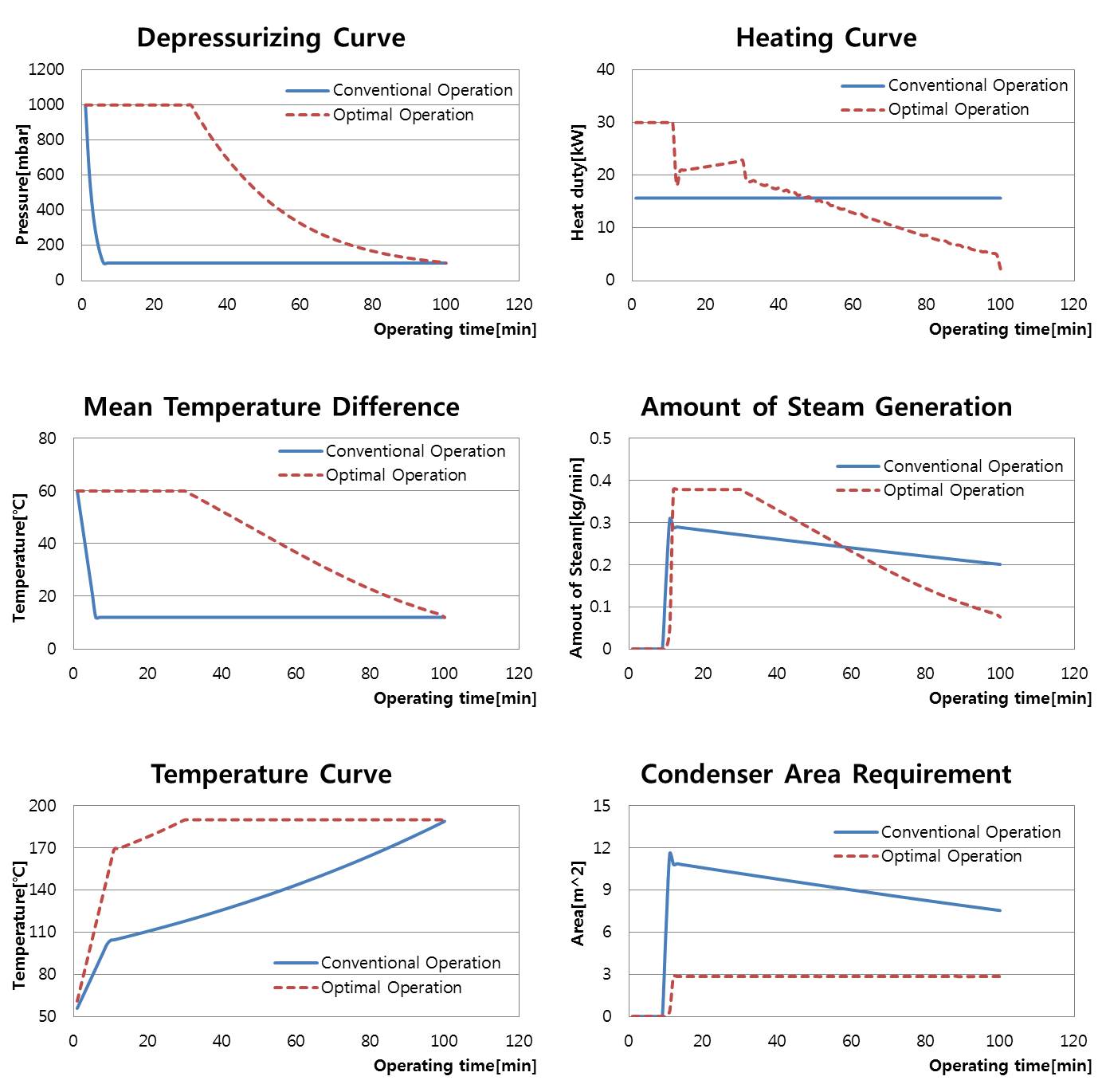
Figure1. The simulation result of optimal operation when operation time is 100 min.
1. Mao, W., H. Ma, and B. Wang, Performance of batch vacuum distillation process with promoters on coke-plant wastewater treatment. Chemical Engineering Journal, 2010. 160(1): p. 232-238.
2. Hiroshi Ogata, and Norio Tanaka, Reduction of Waste in Semiconductor Manufacturing Plant, Sulfuric Acid Recycling Technology. Oki Technical Review 160, 1998. Vol.63: p. 41-44.
See more of this Group/Topical: Computing and Systems Technology Division