
 Google
 Yelp
 Facebook
 Twitter
 ChEnected
310667 Metal Complexes As Catalysts in Enhancing the Oxygen Scavenging Action of Hydrazine in the Boiler Feed Water
Metal complexes as Catalysts in Enhancing the Oxygen Scavenging action of Hydrazine in the Boiler Feed Water
*Koyar Sanlo Rane1, 2 and Sifali S. Bandodkar1
1Goa University, Goa, India ; 2Rani Channamma University, Belgaum-591156, India
Metals are prone to deterioration or destruction or simply to corrosion in a hostile environment. Oxygen is one such an aggressive gas and the oxygen dissolved in water even 3-5 parts per million (ppm) or for that matter 10-12 parts per billion (ppb) is detrimental to the boiler materials when used as boiler feed water. Boiler is an integral part of any industry and hence the minimization of the dissolved oxygen (DO) in the boiler feed water is of prime importance, as industry cannot afford to shut down the boiler for the want of its maintenance due corrosion. Mechanical de-aeration is normally adopted to bring down the DO level of the boiler feed water (de-ionized) to 3-5 ppm. Further reduction of the DO level is done through solid or liquid chemical oxygen scavengers (COS). Liquid COS, hydrazine hydrate, N2H4·H2O, is universally used which reacts with dioxygen, giving environmentally friendly gaseous reaction products, N2H4 + O2→ N2 and H2O. Added advantage of the hydrazine is that it is a reducing agent and it helps in arresting metal oxide formation. In addition to this, the hydrazine promotes the formation of the protective magnetite, Fe3O4, through a reaction with metal oxide scale, 6Fe2O3 + N2 H4→ 4Fe3O4 + N2 + 2H2O. The hydrazine can also form a protective cuprous oxide, Cu2O, film in copper based boiler materials by reacting with the cupric oxide, CuO, that formed due to the corrosion of copper. It is because of these passivation effects that an excess of the hydrazine is added in excess of its normal 1:1 stoichiometry (N2H4:O2:: 1:1) requirement in the boiler feed water. The only objectionable part is that it is indicated as toxic and hence it is unfriendly to the boiler operators, hence excessive use need to be restricted. Another limitation of the use of it is its sluggish reaction with oxygen, when DO level at ppb needs to be maintained at lower temperatures and the enhancement of the reactivity is mediated through catalysts and hence to increase the rate of reaction catalysts are used.
It is found that the oxygen scavenging action of hydrazine in the boiler feed water can be enhanced [1,2] by adding cobalt(II) chloride and 3,4 diamino toluene (DAT). Though the formation of CoII (3,4 Diaminotoluene) chloride type complex, [Co(3,4-DAT)2]Cl2, is mentioned in the patent, details of the enhancing action is not available with the use of such additives. May be the reversible oxygen uptake similar to the well known cobalt complexe such as cobalt salen, N,N'-Bis(Salicylidene) ethylene diamino Cobalt(II) [3] is taking place on the cobalt diaminotoluene complex too. The activated oxygen may then attack the hydrazine more effectively.
Catalytic effect of metal complex
In our studies we synthesized the cobalt diaminotluene (CDAT), [Co(C7H10N2)3]Cl2 and cobalt salen(CS) [Co(C16O2H14N2)]complexes and investigated the oxygen scavenging action of hydrazine in the presence of these complexes in a home built boiler. 30 liters water capacity boiler was de-aerated mechanically at 45°C to 3-5 ppm DO level and then a little excess hydrazine hydrate than required (1:1::N2H4:O2) was added and the amount of oxygen scavenged estimated by Winkler's method, and hydrazine consumed spectrophotometrically.
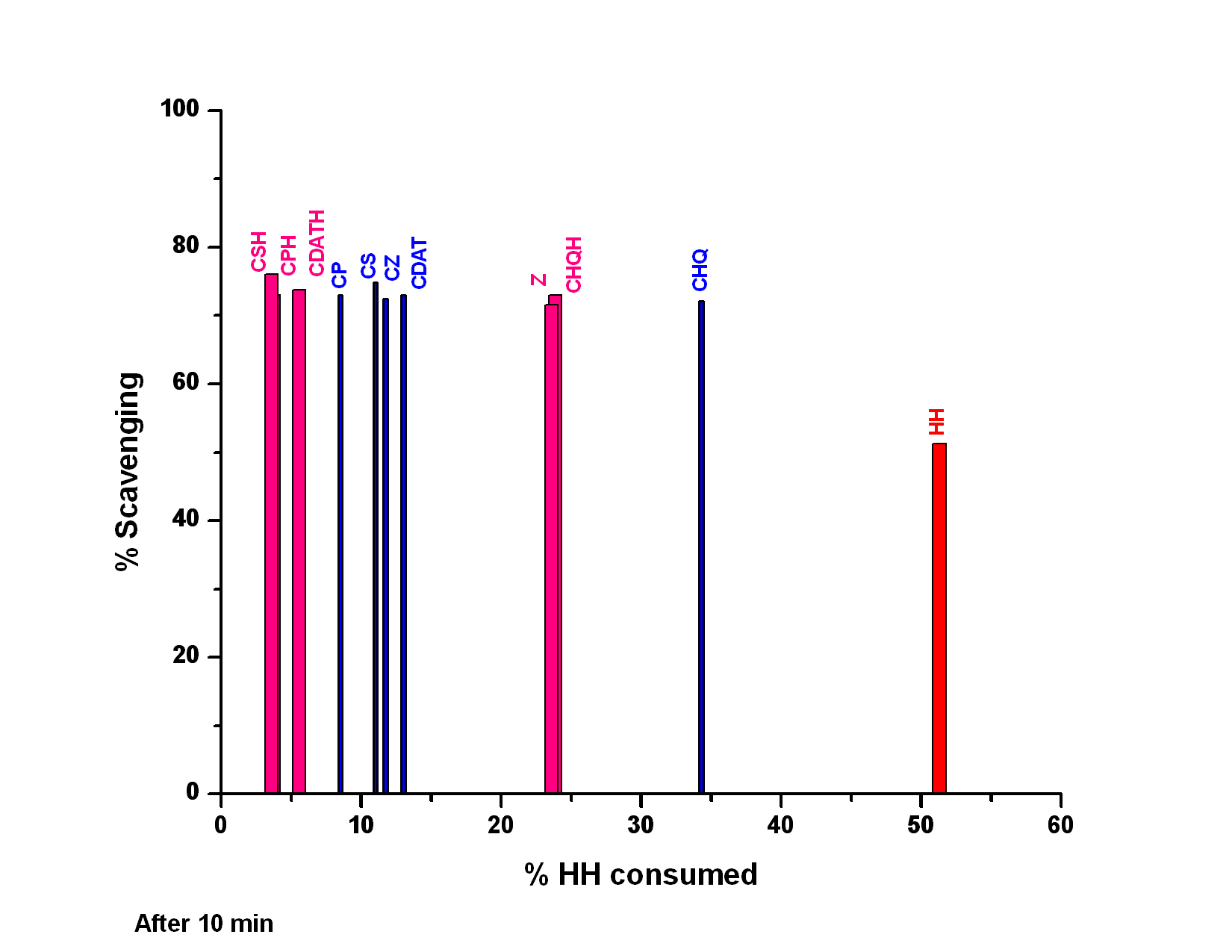
Figure 1 Percentage Oxygen Scavenging by hydrazine hydrate (HH)
in the presence of Cobalt complexes at 45°C
It is observed that, Figure 1, the hydrazine hydrate (HH) scavenged ~50% of the 3-5 ppm DO of the boiler water in 10 minutes by consuming ~50% of the hydrazine added to the water after mechanical de-aeration. When the metal complexes, cobalt diamino toluene (CDAT) and cobalt salen (CS) embedded in the polymer base hung in the mechanically de-aerated boiler feed water(3-5 ppm DO) and then introduced the requisite amount of HH, both showed ~ 70% oxygen scavenging within 10 minutes at 45°C, indicating a catalytic effect of the metal complexes by consuming ~12% hydrazine .
Hydrazine modified metal complexes:
An interesting observation, however, was made with the cobalt diaminotoluene hydrazinate, (CDATH), [Co(C7H10N2) (N2H4)2]Cl2 and cobalt salen hydrazinate (CSH) [Co(C16O2H14N2)(N2H4)], prepared for the first time [4]. Both catalyzed the hydrazine oxygen scavenging capacity by consuming just ~5% hydrazine.
Plausible mechanism:
In autoxidation of hydrazine in an aqueous solution with molecular oxygen O2 by Co(II) 3,10,17,24-tetrasulphophthalocyanine (H2tspc): [CoII(tspc)], it is considered [5] that hydrazine forms an 1:1 adduct with the metal complex and the hydrazine thus activated reacts with the oxygen,
[CoII(tspc)]·(N2H4) + O2 → N2 + H2O + [CoII(tspc)]
The metal complex, [CoII(tspc)], remains unazffected after the hydrazine oxidation. The molecular oxygen getting reversibly attached to cobalt salen either into superoxo, O2- (1:1) or µ- peroxo (2:1; oxygen bridged) complex is well known [3] and the activated oxygen is used in the oxidation reactions. The enhancement of the oxygen scavenging action of hydrazine by the introduction of cobalt salen in the boiler in our studies may be due to the attack of this activated oxygen by the hydrazine. However, further enhancement of the hydrazine oxygen scavenging by the cobalt salen hydrazinate complex, [Co(C16O2H14N2)(N2H4)], may be visualized as follows. Hydrazine is already in the adduct form in the complex and the cobalt salen is a good oxygen carrier and thus hydrazine easily reacts with the oxygen on the metal complex.
In the highly coordinating solvent such as pyridine, in the absence of oxygen the square planar cobalt salen can form 5 or 6 coordinate complex, [Co(salen)(py)] or Co(salen)(py)2]. Such complex too can bind O2 to give derivatives of the type (μ-O2)[Co(salen)py]2 and [Co(salen)py(O2)]. In the cobalt salen hydrazinate, [Co(C16O2H14N2)(N2H4)], the hydrazine ligand may occupy the 5th position of central metal cobalt. Since the lewis base pyridine (sp2 N) is less basic compared to N2H4 (sp3 N) whose basicity is comparable to NH3 (sp3 N), hydrazine occupied in the 5th position of the central Co metal may more efficiently form adduct with dioxygen (1:1superoxo type complex). The hydrazine of the boiler water now readily gets attacked with the superoxo radical.
The enhancement of the oxygen scavenging of hydrazine in the presence of Cobalt diaminotoluene (CDAT), [Co(C7H10N2)3]Cl2, and its hydrazinate (CDATH), [Co(C7H10N2) (N2H4)2]Cl2 ; Cobalt proline(CP), [Co(C5H9NO2)2(H2O)2], and its hydrazinate(CPH), [Co(C5H9NO2)(N2H4)(H2O)2]; Cobalt hydroquinone(CHQ), [Co(C6H4(OH)2)3], and its hydrazinate(CHQH), [Co(C6H4(OH)2)(N2H4)2]; cobalt carbohydrazide(CZ), [Co(CH6N4O)3]Cl2 have been observed( Figure 1). The hydrazinate complexes are prepared for the first time. And the oxygen scavenging action of all the complexes show interesting order of activity,
CSH>CPH>CDATH* >CP > CS > CZ > CDAT > Z ≈ CHQH>CHQ >HH
The paper discusses the preparation, characterization of the cobalt complexes and their effectiveness as catalyzer in the oxygen scavenging action of hydrazine on a home built boiler.
Acknowledgement: KSR thanks University Grants Commission (UGC) New Delhi, India, for the UGC Emeritus Fellowship.
References:
[1] Noack, G.Manfred “Catalyzed hydrazine compound corrosion inhibiting
composition containing a quinone compound and a complex of metal salt and an
ortho aromatic compound” U.S. Patent No. 4026664(1976)
[2] Noack, G. Manfred, “Catalyzed hydrazine compound corrosion inhibiting
composition and use”, U.S. Patent No. 4012195 (1975)
[3] T.Tsumaki,Bull.Chem.Soc.Jap,13(1938) 252
[4] Koyar Sanlo Rane and Sifali S. Bandodkar, “Metal Complexes for enhancing the oxygen scavenging action of hydrazine” India Patent-IP15596 (provisional Filing on 28th Jan.2011) [Sifali Bandodkar, Ph.D Thesis, Nov. 2011, Goa University, Goa, India]
[5] D.J.Cookson, T.D.Smith, J.F.Boas, P.R.Hicks, J.R.Pilbrow, “Electron Spin Resonance Study of the Autoxidation of Hydrazine,Hydroxylamine and Cysteine catalysed by the cobalt(II)Chelate complex of 3,10,17,24Tetrasulpho phthalocyanine” Journal of Chemical Society Dalton (1977)109-114
See more of this Group/Topical: Catalysis and Reaction Engineering Division