
 Google
 Yelp
 Facebook
 Twitter
 ChEnected
311197 Theoretical Investigation of a Semicontinuous Distillation Process for the Separation of Bio-Based Impurities
The transition from fossil-based raw materials to bio-based raw materials is necessary in order to produce chemical products in a sustainable way. For example, n-butyl acrylate is currently produced through a synthetic route using chemicals derived from petroleum, but new research into its production from biological sources (such as wood) is showing promise as a more sustainable alternative. However, the composition of the impurities contained in bio-derived n-butyl-acrylate (and its precursors) significantly differs from traditional, fossil-derived n-butyl acrylate. Furthermore both the composition and the amount of impurities in bio-derived n-butyl acrylate change depending on the biomass feedstock used and even from natural batch-to-batch variations in the biosynthetic reactions. Therefore highly flexible processes which can achieve the required final product purity even with varying initial impurity concentrations need to be developed.
Figure 1: Configuration of semicontinuous distillation process.
|
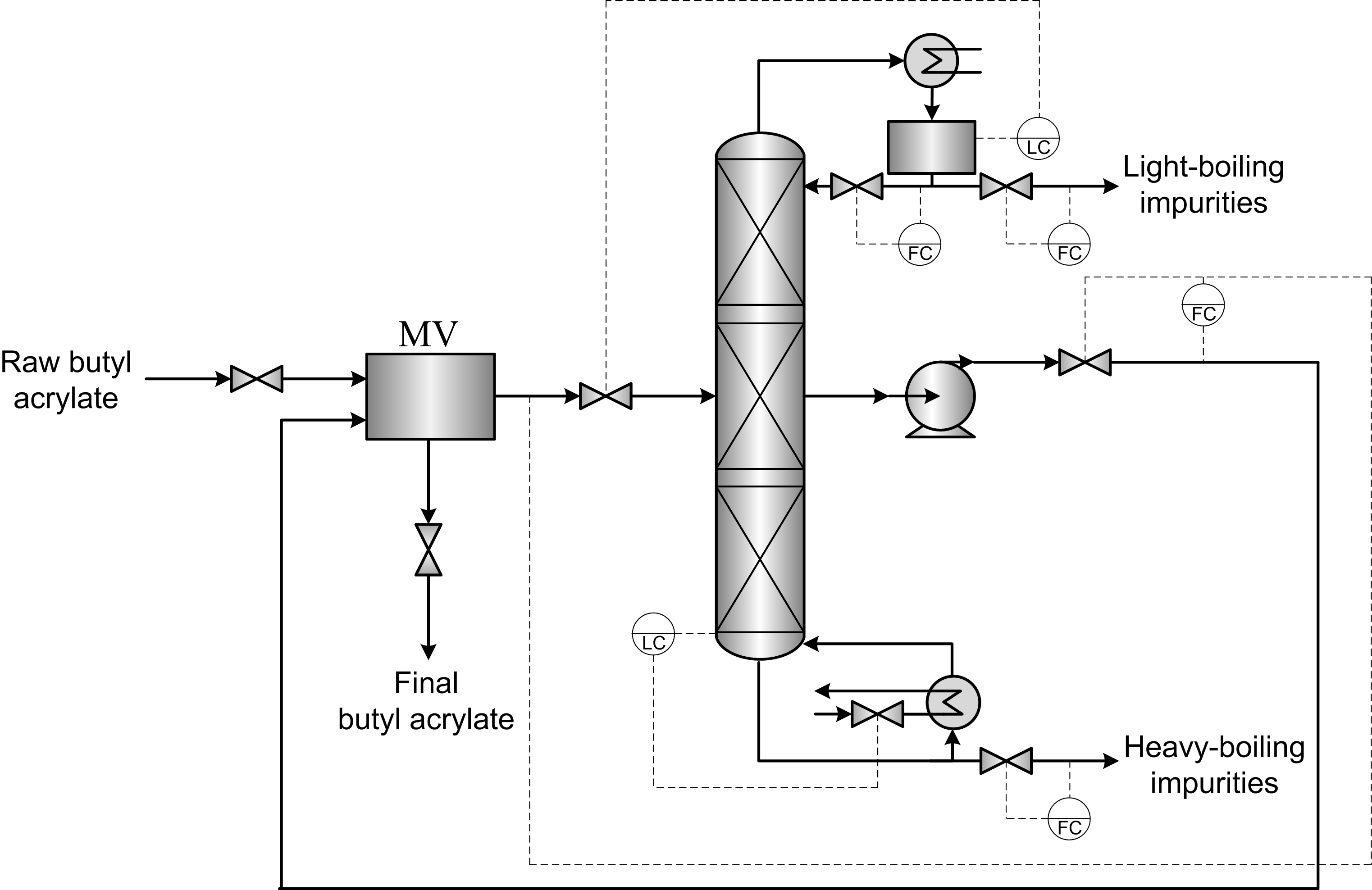
In a previous study, a reactive distillation column for the esterification reaction of bio-n-butanol and bio-acrylic acid to produce n-butyl acrylate was investigated, which is a promising candidate to replace the conventional process, reducing the production costs for n-butyl acrylate. Besides the development of the reactive distillation process, the potential impurities resulting from the biosynthetic production of the reactants were identified. However, the use of bio-based raw materials resulted in insufficient final product purities. Therefore, new and flexible downstream process concepts are investigated in this work in order to remove the impurities.
A promising process concept for the purification of bio-based chemicals is semicontinuous distillation. Semicontinuous distillation processes allow for the separation of three or more streams simultaneously by tightly integrating one or more middle vessels to a distillation column. In this study, the application of a ternary semicontinuous distillation process for the removal of bio-based impurities is studied for the purification of three different material streams: the purification of high-purity bio-based n-butyl acrylate (see Fig. 1) as well as for the purification of bio-n-butanol and bio-acrylic acid which are the reactants fed to the reactive distillation column which produces n-butyl acrylate. The simulation studies are performed using Aspen Dynamics™ V7.3. Three performance criteria which are the specific heat study, the specific product loss and the cycle time of the semicontinuous process are used to characterize and compare the feasibility of the different case-studies. Simulations with varying initial and final impurity concentrations are performed to demonstrate a high flexibility. It is shown that the semicontinuous technology is feasible for two of the investigated case-studies, the purification of bio-n-butanol and the purification of the final product n-butyl acrylate. Purities of up to 99.95 wt.-% are achieved with varying initial purities of 99.00 wt.-% or higher. Different impurity compositions can be handled by this technology and varying final purities are achieved by only changing the cycle time of the process.
Hence, this technology shows a high potential for the purification of bio-based chemicals, offering a high flexibility in respect to initial and final impurity concentrations. Furthermore, it should be noted that the same semicontinuous set-up (meaning the same column height and diameter) used to remove bio-based impurities from the final product n-butyl acrylate can also be used to remove impurities from the reactants bio-n-butanol and bio-acrylic acid. This demonstrates the potential of semicontinuous systems to be used as a multipurpose column which may reduce capital costs.
Acknowledgement: The research leading to these results has received funding from the European Union Seventh Framework Programme (FP7/2007-2013) under grant agreement n° 241718, EuroBioRef. Financial support of the Martin-Schmeißer-Stiftung is gratefully acknowledged.
See more of this Group/Topical: Process Development Division