
 Google
 Yelp
 Facebook
 Twitter
 ChEnected
312127 Calcium Ions in Gypsum (CaSO4·2H2O) Scaling in Forward Osmosis Processes and a Novel Design Strategy to Fabricate Polybenzimidazole Anti-Scaling Hollow Fiber Membranes
Calcium ions in gypsum (CaSO4°¤2H2O) scaling in forward osmosis processes and a novel design strategy to fabricate polybenzimidazole anti-scaling hollow fiber membranes
Si Cong Chena,b, Jincai Sub, Feng-Jiang Fub , Baoxia Mic, Tai-Shung Chunga,b,*
a NUS Graduate School for Integrative Sciences & Engineering (NGS), National University of Singapore, 28 Medical Drive, Singapore 117456, Singapore
b Department of Chemical and Biomolecular Engineering, National University of Singapore, 4 Engineering Drive 4, Singapore 117576, Singapore
c Department of Civil and Environmental Engineering, University of Maryland, College Park, MD 20742, USA
* Corresponding author: chencts@nus.edu.sg
Abstract
Gypsum (CaSO4°¤2H2O) scaling phenomena have been studied on hollow fiber membranes with different physicochemical properties in forward osmosis processes. Three types of hollow fiber membranes were demonstrated i.e., (1) cellulose acetate (CA), (2) polybenzimidazole (PBI)-polyethersulfone (PES) and (3) PBI-polyacrylonitrile (PAN) - polyhedral oligomeric silsesquioxane (POSS). For the first time, we have found that calcium ions not only dominate but also take a leading role on gypsum (CaSO4°¤2H2O) scaling through ionic interactions with the membrane surface. A high level of calcium ions in scaling solutions can initiate gypsum crystallization more effectively than a high level of sulfate ions. Based on this finding, for the first time, a novel strategy to molecularly engineer PBI hollow fiber membranes with superior anti-scaling properties has been proposed and demonstrated. As shown in Figure 1c, the newly designed PBI-PAN (POSS) membranes have a positively charged and smooth membrane surface at the nanoscale level but possess a ridge and valley structure at the micrometer level. It shows slightly positive charge at a low pH and exhibits minimal scaling of only 5% flux reduction in contrast to CA membranes with 63% flux reduction. The adhesion force measured by atomic force microscopy (AFM) confirms a strong repulsive force between gypsum particles and PBI (Figure 1b) at pH values lower than the isoelectric point of 5.7. The repulsion force leads to the anti-fouling properties, while the novel ridge and valley morphology in the micrometer scale facilitates surface turbulence flow and effectively remove foulants.
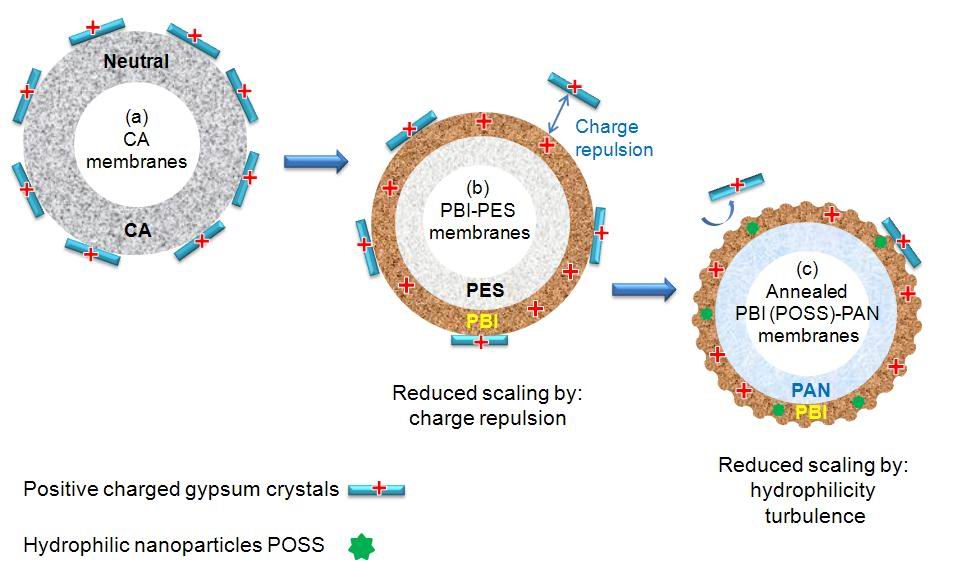
Figure 1: Fouling mechanisms of gypsum scaling on membranes
See more of this Group/Topical: Topical Conference: Innovations of Green Process Engineering for Sustainable Energy and Environment