
 Google
 Yelp
 Facebook
 Twitter
 ChEnected
312158 Polydopamine-Coated PCL Shape Memory Polymer Foams for Bone Regeneration
Introduction: Scaffolds employed in bone regeneration must promote new bone formation while forming a strong physical interface with (conforming with and bonding to) adjacent bone tissue to promote osteointegration. In the present study, the osteoinductivity of a “self-fitting”, polydopamine-coated shape memory polymer (SMP) scaffold was evaluated. This SMP foam was fabricated by photopolymerization of diacrylated poly(e-caprolactone) (DAcPCL) followed by polydopamine coating. When treated with warm saline (T > Tm of PCL), the compressed DAcPCL foam not only expands but is in a softened state, which permits its manipulation and conformability along irregular bone defect “boundaries” thereby promoting osteointegration. A polydopamine coating was selected due to its ability to maintain its integrity under repeated scaffold deformation (in contrast to calcium phosphate coatings) and due to recent literature indicating that polydopamine stimulates osteoblast adhesion and matrix mineralization. Results from the current work demonstrate that polydopamine coatings increase the osteogenic capacity of these SMP foams.
 Materials and Methods: Fabrication of DAcPCL foams. Photosensitive DAcPCL macromers were formed into
open porous foams via solvent casting/particulate leaching (SCPL) technique
which increases pore interconnectivity versus traditional salt-leaching. Following
salt leaching, subsets of foams were coated with an aqueous dopamine chloride
solution for 16 h to allow spontaneous oxidative polymerization of dopamine on
pore walls. Construct Culture and Analysis. Coated and uncoated
DAcPCL foams were seeded with human bone-marrow derived MSCs (Lonza) at 1x10⁶
per cm3. The resulting constructs were cultured for 2 weeks in Growth
Medium (GM; DMEM with 10% MSC-qualified FBS) or Osteogenic Medium (OM) (GM
supplemented with 0.1 µM dexamethasone, 50 µg/ml L-ascorbic acid-2-phosphate,
10 mM β-glycerolphosphate). Gene expression was then analyzed relative to β-actin
using qRT-PCR. Total calcium deposition was quantified using the CPC liquid
color kit (Stanbio).
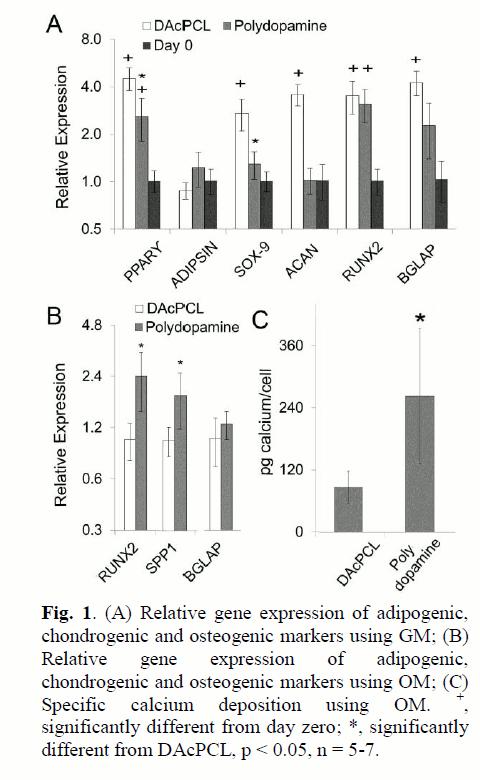
Results and Discussion: The capacity of polydopamine-coated foams to support MSC osteogenesis was analyzed following 2 weeks of culture. In the absence of osteogenic media supplements, general upregulation of adipogenic (pparγ), chondrogenic (sox9, aggrecan [ACAN]), and osteogenic (runx2, osteocalcin [BGLAP]) markers was observed in the uncoated scaffolds relative to initial (day zero) expression levels (p<0.05; Fig 1A). In contrast, polydopamine-coated scaffolds did not promote chondrogenesis, although they still stimulated adipogenesis in addition to osteogenesis. When foams were cultured under conditions of “enforced” osteogenic specificity (under OM conditions), an increase in MSC expression of osteogenic markers (runx2, osteopontin [SPP1]) was observed on polydopamine-coated scaffolds relative uncoated controls (p< 0.023, Fig. 1B). Polydopamine-coated foams were also associated with a 3.2-fold increase in calcium deposition relative to uncoated scaffolds (p = 0.04, Fig. 1C). Cumulatively, these results support the osteogenic potential of polydopamine-coated DAcPCL foams.
Conclusions: DAcPCL SMP foams have significant potential as bone regeneration scaffolds due to their high porosity, elastomeric (non-brittle) nature, and capacity to be inserted in conformal contact with bone defect boundaries (promoting osteointegration). The present studies indicate that coating these SMP foams with polydopamine increases the osteoinductive capacity of these novel scaffolds.
Acknowledgements: MH and MG acknowledge NIH funding.
See more of this Group/Topical: Materials Engineering and Sciences Division