
 Google
 Yelp
 Facebook
 Twitter
 ChEnected
313424 Study On the Wastewater Reuse By Combination of Thermophilic Anaerobic Bioreactor With Forward Osmosis (FO)/Membrane Distillation (MD) Integrated Module
Study on the wastewater reuse by combination of thermophilic anaerobic bioreactor with Forward Osmosis (FO)/Membrane Distillation (MD) integrated module
Zhang Jinsong,* Kwan Zheng Xin Joseph, Goh Shuwen, Anthony Gordon Fane*
Singapore Membrane Technology Centre(SMTC),Nanyang Environment and Water Research Institute(NEWRI),Nanyang Technological University,1 Cleantech Loop, CleanTech One, #06-08, Singapore 637141
*Corresponding author: jszhang@ntu.edu.sg, Tel: 65-65921835, Fax: 65- 67910756
Abstract
The organic loading and temperature of wastewater from industries such as chemical, petroleum and pharmaceutical are typically high. These characteristics make them potential candidates for anaerobic bioprocess, which is able to process high strength wastewater and generate energy in the form of methane. Due to the high temperature of wastewater, applying thermophilic anaerobic digestion has additional benefits over mesophilic digestion, including a higher COD removal efficiency, faster degradation rate, and lower methane solubility in wastewater. However, due to the incomplete degradation of organics, the effluent from the anaerobic bioprocess usually contains a high concentration of organics, which makes it difficult to reuse or dispose according to the discharge standard.
In this study, a thermophilic upflow anaerobic sludge blanket (UASB) combined with the forward osmosis (FO)/membrane distillation (MD) integrated module has been demonstrated for the first time. The schematic diagram of anaerobic bioprocess with FO/MD module is shown in Figure 1. The MD process uses microporous hydrophobic membranes that allow water vapour to pass through the dry pores, while retaining the non-volatile organics and inorganics. If the MD membrane was directly used to treat the UASB effluent, serious biofouling, scaling and wetting will occur. The FO process is a membrane separation process which uses semi-permeable membranes that allows water molecules to pass through while retaining bigger size solutes. The driving force for water transport is an osmotic pressure gradient achieved by using an osmotic ‘draw solution' (DS). The FO/MD integrated module captures the complementary advantages provided by FO and MD in a single step. By applying the FO membrane process at the anaerobic bioprocess effluent side, nearly all the organics and inorganics can be rejected at a low fouling rate. This makes the FO membrane a perfect barrier to prevent MD fouling and wetting. High temperature feed water will also mitigate the concentration polarization effects usually observed in FO processes, resulting in enhanced FO membrane flux. The draw solution is simultaneously regenerated in-situ via the MD process, which completely retains the solute (such as NaCl) in DS while allowing water to diffuse across the membrane into the permeate reservoir. The FO/MD module allows us to achieve a product that is of distilled water quality and ready for reuse in a single step.
Our experiments have shown that the anaerobic bioreactor with FO/MD module had a high rejection for TOC, with a calculated average of 99.55 ± 0.24 %. TOC levels in the permeate remained fairly constant below 0.5 mg/L. Permeate conductivity was stable at 5 μS cm-1 , which is comparable to the RO permeate of wastewater reclamation. The average composition of the biogas generated from the UASB process was found to be 67.4 % methane, with the highest percentage being 83.6 %. Optimally, the bioprocess is able to produce a maximum of 0.35 L methane for every gram of chemical oxygen demand (COD) that is degraded.
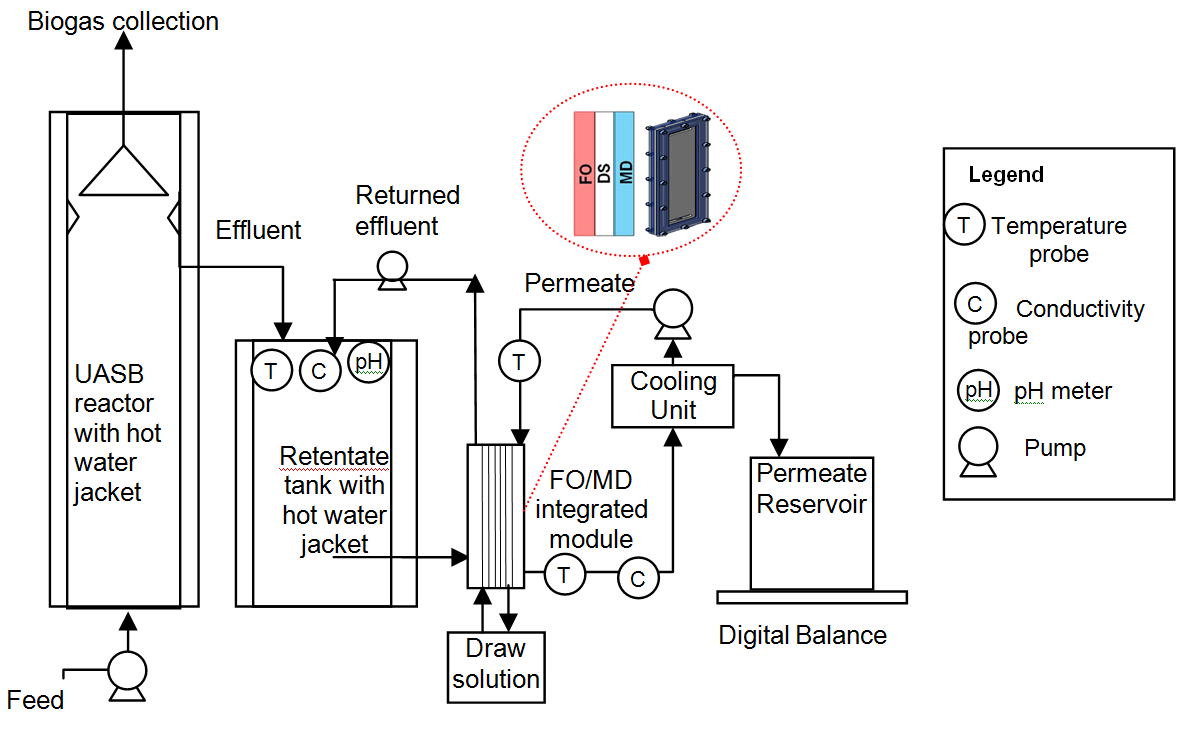
Figure 1 Schematic diagram of side-stream UASB-FO/MD system
In conclusion, the integrated process of combining the anaerobic bioprocess with the FO/MD module is a state-of-art technology and a viable alternative to wastewater reclamation. This technology appears to be particularly well suited for high-strength industrial waste streams reclamation due to the potential to achieve high quality water product with lower energy consumption and higher methane production.
Keywords: Thermophilic, Upflow Anaerobic Sludge Blanket (UASB), Forward Osmosis (FO), Membrane Distillation (MD), FO/MD integrated module
See more of this Group/Topical: Environmental Division