
 Google
 Yelp
 Facebook
 Twitter
 ChEnected
313473 Synthesis of Poly(N-vinyl-2-pyrrolidone)/Poly(N-isopropylacrylamide-co-acrylic acid) Colloidosomes Using UV Crosslinking
Abstract: As a kind of microcapsules with the shell consisting of packed colloidal particles [1], colloidosomes have currently attracted considerable attention because of their promising applications in the field of medicine [2] and biotechnology [3]. Colloidosomes are usually obtained by 'locking' the colloidal particles or microgels in Pickering emulsion together by appropriate technologies. With continued research, a fast and biocompatible method is required in the application. UV crosslinking is a desirable method to lock the interfacial particles in Pickering emulsion. [4] However, the photo-crosslinkable microgels are usually obtained through the introduction of a photo-responsive comonomer into the polymer network which will change the structure of polymers and cause side effects.
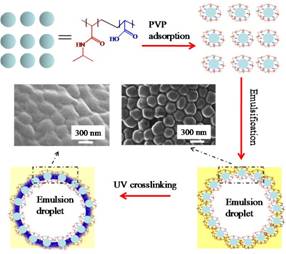
In this work, photo-crosslinkable microgels were prepared via photo-responsive polymer coating for colloidosomes preparation. As depicted in Fig. 1, Poly(N-isopropylacrylamide-co-acrylic acid) (P(NIPAM-co-AAc)) was chosen as a template microgel. Photo-crosslinkable Poly(N-vinyl-2-pyrrolidone) (PVP) [5] layer was formed on the microgel surface via electrostatic adsorption. The PVP/P(NIPAM-co-AAc) composite microgels dispersion was mixed with an oil phase to get the Pickering emulsion. The microgels dispersed at liquid/liquid interface owing to their stabilizing effect. After UV irradiation, the microgels were crosslinked together resulting in the formation of colloidosomes. Photo-responsive comonomer or/and chemical crosslinkers are not essential when the photo-crosslinkable PVP was used in our system. Thus, the proposed method could avoid the possible side effects associated with the addition of photo-responsive comonomer. Furthermore, the biocompatible polymer PVP layer would improve the biocompatibility of the microgels and the performance of colloidosome in applications such as cell encapsulation and drug controlled delivery. This novel colloidosomes will give promise in biotechnology and the synthesis will provide significant contributions to colloidosomes preparation.
|
|
|
Fig. 1 Illustration of the synthesis of colloidosomes.
| Fig. 2 SEM of the P(NIPAM-co-AAc) microgels (a) and relationship between the hydrodynamic diameter of the microgels and the reaction time (b). TEM of the P(NIPAM-co-AAc) microgels before (c) and after (d) PVP coating.
| Fig. 3 Effect of the amount of toluene used in the preparation on the yield of colloidosomes (a) and the average diameter of the obtained colloidosomes (b).
|
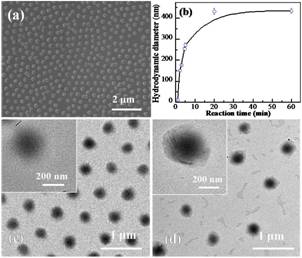
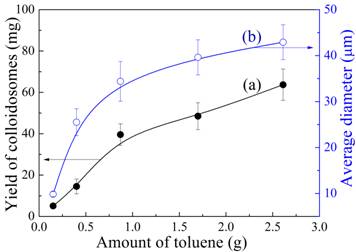
As shown in Fig. 2, uniform P(NIPAM-co-AAc) microgels were first prepared by precipitation polymerization. The mean size of the as-prepared microgels can be controlled by adjusting the reaction time. A photo-crosslinkable PVP layer was then coated on the surface of microgels via electrostatic adsorption. The Pickering emulsion was further fabricated based on the resulting microgels. The toluene/water emulsion was verified by confocal laser scanning microscopy (CLSM). The emulsion was exposed to UV irradiation leading to the formation of colloidosomes. Since only the microgels on the surface of emulsion droplets could be crosslinked by UV irradiation, the yield and the mean size of colloidosomes can be controlled by the amount of toluene used in the preparation (as shown in Fig. 3 ).
Keywords: PVP; P(NIPAM-co-AAc); Microgels; Pickering emulsion; UV crosslinking
References
[1] Lee, D.; Weitz, D. A. Adv. Mater., 2008; 20: 3498-3503.
[2] Shilpi, S.; Jain, A.;Gupta, Y.; Jain, S. K. Crit. Rev. Ther. Drug, 2007; 24: 361-391.
[3] Eze, N. A.; Milam, V. T. Soft Matter, 2013; 9: 2403-2411.
[4] van Rijn, P.; Mougin, N. C.; Franke, D.;Park, H.;Böker, A. Chem. Commun., 2011; 47: 8376-8378.
[5] Zhang, Q. G.; Hu, W. W.; Zhu, A. M.; Liu, Q. L. RSC Adv., 2013; 3: 1855-1861.
See more of this Group/Topical: Materials Engineering and Sciences Division