
 Google
 Yelp
 Facebook
 Twitter
 ChEnected
314936 Peptide Nucleic Acid-Mediated Aggregation of Graphene Oxides and Applications in Detection of DNA Mutations
Peptide nucleic acid-mediated aggregation of graphene oxides and applications in detection of DNA mutations
Taegyeong Kanga, Cheolsang Yoona, Hyungjoon Jeona, Bumsang Kimb, Kyong-Ah Yoonc, and Kangtaek Leea,*
a Department of Chemical and Biomolecular Engineering, Yonsei University, Seoul, Republic of Korea
b Department of Chemical Engineering, Hongik University, Seoul, Republic of Korea
c National Cancer Center, Goyang, Gyeonggi, Republic of Korea
Over the past several years, graphene oxides (GO) has been extensively studied due to its unique properties and potential applications in many fields. Recently, it is found that GO can be folded and aggregated under certain conditions. Herein, we report a simple method to induce aggregation of GOs in aqueous solution using the peptide nucleic acid (PNA). It is well known that single-stranded DNAs can easily adsorb onto the GO surface by non-covalent Ąg-Ąg stacking interactions. Therefore, addition of PNA that is a DNA analogue with a neutral polyamide backbone into the GO suspensions is expected to result in adsorption of PNA on the surface of GO, which leads to destabilization and aggregation of GOs. We have investigated aggregation of GOs using optical microscopy, TEM, and quasi-elastic light scattering. Furthermore, PNA-mediated selective aggregation of GO was applied to detect mutations in DNA sequence by using PNA as probe. Using this method, we could successfully detect mutations in DNA samples with high selectivity and sensitivity.
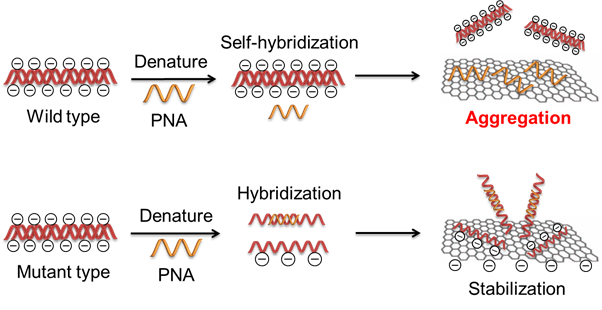
Figure 1. Schematics of PNA-mediated selective aggregation of graphene oxides
See more of this Group/Topical: Nanoscale Science and Engineering Forum