
 Google
 Yelp
 Facebook
 Twitter
 ChEnected
315015 Coupling Online NMR Spectroscopy With Micro-Reaction Technology: A New Way for Quantitative Studies of Fast Reaction Kinetics in Technical Systems
INTRODUCTION
NMR spectroscopy offers unmatched structural information of complex fluid mixtures. Simultaneously, a quantification of all investigated species is possible without previous calibration, which, in contrast to optical spectroscopy, enables an easy access to reaction kinetics and even allows the identification of unknown species, e.g. side- or intermediate products. The method has a high resolution and allows chemically similar compounds to be resolved. It is useful both for equilibrium and kinetic studies. Hence, NMR spectroscopy is a powerful tool for reaction engineering investigations. It is particularly suited for studies of complex reaction networks with intermediates that cannot be isolated [1,2]. Nevertheless, the potential of the method has not yet been fully taken advantage of.
In the present contribution, methods are presented that allow studying complex reaction networks with NMR spectroscopy under industrially relevant conditions. Recent advances in this field were achieved by coupling micro-reaction technology with flow NMR spectroscopy. This led to the development of a new probe head that enables studying fast reaction kinetics with this favorable spectroscopic method.
COUPLING REACTORS WITH NMR SPECTROSCOPY
NMR flow probes can be directly coupled to conventional reactors. The sample is pumped from the reactor to the NMR flow probe head where the composition of the mixtures is monitored. Pressure resistant and thermostated lines can be used to ensure that neither composition nor pressure nor temperature is changed upon analysis. The method is therefore especially advantageous when the mixture contains intermediates which cannot be isolated and have to be analyzed in situ. Different economically important reaction networks from industrial organic chemistry have successfully been studied in this way. Due to limitations of the speed of the sample transfer from the reactor to the NMR probe, the set-up with external reactors is not applicable for kinetic suites of reactions with time constants below 5-10 minutes.
COUPLING MICRO-REACTION TECHNOLOGY WITH NMR SPECTROSCOPY
In order to enable investigations of fast reactions with online NMR spectroscopy a new NMR probe head was developed in co-operation with the Mainz Institute of Microtechnology, Germany (IMM) and the University of Tübingen, Germany. A thermostated micro-mixer was mounted directly in the NMR probe head and was coupled with a capillary NMR flow probe with a solenoidal coil design. The combination leads to a massive reduction of the residence time between the micro-mixer and the probe. Thus, reactions with time constants of only seconds can be studied with this technique.
A pulsation free continuous flow of the reactants through the micro-mixer and the probe is provided by two syringe pumps. The new probe head can be used in a stationary flow- or an instationary stop-flow mode. In the flow mode, the reaction time between the mixing and the detection is adjusted by setting the flow rates of the reactants. In the stop-flow mode the reactants are mixed and transferred to the probe at the maximal flow rate. Then, the flow is stopped and the probe acts as an instationary reactor in which spectra are acquired at predefined time intervals throughout the reaction.
A focus of the development was put on thermal management. Isothermal conditions even for strongly exothermic or endothermic reactions are guaranteed by liquid tempering of the whole flow path of the reactants. The applicability of the novel NMR probe head for monitoring fast reactions was proven in different test studies. The new micro-mixer based probe head design is a breakthrough in online monitoring of fast reactions with NMR spectroscopy.
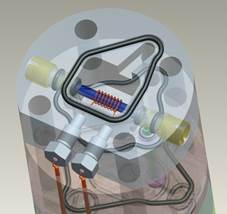
Figure 1: CAD drawing of the novel probe micro-mixer NMR head
REFERENCES
[1] M. Maiwald, H. Fischer, Y. K. Kim, K. Albert, H. Hasse: J. Magn. Res. 166, (2004), 135-146.
[2] E. J. Kibrik, O. Steinhof, G. Scherr, W. R. Thiel, H. Hasse: J. Appl. Polym. Sci. 128, (2013), 3957-3963.
See more of this Group/Topical: Catalysis and Reaction Engineering Division