
 Google
 Yelp
 Facebook
 Twitter
 ChEnected
315027 Shortcoming of Feasibility Analysis Methods for Reactive Distillation Processes
Shortcoming of Feasibility Analysis Methods for Reactive Distillation Processes
Reactive distillation process is a highly integrated unit operation and has shown its significant advantages in chemical industry due to the combination of reaction with distillation separation (Sharma and Mahajani, 2003). So far, a lot of works have been carried out for the purpose of both fundamental understanding and industrial application of the reactive distillation. Generally, the coupled kinetic-thermodynamic feasibility analysis is the first step to develop a new reactive distillation process (Almeida-Rivera et al., 2004; Gadewar et al., 2004; Malone and Doherty, 2000). The main reason is that it is considered to be helpful to decide the theoretical feasibility of the process and provide necessary information for further conceptual design and experimental verification if the process is feasible (Subawalla and Fair, 1999; Tang et al., 2005). With regard to the importance of feasibility analysis, various models with different simplifications and abstractions of real reactive distillation processes have been proposed and developed to acquire as much as possible information, for example, the continuous multiphase reactor model, the reactive flash-cascade model and the singular point equations established by Qi et al. (2004).
An important aim of this work is to evaluate the effect of results from feasibility analyses on the design of reactive distillation processes. For a non-reactive distillation process, it has been recognized that feasibility analysis methods can give the discharge composition of distillation column with an infinite separation power. The information on the maximum separation degree is very helpful to determine the feasibility of distillation separation and further design the distillation process. However, there is no systematic discussion on whether feasibility analysis methods can predict the maximum separation degree of a real reactive distillation process or not.
For this purpose, a infinity/infinity analysis method for reactive distillation processes is established in this work to calculate the maximum separation degree of a reactive distillation process. Eqs. (1-3) for the infinity/infinity analysis are obtained after mathematic simplifications of the mass and enthalpy balance equations of a reactive distillation column. With phase equilibrium equations and relationships between flow rates, they could be employed to calculate the discharge composition at the top and bottom.
 (1)
 (2≤n≤N-1) (2)
 (3)
Because the vapor flow rate Vn in the above equations should keep unchanged to meet both of the enthalpy balance and overall mass balance equations, the Damköhler number Dacol,n,j=kf,jmcat,n/Vn can be a constant as the only parameter required in the infinity/infinity analysis when the catalyst amount mcat,n on every reactive tray is the same. It is an important feature of this method developed in this work, which can provide reasonable comparison with the feasibility analysis models.
In order to compare with the infinity/infinity analysis method with single mole-based parameter, the reactive flash-cascade model presented in Chadda et al.'s work (2001), which used a mass-based vapor fraction as one of two parameters for the non-equimolar reaction case, needs to be rebuilt by one only mole-based parameter. Eqs. (4) and (5) are the fixed-point equations of the rebuilt reactive flash-cascade model with Das,n,j=kf,jmcat,n/Vn and Dar,n,j=kf,jmcat,n/(Vn-1-Vn) (for convenience the subscript 'n' has been removed).
 (4)
 (5)
The condition to determine whether the reactive flash-cascade model can predict the maximum separation degree of a real reactive distillation process or not could be further derived by comparison among Eqs. (1-5). Firstly, assumed that the feasibility analysis method can predict the maximum separation degree achieved through distillation for a certain reactive system, it suggests that the possible discharge composition at the column bottom should meet both of Eq. (1) from the infinity/infinity analysis method and Eq. (4) from the feasibility analysis method (because the infinity/infinity analysis method can always give the maximum for any reactive system). The two equations are rewritten with the new subscript under a fixed Damköhler number,
 (6)
 (7)
Because 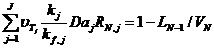 is always
less than 1 on the basis of the mass balance equations of reactive distillation
column, a relation xi,N-1=xi,N=xi can be obtained from
subtracting Eq. (6) and Eq. (7). It suggests that the compositions on the last
tray and the reboiler from the infinity/infinity analysis for the reactive
system should be the same. According to the relation and the mass balance
equations in the infinity/infinity analysis, another equality xi,N-2=xi,N-1=xi
should also hold true for the compositions from the infinity/infinity analysis.
In this case, Eqs. (1) and (2) from the infinity/infinity analysis method can
be simplified to Eqs. (8) and (9) (the subscript 'N' in these equations has
removed for convenience).
 (8)
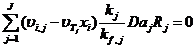 (9)
Furthermore, Eq. (10) is derived. The same equation describing the characteristics of singular points at column top can also be drawn from Eq. (3) in the infinity/infinity analysis method and Eq. (5) in the feasibility analysis method.
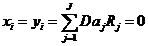 (10)
Eq. (10) states that it is nearly impossible that the composition point predicted by the reactive flash-cascade model appears at the bottom or top of the reactive distillation column with an infinite separation power when it is not a pure component or a common azeotrope under chemical equilibrium. In this situation, it is more likely to appear in the reactive distillation column with a specific separation power and feeding way. In other words, the reactive flash-cascade model shows a shortcoming with regard to predicting a too low separation degree.
Although this conclusion is obtained by the only comparison between the reactive flash-cascade model and the infinity/infinity analysis method, it still applies to other feasibility analysis methods, for example, Qi et al.'s method (2004), where the composition equation of singular points at column bottom has the same form with Eq. (1). However, the discharge composition of column top need be calculated by Eq. (11) with the different form from Eq. (2). In Eq. (11), DaREACL,,j= kf,jmcat/L.
 (11)
In order to determine whether Qi et al.'s method has the same shortcoming referred above or not, the mathematic relationship between the results from the Qi et al.'s model and reactive flash-cascade model needs to be established at first. In modeling the rectifying section of reactive flash-cascade, the mass balance equations can be simplified by two different ways. As the result of the other simplification, Eq. (12) can also be used to calculate the possible discharge composition at column top, where Da*r,n,j=kf,jmcat,n/Ln. It has the same equation form with Eq. (11), which indicates that the two equations with the same parameter value could have the same calculated results.
 (12)
The
relationship between Dar,n,j in Eq. (5) and Da*r,n,j
in Eq. (12) can be determined on the basis of the relation 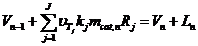 from the mass balance of
the rectifying section:
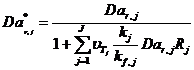 . This relationship indicates that Qi
et al.'s method can predict the same discharge composition at column top to the
reactive flash-cascade model when the parameters in these two methods meet Eq.
(13).
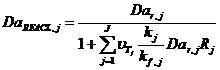 (13)
These analyses suggest that the compositions of singular points predicted by the two different feasibility analysis models should have the same changing path with the increase of Da and the difference between results from the two models is only from the different definitions of the model parameter Da. Furthermore, it is obviously that Qi et al.'s method also has the same shortcoming with regard to predicting the discharge composition point with a too low separation degree.
Although
the shortcoming of feasibility analysis methods suggests the less help to
determine the feasibility of reactive distillation processes, especially the
feeding ratio of reactants, the inconsistence between the results from the two
types of analysis methods indicates that the separation degree predicted by
feasibility analysis methods is hopeful to be broken through in a real reactive
distillation column by higher reflux ratio or more theoretical plates. For the etherification
of cyclohexene as a ternary reactive system, the feasibility analysis indicates
that the stable singular point of the column top is always the ternary mixture containing
the product (cyclohexyl
formate)
at  . However, the rigorous design
work of Katariya et al. (2009) indicated that the product barely
exists in the top discharge under total reflux that means the infinite separation
power.
See more of this Group/Topical: Computing and Systems Technology Division