
 Google
 Yelp
 Facebook
 Twitter
 ChEnected
315060 Multiscale Description of Transport and Reaction in Coated Catalyst Layers
The coated catalytic layer In standard 1D+1D models of monolith channel, is
usually treated as homogeneous, with transport properties represented by
effective diffusivity [1]. This effective diffusivity is typically calculated
from random pore model [2] that considers contribution of both small
micro/mesopores (intrinsic nanostructure of the used material) and larger
macropores (inter-particle structure influenced by the coating procedure). In
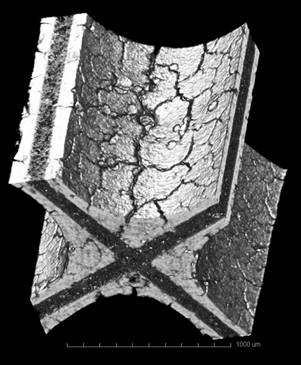
reality, however, the coated layer may contain additional cracks and cavities
(Fig. 1). These structural defects can enhance effective diffusivity in
the layer and improve the performance of the catalyst, so that their occurrence
is beneficial as long as the adhesion and mechanical durability of the layer is
preserved. In this contribution we apply novel experimental and computational methods
to investigate the contribution of cracks and cavities to diffusion in
catalytic coatings. A sample of commercial catalytic monolith for automotive
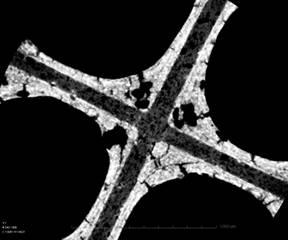
exhaust gas aftertreatment is scanned by X-ray computer microtomograph (µCT) to obtain realistic 3D
images of the coated layer (Fig. 1). Spatially 3D diffusion is then
simulated within a section of the reconstructed porous structure, using a
validated methodology [3,4,5,6]. Additional simulations are performed for the
model coating without any cracks or cavities (i.e., containing only standard
meso- and macro-pores). By comparison of the simulation results, the
contribution of cracks and cavities to transport characteristics of the layer
is quantified. The evaluated effective diffusivities are compared with
random-pore model approximations [2], and further utilized in multi-scale
simulations of combined reaction and transport [3] that reveal the impact of
transport effect on overall performance of the monolith reactor. The proposed combination of advanced 3D structural analysis technique and
detailed modeling approach significantly extends the level of detail in
understanding the internal transport effects in catalytic coatings of
monoliths.
Fig. 1. 3D
reconstruction of catalytic coating in commercial monolith with square channels
(CLEERS research community [7] reference commercial catalyst LNT BMW 120i
model year 2009) – sections around the channel corner are shown. Monolith
substrate is displayed as dark grey, catalytic coating is bright, and black
color corresponds to void space (pores, cavities and cracks). The sample
scanned by X-ray computer microtomograph (µCT). Acknowledgements This work has been financially supported by the Czech Science
Foundation (GACR P106/10/1568). The X-ray microtomography scans and 3D
reconstruction results were obtained within the CENTEM project
CZ.1.05/2.1.00/03.0088, co-funded by the European Research Development Fund as
part of the Czech Ministry of Education, Youth and Sports' OP RDI programme.
The work was further supported by the project LH 12086 of the Czech Ministry of
Education, Youth and Sports. References [1] Güthenke A., Chatterjee D., Weibel M.,
Krutzsch B., Kočí P., Marek M., Nova I., Tronconi E., Current status of
modelling lean exhaust gas aftertreatment catalysts, Advances in Chemical
Engineering 33 (2007), 103-211. [2] Wakao N., Smith J.M., Diffusion in
catalyst pellets, Chemical Engineering Science 17 (1962),
825-834. [3] Kočí P., Novák V., Štěpánek F., Marek M., Kubíček M.
Multi-scale modelling of reaction and transport in porous catalysts. Chemical
Engineering Science 65 (2010), 412-419. [4]
Novák
V., Štěpánek F., Kočí P., Marek M. Evaluation of local pore sizes and transport
properties in porous catalysts. Chemical Engineering Science 65
(2010), 2352-2360. [5] Novák V., Kočí P., Marek M., Štěpánek F.,
Blanco-García P., Jones G. Multi-scale modelling and measurements of diffusion
through porous catalytic coatings: An application to exhaust gas oxidation. Catalysis
Today 188 (2012), 62-69. [6] http://www.vscht.cz/monolith
See more of this Group/Topical: Catalysis and Reaction Engineering Division