
 Google
 Yelp
 Facebook
 Twitter
 ChEnected
315827 Heterogeneous Chlorine Chemistry in the Atmosphere: Insights From Modeling and Experiments
Heterogeneous Chlorine Chemistry in the Atmosphere: Insights from Modeling and Experiments.
Background
To date, numerous studies using both computational and experimental methods have shown that the presence of gas phase atomic chlorine radicals (Cl•) can influence tropospheric photochemistry. Specifically, Cl• participates in the ozone production cycle in a manner analogous to the hydroxyl radical (OH•), and elevated concentrations can lead to increases in ozone production rates. Cl• radicals are produced from the photolysis of a gas phase precursor such as Cl2 or HOCl. Impacts on ozone production resulting from anthropogenic point source emissions of these gas phase Cl• precursors tend to be highly localized due to rapid rates of photolysis during the day.
Aside from direct emission from anthropogenic sources, gas phase chlorine species can be produced through heterogeneous mechanisms involving chloride aerosols. One such species is nitryl chloride (ClNO2), which was initially observed in ambient air in 2006 during a study along the Gulf Coast of the U.S. Additional observations have also been made in Boulder, CO, Alberta, Canada and off the coast of California, near the Los Angeles Basin. Multiple studies investigating ClNO2 production have determined that the responsible mechanism is the reactive uptake of N2O5 onto aqueous chloride aerosols. N2O5, which is formed from the gas phase reaction between NO2 and NO3, photolyzes rapidly and therefore only builds up to significant concentrations at night. The nocturnal conversion of N2O5 into ClNO2 results in the rapid production of Cl• when ClNO2 photolyzes at sunrise. Through gas phase reactions initiated by Cl•, this can increase the rate of oxidation for volatile organic compounds (VOCs) and thus increase the rate of ozone production. The heterogeneous uptake and dissociation of N2O5 has been determined to be the rate limiting step, and the full mechanism is shown below.
NO2,g + NO3,g ↔ N2O5,g (1)
N2O5,g ↔ N2O5,aq (2)
N2O5,aq ↔ NO2+aq + NO3-aq (3)
NO2+aq + H2Oaq → H3O+aq + HNO3aq (4a)
NO2+aq + Cl- → ClNO2 + H2Oaq (4b)
NO3-aq + H+ ↔ HNO3+aq (5)
Another heterogeneous mechanism of interest involves the production of Cl2 from chloride aerosol particles. Previous studies have suggested a direct reaction between O3 and particulate chloride. Other studies have suggested a surface reaction between particulate chloride and OH•. These mechanisms were formulated in response to experimental observations of gas phase Cl2 when aqueous NaCl and O3 were present together. The reaction has been reported to occur both in the presence of light as well as in the dark. The mechanism for the reaction between OH• and particulate chloride can be represented as follows, where 2OH•••Cl- represents an intermediate species that forms at the particle surface.
OHg + Cl•-aq,surface → OH•••Cl•-aq,surface (6)
2OH•••Cl-aq,surface → Cl2,g + 2OH-aq (7)
Cl2 concentrations up to 150 pptv have been detected in marine air at night, suggesting a nocturnal 330 pptv day-1 Cl2 source. Additionally, detection of Cl2 in both coastal marine and coastal urban air has been reported. Therefore, the determination of an exact mechanism and quantification of the rate would be useful in predicting the impact Cl2 production from chloride aerosols on tropospheric chemistry. This is particularly relevant in coastal regions where chloride particles are typically present in large quantities. The mechanism involved in reactions 6 – 7 is the focus of the experimental results presented here.
Methods and Discussion
This work presents both computational and experimental investigation of the heterogeneous processes described above. An overview of a sensitivity analysis of the physical parameters involved in the mechanism described by reactions 1 – 5 will be discussed. The parameters investigated in the analysis include the reactive uptake coefficient, ClNO2 yield, particle surface area, and gas phase concentrations of VOCs and NOx. The sensitivity analysis was carried out through photochemical box modeling using the SAPRC software and the Carbon Bond 5 mechanism. The focus of this sensitivity analysis was on the effects of variations in parameter values on the production of ClNO2 and subsequent impacts on ozone production. The results obtained from simulations using various parameter value combinations were compared to a base case modeling scenario in which all heterogeneous reactions were absent. In order to quantify differences in O3 production, the peak O3 concentration from each simulation was used as a point of comparison. An analysis of parameter values reaching the upper limits reported by the literature was undertaken.
Results from the sensitivity analysis indicate that ClNO2 chemistry can potentially change peak O3 concentrations by -10.5% – 27%. The availability of NOx was found to play an important role. The presence of additional NOx during nocturnal hours resulted in greater production of N2O5 and thus higher concentrations of ClNO2. However, NOx emissions after sunrise reduced the impact of N2O5-ClNO2 chemistry on O3 production. Additionally, the presence of large concentrations of VOCs that are highly reactive with the NO3 radical significantly reduced the impact of N2O5-ClNO2 chemistry on ozone production. Figure 1 shows the combined influence of variations in the reactive uptake (γ) and ClNO2 yield (YClNO2) on peak ozone concentrations as compared to the base case scenario. Further discussion of details on the impacts of ClNO2 chemistry with respect to O3 production and NOx cycling within the atmosphere will be included in the presentation.
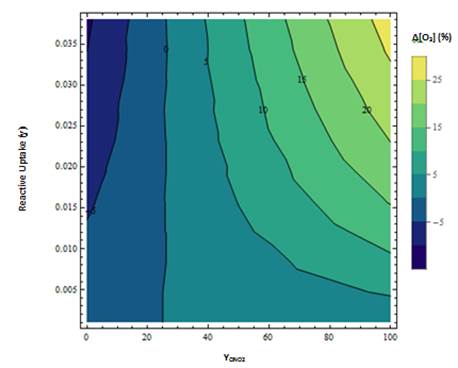
Figure 1: Percentage peak O3 increases in over the base case scenario (no heterogeneous reactions) for various combinations of the ClNO2 yield and reactive uptake parameter values.
Experimental work investigating the heterogeneous mechanism described in reactions 6 – 7 will also be covered. Specifically, results from environmental chamber experiments involving the exposure of NaCl aerosol particles to various gas mixtures representative of conditions present in the atmosphere, including HOx, NOx and O3 will be presented. Experiments were carried out in a 10 m3 reaction chamber equipped with UV lights which induce photochemistry. Chemical Ionization Mass Spectrometry (CI-MS) utilizing iodide as the reagent ion was used to quantify and identify gas phase species produced by the mechanism. Aerosol population size distributions were monitored using a Scanning Electrical Mobility System (SEMS).
Experiments were carried out by generating and injecting NaCl aerosol particles into the chamber along with photolytic precursors of the hydroxyl radical. The mixture was then exposed to UV radiation in order to initiate photochemistry and hydroxyl radical production. Resulting gas phase Cl2 concentrations were monitored using iodide CI-MS. Various initial conditions were used to test the impact of several factors on the overall efficiency of the mechanism in producing gas phase chlorine. One factor is the impact of variations in relative humidity levels on the efficacy of the mechanism. Another factor is the variation of the composition of the bulk aerosol. The impact of the presence or absence of elevated O3 concentrations is also examined. Resulting variations in overall Cl2 production due to these factors will be compared and discussed.
See more of this Group/Topical: Environmental Division