
 Google
 Yelp
 Facebook
 Twitter
 ChEnected
316959 Development of Bench-Scaled Adsorption Type Steam Recovery System for Generating High Temperature Steam From Hot Waste Water
The efforts for energy conservation are requested because of the limitation of fossil fuel and the environmental issue of global warming. Petrochemical and Steel industries are especially the largest energy-consuming manufacturing industries. While large amount of hot waste water with the range of 60-90 degree C is released from these industrial processes, steam is demanded and large quantities of fossil fuel are generally consumed. The system to generate steam from low-grade waste heat is therefore required for the effective utilization of energy.
In this study, a novel steam generation process using a direct heat exchange system with adsorbent-water pair is proposed. Contacting water with adsorbent makes excess water evaporate due to the release of adsorption heat from adsorbent. Because this system does not require any heat exchangers, increment in packing density of adsorbent particles in the reactor is expected. The purpose of this study is to investigate the novel steam generation system using adsorbent-water pair. Cycle operation which consists of steam generation process and regeneration process of this system has been studied experimentally and numerically using laboratory-scaled equipments of steam generator for 0.3 kg-adsorbent/unit. Based on this basic study, bench-scaled adsorption type steam recovery system of the steam generators for 10-15 kg-adsorbent/unit were manufactured. Operation condition of the steam generation process and the regeneration process of this system was investigated using bench-scaled equipment of one steam generator. And more, continuous steam generation operation was examined using this equipment of the three generator units.
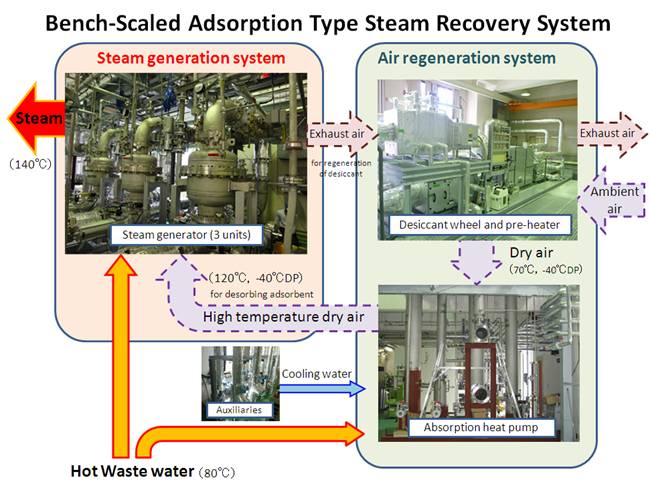
The bench-scaled adsorption type steam recovery system is composed of steam generation system, air regeneration system, and their auxiliaries. The steam generation system is composed of cylindrical steam generators, a feeding pump of water, a vacuum pump, a compressor of air, and a water tank for hot water. The steam generator was made of stainless steel with the height of 565 mm and the inner diameter of 498 mm. As the adsorbent, zeolite pellet was packed into the steam generator for 10-15kg/unit. The air regeneration system produced high temperature dry air for desorbing zeolite pellet at the regeneration process. The air regeneration system is composed of a blower, a desiccant wheel, a pre-heater, and LiBr/H2O absorption heat pump to heat up dry air.
First, operation conditions of the steam generation process and the regeneration process were confirmed experimentally using the bench-scaled equipment of one steam generator. In the steam generation process, air in the steam generator was removed by the vacuum pump. Hot water of 80 degree C was introduced to the steam generator from the water tank by the feeding pump. Steam was then generated by adsorption heat. The steam generation process was terminated when water interface reached the top of packed bed of zeolite pellet. At the last, remained water was drained from the bottom of the steam generator by compressed air from the compressor. After the steam generation process, it is changed to the regeneration process. High temperature dry air at 1050 Nm3/h was introduced to the generator for 1200 sec. The high temperature dry air with dew point of -40 degree C was produced from ambient air by the desiccant wheel. The high temperature dry air was heated up to 70 degree C by the pre-heater, and more, heated up to 125 degree C by the LiBr/H2O absorption heat pump. As results of those processes, superheated steam whose temperature was 200 degree C and pressure was 0.27 MPa was generated from the hot water at 80 degree C. The peak temperature in the packed bed reached 260 degree C. The mass of steam generated per unit mass of zeolite was 0.09 kg-steam/kg-zeolite/cycle.
After that, Cycle operation condition for continuous steam generation was confirmed using the bench-scaled equipment of the three generator units. Steam was by turns in the three generators (unit A, B, C). The steam generation process time and the regeneration process time were decided to be 600 sec and 1200 sec, respectively. For example, when the unit A was operating at the steam generation process, the unit B and C were operating at the regeneration process. After 600 sec, the unit B was turned to the steam generation process, and then unit C and A were operating at the regeneration process. Furthermore, after 600 sec, the unit C was turned to the steam generation process. By the experimental result, the generated steam whose temperature was 125-155 degree C and pressure was 0.25-0.55 MPa (140 degree C and 0.4MPa on the average) was obtained continuously from the three generator units.
This work was supported by Research and Development Program for Innovative Energy Efficiency Technology under the New Energy and Industrial Technology Development Organization (NEDO) project based on a grant from METI.
See more of this Group/Topical: Sustainable Engineering Forum