
 Google
 Yelp
 Facebook
 Twitter
 ChEnected
317009 Application of DEM Simulations and Experimental Studies to Improve the Uniformity of An Active Coating Process
Introduction: Pan coating is commonly used to apply a functional layer to tablet cores. Tablets are placed in a rotating drum, and a coating liquid is sprayed onto the moving tablet bed. For most applications, the uniformity of coating (the equal distribution of coating over a single tablet and/or between different tablets of a batch) is of great importance. This necessitates a high degree of process understanding. A number of investigations were done both experimentally [1] and in recent years also computationally using the Discrete Element Method (DEM) [2], [3].
Objective: In this work, the application of an active coating was investigated: Gastrointestinal therapeutic systems (Adalat® GITS, Bayer Pharma AG, Germany) were coated with an aqueous suspension containing candesartan cilexetil as active pharmaceutical ingredient (API). As the variation of this API between tablets has to be small, a high inter-tablet coating mass uniformity is vital. The central aim therefore was to improve the inter-tablet coating uniformity.
Methods: To study how different process parameters influence the uniformity, both experiments and DEM simulations were performed. A lab pan coater (BFC 5, L.B. Bohle, Germany) with two or four spray nozzles (Düsen Schlick GmbH, Germany) was used. The process parameters were set according to the same statistical plan in experiments and simulations. The results of both are compared, and guidelines for optimization are extracted.
-- Experiments: The factors pan load, pan speed, and spray rate were investigated in two 23 full factorial DoEs with three centre points. For each DoE, either two or four spray nozzles were used. The response variable was the coefficient of variation (CoV) of the API amount in the coating layer at the coating endpoint. To get the API amount, 20 active coated tablets per trial run sampled at the endpoint were analysed by HPLC (Elite La Chrom, VWR Hitachi, Germany).
-- Simulation: The Discrete Element Method (DEM) simulations were done using commercial software (EDEM 2.4, DEM Solutions, UK). The geometry of the coating apparatus was provided by the manufacturer. The material properties came from measurements [4]. Two methods for the modelling of a spray in DEM simulations were used (during run-time and in post-processing). They gave detailed information on the spray process, such as the coating mass of each tablet or the cycle and spray zone residence times.
Two 23 full factorial DoE (the same as in the experiments) were performed; for each run 90 seconds of process time were simulated. The response variable was the CoV calculated from the individual coating mass on the tablets. Further, additional simulations were done to provide more data points and to study the impact of e.g. axial tilt or spray nozzle setup.
Results & Conclusion: In the presented work, DEM simulations and experiments were performed to investigate active coating. The results are compared, and the insights concerning the optimization of uniformity are presented. For a deeper understanding, the outcome is also interpreted in the light of known analytic expressions for e.g. the time development of coating uniformity (cf. Fig. 1). It was possible to decrease the variation between tablets to values well below 6% as required from regulatory authorities, and to reduce the total process time.
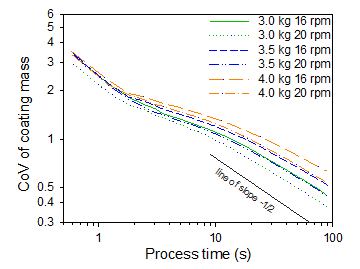
Figure 1: CoV of coating mass with increasing time for different process parameter settings from the DEM simulations. Random mixing models predict a decrease inversely proportional to the square root of coating time. (line of slope of -1/2 in the figure). After ~10 seconds, tablet movement is randomized, and the DEM results agree well with model expression.
References
[1] D. Brock, J. A. Zeitler, A. Funke, K. Knop, and P. Kleinebudde, “A comparison of quality control methods for active coating processes.,” International Journal of Pharmaceutics, vol. 439, no. 1–2, pp. 289–95, Dec. 2012.
[2] B. Freireich, J. Li, J. Litster, and C. Wassgren, “Incorporating particle flow information from discrete element simulations in population balance models of mixer-coaters,” Chemical Engineering Science, vol. 66, no. 16, pp. 3592–3604, 2011.
[3] A. Dubey, F. Boukouvala, G. Keyvan, R. Hsia, K. Saranteas, D. Brone, T. Misra, M. G. Ierapetritou, and F. J. Muzzio, “Improvement of tablet coating uniformity using a quality by design approach.,” AAPS PharmSciTech, vol. 13, no. 1, pp. 231–246, Mar. 2012.
[4] S. Just, G. Toschkoff, A. Funke, D. Djuric, G. Scharrer, J. G. Khinast, K. Knop, and P. Kleinebudde, “Experimental Analysis of Tablet Properties for Discrete Element Modeling of an Active Coating Process,” AAPS PharmSciTech, 2013.
See more of this Group/Topical: Particle Technology Forum