
 Google
 Yelp
 Facebook
 Twitter
 ChEnected
317069 Experimental Investigation to Characterize the Influence of Single Components On a Complex Multicomponent Liquid-Liquid-Equilibrium
The most commonly used separation process in chemical industry is distillation, followed by liquid-liquid-extraction. In general, the separation process can be modeled using the equilibrium method. While vapor-liquid-equilibria (VLE) are the basis for distillation processes, extractive separations can be described using liquid-liquid-equilibria (LLE). The NRTL-equations are a common model used to account for the real behavior of the respective liquid phases by activity coefficients. Experimentally determined binary interaction parameters are commonly used to describe the behavior of multicomponent systems. Furthermore, predictive methods, like UNIFAC, often estimate the VLE behavior of simple mixtures with a satisfactory accuracy. The complexity increases with two liquid phases in equilibrium (VLLE or LLE). Due to strong interactions in the liquid phases, the thermodynamic modeling of such industrial relevant systems is very complex. The exact description of these systems especially when polar molecules or electrolytes are included is an enormous challenge. A theoretical or predictive behavior of such complex LLE systems often does not reflect the reality since there is a huge number of influencing parameters. In order to reduce the experimental effort, a systematic approach, based on a minimal necessary number of fundamental experiments is needed to describe such complex mixtures.
This systematic approach is required to understand the influence of every component on the thermodynamic equilibrium. The characterization of a multicomponent liquid-liquid-mixture can be realized in four steps that are schematically shown in Figure 1. In the first step the components which are forming two liquid phases have to be identified. Their binary or ternary mixing behavior has to be investigated to a sufficient extent. The second step includes the investigation of the influence of single additives on the thermodynamic equilibrium. Therefore, the respective components are added separately in different quantities to a binary or ternary model mixture in order to characterize their influence on the equilibrium by use of the partition coefficient. In the third step of the routine, the additive interactions are investigated. All relevant components are combined into a multicomponent reference system, with which the combined effect can be compared to the influence of the single components. In the fourth step, the key components that show the largest impact on the equilibrium have to be identified evaluating the results of steps one to three. The resulting reduced mixture of key components is less complex but shows equivalent characteristics compared to the real process solution including even unknown components.

Figure 1:Approach for the identification of key compounds
This practical approach is illustrated in an example where the optimization of a complex industrial process is subsequently accomplished. A liquid-liquid extraction process is the key operation of the entire process. The investigated mixture consists of water, different alkyl-pyridines, an ammonium salt, other organic nitrogen compounds and unknown components, where water has to be separated from the pyridines. In the first step, water and two alkyl-pyridines have been identified as main components. The isothermal LLE of the three main components is presented in Figure 2. Pyridine A and water form two liquid phases. The closed miscibility gap has its critical point near the water/pyridine B binary system. In the second step, components were added to model solution. The thermodynamic behavior shows a strong dependence on the species of the additives and the added amount. A correlation between the polarity of the additives and the impact on the equilibrium can be seen. Interactions between additives in a multicomponent model mixture and the process solution will be investigated in step three. Step four ends with the definition of the resulting key components. The thorough application of the systematic approach will help to optimize the extractive separation unit incorporated in this complex industrial process and to reduce the complexity of the downstream processing.
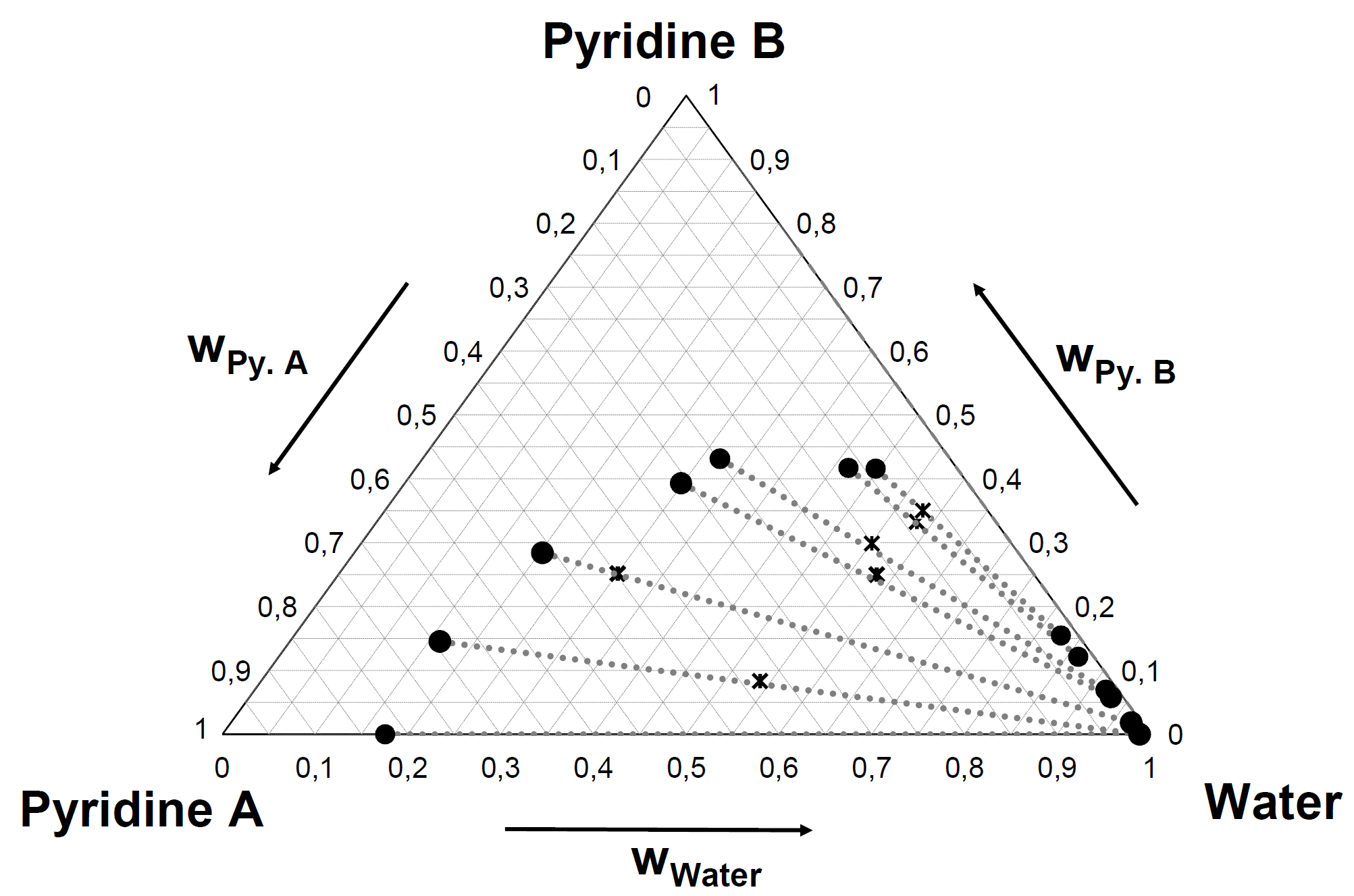
Figure 2: Ternary LLE of Pyridine A, Pyridine B and water, experimental results, T= 60°C
See more of this Group/Topical: Engineering Sciences and Fundamentals