
 Google
 Yelp
 Facebook
 Twitter
 ChEnected
317212 Use of Supported Group IB-Pd Bimetallic Catalysts Prepared By Electroless Deposition for the Selective Hydrogenation of Acetylene and 1,3-Butadiene
Use of Supported Group IB-Pd Bimetallic Catalysts Prepared by Electroless Deposition for the Selective Hydrogenation of Acetylene and 1,3-Butadiene
Yunya Zhang, Christopher T. Williams and John R. Monnier
Department of Chemical Engineering, University of South Carolina, Columbia SC 29208 USA
Ethylene is used as a starting point for many chemical intermediates in the petrochemical industry. The yearly demand for ethylene is over 150 million tons with a growth rate of 3.5% [1]. Ethylene obtained from steam cracking of higher hydrocarbons contains up to 2% acetylene, which acts as a poison for ethylene polymerization catalysts at even ppm concentrations (> 5 ppm) [2]. Thus, selective hydrogenation of acetylene to ethylene over low weight loading Pd catalysts is industrially used to purify ethylene streams. Due to inferior selectivity at high acetylene conversion and the formation of green oil during this reaction, various additives, such as Ag, Ni, Cu, Au, Pb, Tl, Cr and K have been added to Pd to improve the performance of current generation catalysts [3-6]. However, the bimetallic effects of the above additives are not yet well understood, possibly because the conventional methods of catalyst preparation (i.e., co-impregnation, successive impregnation) result in both monometallic and bimetallic particles with varying compositions. This in turn makes it difficult to determine the position of the two metallic components, since the bimetallic interaction occurs only when the two metallic components form bimetallic surface compositions instead of separate particles.
We use electroless deposition (ED) to prepare Ag- and Au-Pd/SiO2 bimetallic catalysts with controlled and proximal contact between the two metals. ED uses a controlled redox chemical reaction to deposit Ag or Au onto Pd surface from a solution containing a reducible Ag or Au salt and a reducing agent. Because the reducing agent is catalytically activated by Pd surface atoms to produce an active hydrogen species, Ag or Au is only deposited on Pd surface atoms. Since ED is kinetically controlled, the final composition of a particular bimetallic catalyst can be controlled to give rather precise combinations of the two metallic components. Our goals are not only to discuss the improvements in catalysts selectivity of acetylene to ethylene, but also to illustrate the roles of Ag and Au additives during acetylene hydrogenation. If the promoting effect of Ag or Au is to modify the electronic structure of the catalytically-active Pd component, we should expect different behavior for the Ag-Pd and Au-Pd bimetallic catalysts. On the other hand, if Ag or Au only dilutes the Pd surface into different ensemble sizes that change the adsorption modes of acetylene on Pd to allow the hydrogenation of acetylene to ethylene and not ethylene to ethane, Ag-Pd and Au-Pd bimetallic catalysts should behave similarly.
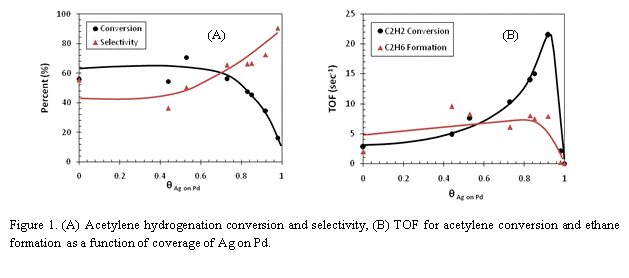
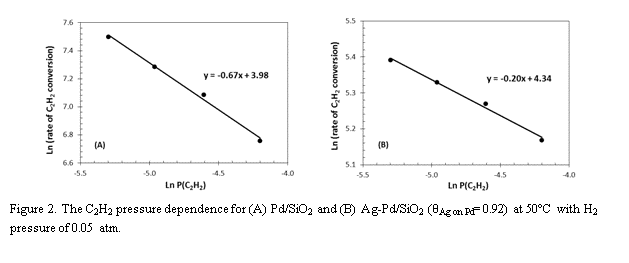
Figure 1A shows that the conversion of acetylene for Ag-Pd/SiO2 bimetallic catalysts decreased sharply at ¦ÈAg > 0.7 while the selectivity for acetylene conversion to ethylene increased to 90% between ¦ÈAg = 0.7 ¨C 0.95. It is proposed that at low coverages of Ag on Pd, there is an abundance of contiguous Pd surface sites where the strongly adsorbed acetylene and ethylene are adsorbed as ethylidyne. This surface species has been observed in the direct formation of ethane in the following sequential hydrogenation process: ethylidyne °ú ethylidene °ú ethyl °ú ethane [7, 8]. As a result, this type of adsorption is not selective for hydrogenation to ethylene. At high coverages where Ag atoms cover most of the Pd surface, the remaining ensembles of Pd sites are too small to allow the formation of ethylidyne. In this case, acetylene is more weakly adsorbed as a ¦Ð-bonded species requiring only a single Pd surface site, which favors formation of ethylene.The turnover frequencies (TOF) results shown in Figure 1B are consistent with the above assumptions. At low Ag coverages, since ethylidyne requires more Pd surface sites than adsorbed ¦Ð-bonded species at high coverage, there are less C2H2 molecules reacted per Pd surface site. Thus, TOF of C2H2 conversion was lower at low Ag coverage. On the other hand, hydrogenation of these strongly bound ethylidyne species leads to the preferable formation of C2H6 while hydrogenation of ¦Ð-complex species prefers the formation of ethane, so TOF of C2H6 formation was higher at low Ag coverage.The kinetics was then investigated to verify the above hypotheses. In Figure 2, analyses for un-promoted Pd and ¦ÈAg on Pd= 0.92 gave C2H2 pressure dependences of ¨C0.67 and ¨C0.20, respectively, consistent with much more strongly adsorbed C2H2 for large Pd ensembles. Families of Au-Pd/SiO2 bimetallic catalysts have similar performance trend as Ag-Pd/SiO2 catalysts, indicating the bimetallic effect for these catalysts is not electronic but geometric in nature.
We are now using the same Ag- and Au-Pd/SiO2 bimetallic catalysts to investigate the reaction mechanism of selective hydrogenation of 1,3-butadiene. Similar to acetylene, 1,3-butadiene, along with other diolefins also contaminates the ethylene streams and poisons the catalyst used for further polymerization of ethylene. In addition to evaluation and kinetics study, the mechanism of this reaction will be investigated by studying the adsorption of reactants and products on the surface of catalysts using Fourier transform infrared (FTIR) spectroscopy. The elucidation of reaction mechanism will advance our understanding of the catalytic phenomena and allow us to relate the variations in catalytic behavior to the properties of metals. In the future research, it will be interesting to study hydrogenation of 2-methyl-1,3-butadiene (isoprene), 1,3-pentadiene (isomer of isoprene) and 2,3-dimethyl-1,3-butadiene, which are electronically similar to 1,3-butadiene but have more steric hindrance. Comparison between the results of acetylene and diolefin hydrogenation will give us a better idea to understand how Ag- or Au-Pd/SiO2 bimetallic catalysts affect the reaction pathways to control the product distribution during hydrogenation of unsaturated hydrocarbons.
References
[1] W. R. True, Oil Gas J.110 (2012).
[2] H. Zea, K. Lester, A. K. Datye, E. Rightor, R. Gulotty, W. Waterman, Appl. Catal., A 282, 237-245 (2005).
[4] P. Miegge, J. L. Rousset, B. Tardy, J. Massardier, J.C. Bertolini, J. Catal. 149, 404-413 (1994).
[5] S. Leviness, V. Nair, A. H. Weiss, J. Mol. Catal. 25, 131-140 (1984).
[6] V. H. Sandoval, C. E. Gigola, Appl. Catal., A 148, 81-96 (1996).
[7] J. Wood, M. J. Alldrick, J. M. Winterbottom, E. H. Stitt, S. Bailey, Catal. Today 128, 52-62 (2007).
[8] J. Margitfalvi, L. Guczi and A. H. Weiss, React. Kinet. Cutal.Letr. 15, 475-479 (1980).
See more of this Group/Topical: Catalysis and Reaction Engineering Division