
 Google
 Yelp
 Facebook
 Twitter
 ChEnected
317274 Computational Fluid Dynamic Simulations of Gas-Liquid and Liquid-Liquid Flow in An Advanced-Flow Reactor (AFR)
Computational Fluid Dynamic Simulations of Gas-Liquid and Liquid-Liquid Flow in an Advanced-Flow Reactor (AFR)
María José Nieves Remacha1 and Klavs F. Jensen1,*
1 Dept. of Chemical Engineering, Massachusetts Institute of Technology, Cambridge, MA 02139, USA
Microreactor technology has been demonstrated to be very useful in the laboratory scale to perform kinetic studies, optimization of reaction conditions, and catalyst screening with reduced waste generation, high mass and heat transfer rates, and automated operation, among other benefits. However, microreactors do not provide sufficient throughput for production purposes. Thus, the alternative is to have an intermediate-scale device that still holds microreactor technology advantages (such as mass and heat transfer performance) and can be parallelized with a reasonable number of units to achieve the production rate according to the demand.
One alternative is the Advanced-Flow Reactor (AFR) manufactured by Corning Inc. The mixing module is devoted for multiphase reactions and has a special design with several rows of heart-shaped cells in series that produce large specific interfacial areas (1,000 – 10,000 m-1) and overall mass transfer coefficients (0.1 – 10 s-1).1
The hydrodynamic characteristics of the AFR have been studied experimentally for carbon dioxide-water and hexane-water. Experiments can be tedious, expensive, and consume materials. Modeling allows us to study the effect of fluid properties and operating conditions (temperature, pressure, flow rates) on bubble/drop size distribution, specific interfacial areas, phase holdup, and mass transfer coefficients without the need of experiments. Computational fluid dynamic (CFD) simulations help us understanding the local behavior of the flow in the reactor, propose new designs, and select the best operating conditions and materials based on the CFD results.
Here we present results of CFD simulations using the open source software OpenFOAM® for steady-state single-phase (Figure 1 shows an example of the velocity profile obtained in the AFR) and transient two-phase flow (gas-liquid and liquid-liquid). For two-phase simulations, the interface capturing volume-of-fluid (VOF) approach was used, which corresponds to the interFoam solver included in OpenFOAM ®. Slight modifications to the code were performed in order to improve the results and these are also presented here.
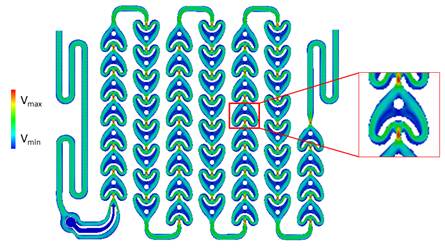
Figure 1: Velocity profile of CFD simulation of single-phase flow through the AFR using OpenFOAM®.
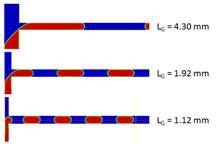
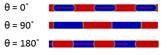
A first validation of the VOF method in simple geometries was performed to determine variables that are critical to guarantee a successful prediction of the biphasic flow characteristics. Some examples such as the prediction of two-phase flow in a T-junction are included in Figure 2 2. Results simulated with OpenFOAM® are compared with experiments and simulations with Fluent available in the literature 2-4.
A)
 B)
 C)
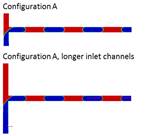
Figure 2: CFD Simulation of two-phase flow in a T-junction using OpenFOAM ®: A) Effect of inlet channel width on slug length; B) Effect of contact angle on flow characteristics; C) Effect of inlet channel length on slug size.
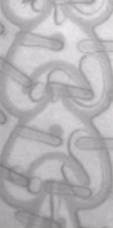
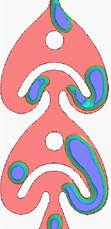
CFD simulations for hexane-water and carbon dioxide-water in the AFR are included in Figures 3 and 4 for different combinations of flow rates and orientations of the AFR. Fair agreement between simulation results and experiments based on the images of the flow obtained by high speed imaging was observed. Greater discrepancies were encountered when including gravity in simulations for liquid/liquid flow (as shown in Figures 3A) and 3C)), and better agreement between experiments and simulations for gas/liquid flow was observed (Figures 4A) and B)). Current analysis of the CFD results include measurement of bubble/drop size distribution, specific surface area, dispersed phase holdup, and mass transfer coefficients, and comparison with the experimental values. Future CFD simulations will include different fluid properties to study their effect on the hydrodynamic characteristics of biphasic flows. The current interFoam solver only solves the transient dynamics of the biphasic flow without mass transfer of components between phases or reaction terms. The ultimate goal is to include mass transfer and reaction so that prediction of conversion and selectivity for specific multiphase reactions can be performed.
A)
|
| B)
|
|
C)
|
| D)
|
|

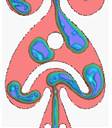
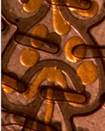
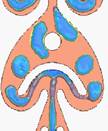
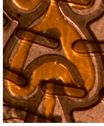
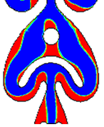
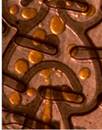
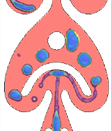
Figure 3: CFD Simulation of hexane/water flow using VOF in OpenFOAM® for vertical orientation of the AFR:
A) Qw = 10 ml/min, Qh = 10 ml/min; B) Qw = 20 ml/min, Qh = 20 ml/min; C) Qw = 10 ml/min, Qh = 40 ml/min; D) Qw = 40 ml/min, Qh = 10 ml/min
A)
 B)
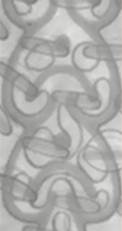
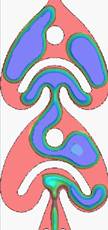
Figure 4: CFD Simulation of carbon dioxide/water flow using VOF in OpenFOAM® for QL = 10 ml/min: A) Vertical orientation, Qg = 13.3 ml/min B) Horizontal orientation, Qg = 20.8 ml/min
References:
[1] Nieves-Remacha, M. J.; Kulkarni, A. A.; Jensen, K. F. Hydrodynamics of Liquid-Liquid Dispersion in an Advanced-Flow Reactor. Ind. Eng. Chem. Res., 51 (50), 2012, pp 16251–16262
[2] Qian, D; Lawal, A. Numerical study on gas and liquid slugs for Taylor flow in a T-junction microchannel. Chem. Eng. Sci. 61 (23) 2006 pp 7609–7625
[3] Santos, R.; Kawaji, M. Numerical modeling and experimental investigation of gas–liquid slug formation in a microchannel T-junction. International Journal of Multiphase Flow 36, 4 2010 pp 314-323
[4] Vandu, C.O.; Liu, H; Krishna, R. Mass transfer from Taylor bubbles rising in single capillaries. Chem. Eng. Sci., 60 2005 pp 6430 – 6437
See more of this Group/Topical: Catalysis and Reaction Engineering Division