
 Google
 Yelp
 Facebook
 Twitter
 ChEnected
317467 A Fundamental Investigation of Single Bubble and Bubble Swarm Behavior With Respect to Fouling Prevention in Membrane Systems
A fundamental investigation of single bubble and bubble swarm behavior with respect to fouling prevention in membrane systems
L Böhm1, M Kraume1
1Chair of Chemical and Process Engineering, Technische Universität Berlin, Germany
FH6-1, Fraunhoferstrasse 33-36, 10587 Berlin, Germany. Tel: +493031472791, email: lutz.boehm@tu-berlin.de
Aim
Aeration is a common measure to detach deposition layers from membranes. A detailed view at commercially available flat sheet membrane modules reveals that although aeration is a main cost factor in the operation of membrane bioreactors (MBR), no optimal design and operation with respect to the cleaning efficiency was found yet. Different gap distances between the membrane cushions, different bubble sizes, additional mechanical cleaning with the help of granulates, pulsating aeration etc. are applied. This investigation's focus is gaining a fundamental understanding about the behavior of single bubbles and bubble swarms in such systems. The complexity of the behavior of a bubble swarm in an MBR is rather high. The fundamental approach of investigating the single bubble and bubble swarm behavior in one rectangular channel will help getting a deeper insight into the bubble dynamics in such systems. Especially the investigations with model solutions imitating the rheological behavior of activated sludge can deepen the understanding of the cleaning process.
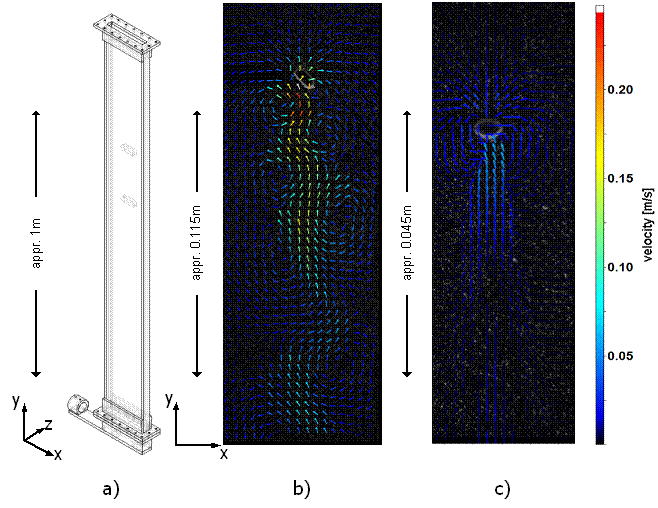
Figure 1. Schematic of the rectangular channel (a), front view of the flow field near a 5 mm bubble in a 5 mm channel in stagnant water (b) and in non-Newtonian Xanthan solution
Methods
For this purpose, an experimental apparatus was built which represents one of the channels with a rectangular cross section area between two flat sheet membrane cushions [1]. Acrylic glass is used to make optical measurements possible (Fig.1a). The fully automated rig is used to investigate single bubbles rising in the channel with the help of the electrodiffusion method for the determination of the generated shear stress on the walls, with a high speed camera for the determination of the bubble dynamics and with particle image velocimetry for the determination of flow field parameters in the liquid surrounding the bubble. In these investigations, the gap distance between the plates (3-7 mm), the single bubble size (3-9 mm), the superimposed liquid velocity (0-0.2 m/s) and the rheology of the liquid (Newtonian, non-Newtonian) were varied. For the investigation of the bubble swarm, in this list of parameters, the single bubble size is replaced by the aeration rate and aerator type.
Results
Exemplary flow fields near a single bubble are shown in Fig.1b) for the rise in water and c) for the rise in Xanthan solution. The concentration of Xanthan is chosen in a way, so that the shear thinning behavior of the solution is according to the one of activated sludge in MBRs [3]. The flow fields show the strong influence of the rheology of the continuous phase on the rise behavior. In case of the rise in water, the typical vortices which detach periodically from both sides of the bubble are visible. This leads to an oscillating movement of the bubble. Due to the confinement by the walls, especially for the bubbles equal or larger in size in comparison to the gap distance, only a zigzag-movement in the x-y-plane is found. For bubbles smaller than the gap distance, a zigzag-movement in the y-z-plane is appearing as well. Depending on the bubble size, in unconfined geometries the bubble in the size range investigated here would rise in a zigzag or helical motion. In case of the rise in the Xanthan solution, an almost symmetric flow field with respect to the vertical center line is found. Therefore, if appearing at all, only minor oscillations were found in any direction. The very particular flow field in the non-Newtonian liquid was similarly found for bubbles rising in unconfined geometries [2]. Near the bubble, the liquid is pushed around the bubble's edges on both sides. In the wake of the bubble, a triangular area with an upward flow on the edges of the triangular and a downward flow in the center of the triangular was found. This is due to the lower viscosity of the liquid in the high shear zone induced by the bubble movement. This effect will be visible for bubble swarms as well. In the investigation of the bubble swarm with the high speed camera, the bubble dynamics, bubble rise velocities und rising path are compared to the single bubble results and literature values e.g. from Yamanoi and Kageyama [4].
Conclusion
This fundamental investigation illustrates the influence of the liquid rheology in MBRs on the bubble dynamics and therefore the cleaning effect. With shear thinning liquids, e.g. the oscillation parallel to the membrane will be dampened and therefore the membrane area that is influenced by the bubble will be reduced. Without oscillation normal to membrane, the generated shear stress will be reduced as the liquid film thickness between bubble and wall increases in comparison to the film thickness in water. The investigation of the bubble swarm will show if the effects found for single bubbles can be confirmed.
References
[1] L. Böhm, A. Drews, and M. Kraume. Bubble induced shear stress in flat sheet membrane systems - serial examination of single bubble experiments with the electrodiffusion method. J. Membr. Sci., 437:131–140, 2013.
[2] D. Funfschilling and H. Z. Li. Flow of non-Newtonian fluids around bubbles: PIV measurements and birefringence visualisation. Chem. Eng. Sci., 56(3):1137 – 1141, 2001.
[3] S. Rosenberger, K. Kubin, and M. Kraume. Rheology of activated sludge in membrane bioreactors. Eng. Life Sci., 2(9):269–275, 2002.
[4] I. Yamanoi and K. Kageyama. Evaluation of bubble flow properties between flat sheet membranes in membrane bioreactor. J. Membr. Sci., 360(1-2):102–108, 2010.
See more of this Group/Topical: Catalysis and Reaction Engineering Division