
 Google
 Yelp
 Facebook
 Twitter
 ChEnected
318108 Peptide Nanofiltration By Quality By Design
Peptide nanofiltration by Quality by Design
Recently, nanofiltration (NF) techniques have been introduced by the pharmaceutical industries as part of the downstream processes for peptides, to perform concentration, purification and salt/solvent exchange, and they have been demonstrated as being suitable for integration with conventional purification techniques, providing savings in terms of time and costs. Application of NF has been supported by the development of new membrane materials with high stability in organic solvents (commonly used in the peptide industry), and efficient membrane modules [1,2,3].
During process development, process parameters and quality attributes are investigated, with the aim of establishing a relationship among them. Critical Quality Attributes (CQAs) are physical or chemical characteristics, which must be controlled to ensure the quality of the product. Critical Process Parameters (CPPs) are process inputs, which have a direct and significant effect on CQAs, when they are varied within the experimental range [4]. Typical CQAs for a mixture after NF are specifications regarding concentration of main product, impurities, ionic and solvent composition. To support new initiatives and provide guidance for pharmaceutical process development, the International Conference on Harmonisation (ICH) of Technical Requirements for Registration of Pharmaceuticals for Human Use introduced the Quality by Design (QbD) concept [5]. This concept was defined as "a systematic approach to development that begins with predefined objectives and emphasizes product and process understanding and process control, based on sound science and quality risk management" [5], and it has become an important tool in assisting the industry to move towards a more scientific approach to pharmaceutical development. As a result of all this knowledge, the company can: (i) select the best process conditions with a limited number of experimental data; (ii) continually monitor the process to assure consistent product quality; and (iii) update the process without requiring further experimental effort.
Understanding and, possibly, modelling all the possible effects and sources of variations on the quality of the final product is often difficult. Consequently, Design of Experiments (DoE) methods are extensively applied in process design [6]. DoE is characterized by reduction or minimization of the total number of trials by the simultaneous variation of all potential influencing factors. Application of DoE provides scientific understanding of the effects of multiple process parameters on product CQAs, allows the identification of interactions among process parameters (impossible for the 1-factor-at-a-time approach) and favours the selection of optimal working conditions. DoE methods have been largely employed for the development of chromatographic techniques, to identify the important factors affecting the retention performance and optimize the separation [7,8]. Studies of NF by DoE are, on the other hand, few [9,10] and rarely show how information from DoE can be used to support process modelling for process selection [11].
In this paper, it is shown how empirical DoE models can (i) provide phenomenological understanding of the transport mechanism through nanofiltration membranes for a specific solute of interest, and (ii) successfully support the process modelling for concentration and diafiltration, providing a methodology to select the most appropriate filtration technique for a given separation problem. In the first part of this work, the permeation of three model peptides, produced by Lonza (Visp, Switzerland) in acetonitrile/water mixtures through two ceramic NF membranes (Inopor® Nano 450 and Inopor® Nano 750, both composed of TiO2/Al2O3) is studied by DoE and the results are analysed by statistical Analysis of Variance (ANOVA). Typical peptide mixtures are composed of peptides and salts (as counter-ions or buffers) dissolved in solvent mixtures. Two peptides, one with preferential solvation for acetonitrile over water (PEP1) and the other with preferential solvation for water over acetonitrile (PEP2), are studied under conditions largely below the isoelectric point; a third peptide (PEP3) is studied under conditions close to its isoelectric point. For each peptide, peptide rejection, flux and trifluoroacetic acid (TFA-H) rejection are modelled as function of five operating parameters (peptide concentration, %v TFA-H, pressure, cross-flow velocity, and %v acetonitrile/water). The effects of the operating parameters and their interactions are discussed in terms of positive or negative effects on the responses and the role of preferential solvation and effect of salt on peptide flux and rejection is highlighted. For the peptide under conditions close to its isoelectric point (PEP3), reversible formation of micelles is observed and its effect on the permeation performance identified.
In the second part of this work, DoE analysis is used to support process selection for the first model peptide, PEP1. The peptide mixture exits the preparative chromatography with a composition of 0.06 to 0.1%v TFA-H / 30%v ACN/water; NF can be successfully used to perform concentration and diafiltration to (i) increase the peptide concentration, (ii) reduce the operating volumes and (iii) reach the required composition of 0.02%v TFA / 0.003%v ACN/water, before entering the lyophilization.
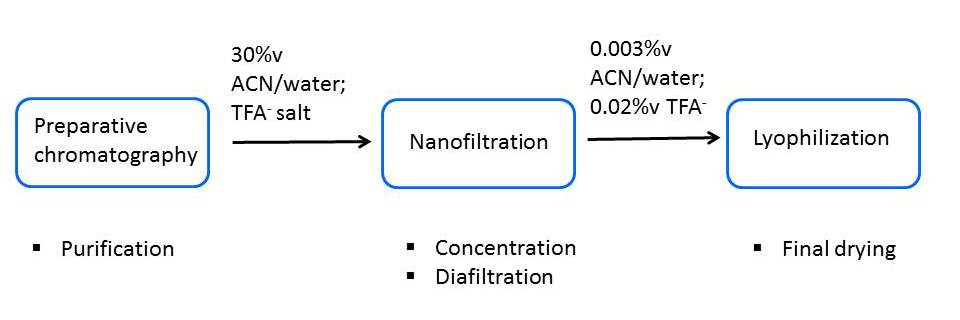
Figure 1. Downstream process (DSP) for PEP1.
The best operating conditions for concentration are found by numerical optimization of the statistical models obtained by DoE. The statistical models from DoE are afterwards included in the mathematical framework of the diafiltration process, to calculate the evolution of peptide, counter-ion and solvent concentrations over time, compare constant volume vs. variable volume diafiltration modes, and select the best process in terms of operating time and solvent consumption. Preconcentration followed by constant volume diafiltration is compared to variable volume diafiltration, in terms of operating time and solvent consumption. For the case study in this work, the former strategy (i.e. preconcentration + constant volume diafiltration) is identified as the best one.
Bibliography
[1] Yang, X. J., Livingston, A. G., Freitas dos Santos, L., Experimental observations of nanofiltration with organic solvents, Journal of Membrane Science 190, (2001) 45-55.
[2] Vandezande, P., Gevers L. E. M., Vankelecom I. F. J., Solvent resistant nanofiltration: separating on a molecular level, Chemical Review Society 37 (2008) 365-405.
[3] Tsuru, T., Miyawaki, M., Kondo, H., Yoshioka, T., Asaeda, M., Inorganic porous membranes for nanofiltration of nonaqueous solutions, Separation and Purification Technology 32 (2003) 105.
[4] Yu, L. X., Pharmaceutical Quality by Design: product and process development, understanding and control, Pharmaceutical Research 25 (2007) 781-791.
[5] International Conference On Harmonisation of Technical Requirements for Registration of Pharmaceuticals for Human Use, August 2009, ICH Harmonised Tripartite Guideline: Pharmaceutical Development Q8 (R2)
http://www.ich.org/products/guidelines/quality/article/quality-guidelines.html.
[6] Shivhare, M., McCreath, G., Practical considerations for DoE implementation in Quality by Design, BioProcess International 8(6) (2010) 22-30.
[7] Hibbert, D. B., Experimental design in chromatography: a tutorial review, Journal of Chromatography B 910 (2012) 2-13.
[8] Atkinson, A. C., Tobias, R. D., Optimal experimental design in chromatography, Journal of Chromatography A 1177 (2008) 1-11.
[9] Ahmad, A. L., Leo, C. P., Shukor, S. R. A., Statistical design of experiments for dye-salt-water separation study using bimodal porous silica/gamma-alumina membrane, Desalination and Water Treatment 5 (2009) 80-90.
[10] Polom, E., Szaniawska, D., Rejection of lactic acid solutions by dynamically formed nanofiltration membranes using a statistical design method, Desalination 198 (2006) 208-214.
[11] Román, A., Vatai, G., Ittzés, A., Kovács, Z., Czermak, P., Modeling of diafiltration processes for demineralization of acid whey: an empirical approach, Journal of Food and Process Engineering 35 (2012) 708-714.
See more of this Group/Topical: Separations Division