
 Google
 Yelp
 Facebook
 Twitter
 ChEnected
318142 Effects of Coverage Dependent Adsorbate-Adsorbate Interactions for CO Methanation On Transition Metal Surfaces
Recent advances in electronic structure theory have enabled researchers to understand the kinetics of surface reactions on the molecular level. Using microkinetic-modeling techniques, trends in the reaction rates and selectivities of heterogeneous catalysts can be predicted for a variety of chemical reactions.
These strategies, however, are based on a series of assumptions that may not be appropriate under all reaction conditions. The mean field model, which describes reaction kinetics with low coverages of reaction intermediates, may represent one such example. It has been reported previously that the dissociation of strongly bonded molecules (such as N2, O2, and CO) typically takes place under conditions where the surface coverages of intermediates are relatively high. In such cases, the trends in predicted rates and selectivities may be influenced by interactions between surface adsorbed reaction intermediates. Research described in this paper investigated the effect of these interactions on the adsorption energies (and hence reaction rates) of transition metal surfaces for the CO methanation reaction.
The DFT-calculated adsorption and transition state energies of the relevant intermediates were calculated for the 211 surfaces of Ag, Cu, Pd, Pt, and Rh. As described in the literature, the binding energies for these intermediates on a given surface can be scaled with the binding energies of carbon and oxygen. Likewise, the energies of a given transition state species can be scaled with the energies of the reaction products. By combining these scaling relations with a microkinetic modeling technique, we calculated the reaction turnover frequencies for CO methanation (both with and without interaction effects) for a range of carbon and oxygen binding energies (Figure 1).
In general, trends in the predicted methanation rates were unaltered by the inclusion of adsorbate-adsorbate interactions. The highest methanation rates were predicted for Ru, Co, and Ni, which is consistent with earlier experimental and theoretical studies. Inclusion of adsorbate interactions resulted in an increase in the predicted rates for materials with the strongest binding energies of C and/or O (e.g., Fe and Re). These increases were primarily due to an increase in the concentration of active sites via a reduction in surface poisoning due to strongly bound intermediates.
In general, the results of this analysis support the use of the mean field model for determining qualitative trends in simple reactions like CO methanation. Nevertheless, the inclusion of interaction effects is suggested to be increasingly important in cases where reaction selectivities play an important role.
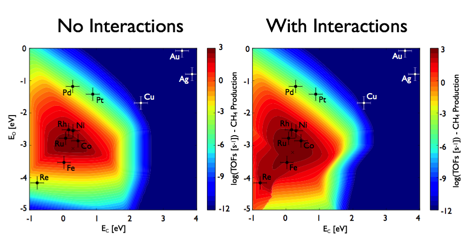
Figure 1 - Theoretical turnover frequencies as a function of the carbon (ĈEC) and oxygen (ĈEO) binding energies with and without interaction effects (T = 523 K, P = 1 bar, 1% CO in H2). Carbon and oxygen binding energies for the (211) surfaces of selected transition metals are depicted.
See more of this Group/Topical: Catalysis and Reaction Engineering Division