
 Google
 Yelp
 Facebook
 Twitter
 ChEnected
318528 Simulations of Solid-Liquid Scalar Transfer in Turbulent Flow
We numerically study scalar transfer from a single solid sphere into a surrounding fluid phase that undergoes turbulent flow. The conditions are such that the diameter of the sphere is an order of magnitude larger than the Kolmogorov length scale so that the sphere experiences an inhomogeneous and strongly time varying flow.
In the simulations, the turbulence as well as the sphere are fully resolved. This is achieved by means of the lattice-Boltzmann method. Its uniform, cubic lattice has a spacing close to the Kolmogorov length scale. The no-slip condition on the surface of the translating and rotating sphere is imposed by an immersed boundary method. Turbulence in the fully periodic, three-dimensional domain has been created through linear forcing.
In addition to the flow dynamics, we solve a convection-diffusion equation for the passive scalar c with c=1 at the solid surface and initially c=0 in the rest of the domain. Since we deal with liquid systems, the Schmidt number is high and we anticipate issues with the spatial resolution of the scalar concentration field, at least close to the sphere. To mitigate these we solve the scalar transport equation on two connected grids: an inner spherical grid that moves with the sphere, and an outer cubic grid that is the same as the grid on which the flow is solved (see Figure 1). For solving the scalar transport equation a finite volume method with a TVD scheme has been used.
This dual-grid approach has first been benchmarked for the case of a sphere suspended in simple shear. Reference data for this case are available due to Yang et al (2011). This benchmark provides us with notions as to the spatial resolutions required as a function of Schmidt and Peclet numbers.
First results with the sphere immersed in turbulent flow (illustrated in Figure 2) show the erratic structure of the mass transfer process close to the sphere with strong inhomogeneities due to the turbulent flow. Further analysis of the results gives credit to mass transfer models based on surface renewal with time scales of the order of 50 Kolmogorov times.
Chao Yang, Jingsheng Zhang, Donald L. Koch, Xiaolong Yin. Mass/heat transfer from a neutrally buoyant sphere in simple shear flow at finite Reynolds and Peclet numbers. AIChE J. 57, p1419, 2011.
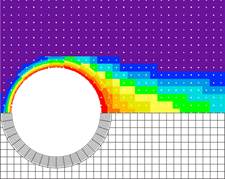
Figure 1
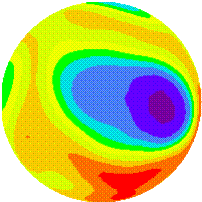
Figure 2
See more of this Group/Topical: Engineering Sciences and Fundamentals