
 Google
 Yelp
 Facebook
 Twitter
 ChEnected
318616 CFD Analysis of Slag Flow and Residence Time in a Packed Bed Reactor
Phosphorus is an essential and non-replaceable element for all life forms. While the phosphate rock still remains the main source for the worldwide production of phosphorus today [1], this practice is not sustainable due to rather fast depletion of this non-renewable resource [1, 2]. The ecological cost of phosphate rock mining is also tremendous, ranging from eutrophication [3] to emissions of toxic and radioactive pollutants [4, 5]. Sustainable recycling of this crucial food resource will help combating global poverty and providing better conditions for human life. The main source for recycling of phosphorus is the sewage sludge and particularly sewage sludge ashes after mono-incineration of the sludge [6]. The European Union is committed to promote research in this direction and the study presented here is part of the “RecoPhos” project which has received funding from the European Union Seventh Framework Programme (FP7/2007-2013) under grant agreement no. 282856.
The basic idea in RecoPhos project is thermal reduction of the phosphates in sewage sludge ash to phosphorus gas in an inductively heated bed of Carbon. In this paper, CFD analysis and simulation of the fluid flow through the packed bed in the so called “InduCarb” reactor is presented. The focus is on the residence time of the molten ash in the reactor under different operating conditions. Such a study is crucially important for better understanding of the fluid dynamics in such a complex system and to provide insight for proper design and optimization of the reactor. As such, the current study disregards the chemical reactions taking place and only focuses on the multiphase flow of the non-reacting flow and how the flow is affected by changes in ash properties, packed bed characteristics or operating parameters.
The CFD study is performed employing the latest version of the commercial software Ansys Fluent. The multiphase model used is the Eulerian granular which is the most complete approach among Ansys Fluent multiphase models [7]. The flow behavior in the reactor also depends on whether the reactor is at transient or steady state. The residence time of the molten ash during start-up i.e. transient state is different than the residence time during steady state. Both states are considered in this study. During steady state, the residence time distribution of the molten ash in the reactor is studied. This is done by pulse injection of a tracer at the inlet and monitoring its concentration at the outlet at fixed time intervals. The resulting exit concentration curve is widely used among chemical engineers to characterize the reactor performance [8]. CFD visualization opportunities e.g. by visualizing localized concentration of the tracer inside the reactor will give even more insight for understanding the behavior of such a complex system. Fig. 1 shows the molten ash flow through the packed bed by color coding the volume fraction of the ash in relation to the total volume of all phases including gas, liquid and granular.
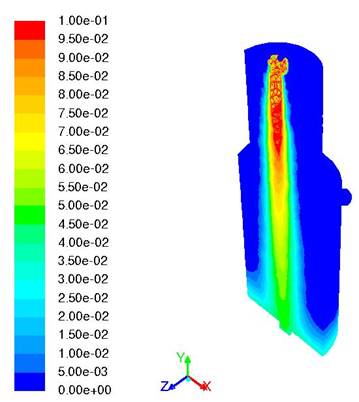
Fig. 1. Visualization of the molten ash flow through the packed bed reactor by color coding contours of ash volume fraction in the reactor.
The CFD results show interesting correlations between operating parameters and flow behavior of the molten ash in the reactor. In particular, the ash feed rate, viscosity and particles size have shown to be highly influential on the molten ash residence time. Porosity of the packed bed also affects the distribution of the residence time. The ash feed rate and the outlet diameter should be designed in such a way that flooding of the reactor by the molten ash is avoided. If the molten ash viscosity is too high or the particles in the packed bed are too small, liquid hold-up in the reactor can become a problem too.
References
1. Cordell, D., Drangert, J.-O., White, S. (2009). The story of phosphorus: Global food security and food for thought. Global Environmental Change 19: 292-305.
2. Steen, I. (1998). Phosphorus availability in the 21st Century: management of a non-renewable resource. Phosphorus and Potassium 217: 25-31.
3. Wissa, A.E.Z. (2003). Phosphogypsum Disposal and the Environment. Ardaman & Associates Inc., Florida. Available: http://www.fipr.state.fl.us/pondwatercd/phosphogypsum_disposal.htm
4. Kratz, S., Schnug, E. (2006). Rock Phosphates and P Fertilizers as Sources of U Contamination in Agricultural Soils. Institute of Plant Nutrition and Soil Science, Federal Agricultural research Center, Germany, pp: 57-67, in Uranium in the Environment: Mining Impact and Consequences, Springer Berlin Heidelberg.
5. Saueia, C. H., Mazzilli, B.P., Favaro, D.I.T. (2005). Natural radioactivity in phosphate rock, phosphogypsum and phosphate fertilizers in Brazil. Journal of Radioanalytical and Nuclear Chemistry, 264: 445-448.
6. Donatello, S., Tong, D.,Cheeseman, C.R. (2010). Production of technical grade phosphoric acid from incinerator sewage sludge ash (ISSA). Waste Management 30: 1634–1642.
7. ANSYS FLUENT Theory Guide (2011). ANSYS Inc., Release 14.0, Canonsburg.
8. Levenspiel, O. (1972). Chemical reaction engineering. (2nd ed.) John Wiley & Sons, Toronto, Canada.
See more of this Group/Topical: Sustainable Engineering Forum