
 Google
 Yelp
 Facebook
 Twitter
 ChEnected
318797 Unusual Patterns in the Adsorption and Diffusion of C1-C6 Alcohols and Other Organic Compounds in the ZIF-68 Metal-Organic Framework
Zeolitic Imidazolate Frameworks (ZIFs) are crystalline microporous materials, consisting of transition metals (M = Co, Cu, Zn, etc.) linked by imidazolate (Im) or functionalized Im ligands. This subfamily of the Metal-Organic Frameworks (MOFs) displays good chemical and structural stability, which make them attractive as separation media in liquid phase separations. ZIF-68 is an interesting member of this family, with a complex pore structure consisting of two one-dimensional channels formed by three different types of cages. The small channel is composed of alternating small and medium cages, while the large channel comprises the large cages [1].
In the present work, the adsorption behavior of ZIF-68 is studied via vapor phase kinetic and equilibrium experiments with C1-C6 alcohols and other organic compounds (acetone, acetonitrile, C6-isomers, tri-isopropylbenzene) and kinetic batch experiments of alcohol mixtures in water. S-shape isotherms are obtained for polar adsorbates (fig.1), which is related to (1) the presence of two chemically different channels in the ZIF-68 framework and (2) the rather apolar nature of the material, which results in unfavorable adsorption of polar compounds at low concentration. Depending on the component, the adsorption capacity varies between 0.25 and 0.30 g/g. A comparison to the Argon isotherm indicated that both types of channels of ZIF-68 are densely filled with the different organic compounds.
Uptake of the different alcohols occurs slowly on the large crystals (around 70 µm) used in this study. Moreover, two different diffusion regimes can be observed, in which molecular transport in the two-pore systems occurs at different rates. Besides, it was observed that bulky molecules, with a kinetic diameter significantly larger than the pore windows, are adsorbed in large amounts, which gave reasons to think that also this ZIF material, just as ZIF-7 [2] and ZIF-8 [3-5], has a certain degree of structural flexibility to enlarge the free aperture of the channels, enhancing the diffusion process. Liquid phase experiments indicate the potential of ZIF-68 in the selective uptake and separation of alcohol/water mixtures.
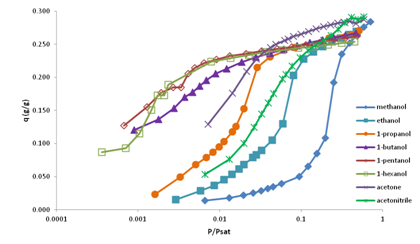
Fig.1: Adsorption isotherms of C1-C6 alcohols, acetone and acetonitrile at 50 °C.
References
[1] R. Babarao, S. Dai and D. Jiang, J. Phys. Chem. C 115 (2011) 8126–8135
[2] C. Gücüyener, J. van den Bergh, J. Gascon and F. Kapteijn, J. Am. Chem. Soc. 132 (2010) 17704-17706
[3] S.A. Moggach, T.D. Bennett and A.K. Cheetham, Angew. Chem. 121 (2009) 7221-7223
[4] D. Fairen-Jimenez, S.A. Moggach, M.T. Wharmby, P.A. Wright, S. Parsons and T. Düren, J. Am. Chem. Soc. 133 (2011) 8900-8902
[5] J.C. Saint Remi, T. Rémy, V. Van Hunskerken, S. Van der Perre, T. Duerinck, M. Maes, D.E. De Vos, E. Gobechiya, C.E.A. Kirschhock, G.V. Baron and J.F.M. Denayer, ChemSusChem 4 (2011) 1074-1077.
Acknowledgements
The authors are grateful to the Agency for Innovation by Science and Technology in Flanders (IWT) for support in the SBO MOFshape project.
See more of this Group/Topical: Separations Division