
 Google
 Yelp
 Facebook
 Twitter
 ChEnected
318798 Removal of Heavy Metal Ions From Lean Amine Solvent Using Chitosan Coated Ion-Exchange Resins in a Gas Sweetening Plant
1. Introduction
In natural gas sweetening plant aqueous methyldiethanolamine (MDEA) solution is used to scrub natural gas. Finally, the rich MDEA solution is fed to a regeneration column where heat is applied to strip the acid gas components out of the MDEA solution. Make-up water and MDEA are added to maintain the concentration of MDEA solution. The heavy metal ions present as contaminant in lean amine solvent may come from make-up water. Many researchers identified the metal ions present in the lean amine solvents and removed using electrodialysis and ion-exchange (IE) resins. IE process outperforms electrodialysis technique in terms of higher energy requirements and continuous supply of huge volumes of water [1]. IE processes are capable of achieving very low salt concentrations [2], operating and installation costs are less and the requirements for regeneration chemicals have reduced currently [3]. Cummings and Smith [4] used continuous adsorption studies passing the alkanolamine solutions over cation bed where positively charged contaminants such as ferrous ions and sodium ions were exchanged with protons. Audeh and Yan [5] showed that weakly acidic cationic resins with carboxylic acid functionality outperform strongly acidic resins with a sulfonic acid groups.
The basic objective of this research work was to remove heavy metal ions (iron, chromium, lead etc.) accumulated in lean MDEA solution in gas sweetening process. MDEA containing both amine and hydroxyl group chelate and adhere heavy metal ions strongly. Thus bare ion-exchange resins cannot always successfully remove heavy metal ions from this lean amine solvent overcoming the chelation. The novelty of this research work lies in the use of chitosan coated ion-exchange resin which contains both the above groups present in the amine solvent and could hence successfully remove heavy metal ions from MDEA.
2. Materials and Methods
Lean MDEA solvents (45 weights %) were obtained from the Gasco, Habshan, Abu Dhabi. Commercially available ion-exchange resins (ZGC151) were obtained from Hangzhou Zhengguang Resin Co., Ltd., China. Chitosan and all other chemicals used in this study were purchased from Sigma Chemical Co., USA. At first, the bare resins were coated with chitosan. 1.0 gram chitosan powder was added to 100ml 5% acetic acid solution and left overnight in stirring condition to dissolve completely. 10 grams of ion-exchange resin was added into the chitosan solution and stirred for six hours, decanted and kept at vacuum oven at 60oC for curing. The resin beads was then added drop wise to 100 ml 4% sodium hydroxide solution and stirred overnight for chitosan coating. Chitosan coated ion-exchange resins were treated to regenerative form before their use in ion exchange batch sorption experiments.
Elemental analysis was carried out using Inductively Coupled Plasma Optical Emission Spectrometry (ICP-OES, Optima 8000). The FTIR studies of chitosan coated ion-exchange resins were carried out using FTIR, Nicolet, iS10, Thermo Scientific instrument using OMNIC software (number of scans 64, resolution 4). Scanning Electron Microscopy (SEM) was carried out with FEI Quanta 200, The Netherland.
3. Batch and Continuous ion exchange experiments studies
Ion exchange experiments were conducted using mixed batch reactor technique for obtaining the equilibrium parameters data for the removal of heavy metal ions using chitosan coated cation exchange resins. The amount of heavy metal ions adsorbed per unit mass of the resin (qe, microgram/gram) at equilibrium was calculated as:
qe = (V/m)*(Co–Ce) (1)
Where V is the volume of the lean amine solution, m is the mass of the ion exchanger resin; Co and Ce are the respective ion concentrations in solution (microgram/liter) initially and at equilibrium. The equilibrium studies were conducted with lean amine solvent on ion exchange resins at pH 10.6, at 296 K.
The equilibrium data were fitted on to well-known established sorption isotherm models:
The Langmuir isotherm
The Langmuir isotherm [6] model and its linearized form are usually described by:
1/qe = (1/qmaxkL)(1/Ce) + 1/qmax (2)
Where, qmax is the maximum sorption capacity of anions (microgram/gram of resin), Ce is the equilibrium heavy metal ion concentration (microgram/liter) and kL is the langmuir isotherm constant (liter/microgram).
The Freundlich isotherm
The Freundlich [7] isotherm in its linearized form is expressed as:
ln(qe) = lnkF + (1/n) lnCe (3)
In this equation kF(microgram(1-1/n)L(1/n)/gram) and n are the Freundlich constants.
For continuous adsorption experiment in column, a pyrex tube of 2.54 cm inner diameter and 10 cm height was used. Thirty grams of chitosan coated pretreated cation exchange resin (ZGC 151) was randomly packed in the column to a bed volume (BV) of 30 cm3. The lean MDEA solution was fed to the bottom of the resin column by a peristaltic pump at a rate of 4.5 ml/min. Samples were taken periodically at the top of the resin column for individual and total heavy metal content and measured using ICP-OES.
4. Results and discussion
4.1 FTIR Analysis
FTIR analysis was carried out to observe the adherence of chitosan on resin surface. Figure 1 shows the FTIR spectra of the two structures. From the FTIR spectrum, it could be concluded that chitosan was successfully coated on resin surface to remove heavy metal ions from the lean amine solvent.
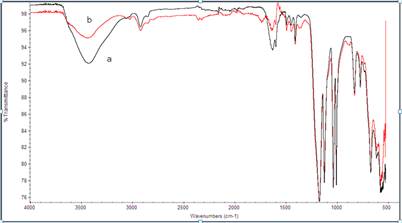
Figure1. FTIR Spectra of a) bare resin b) chitosan coated resin
4.2 SEM Analysis
Modification of the chitosan coated resin molecules followed by adsorption of MDEA was observed from the SEM images (Figure 2). Smooth chitosan coated resin surface was observed before adsorption (a) whereas surface becomes rough after adsorption reactions occurring between resin molecules and MDEA (b).
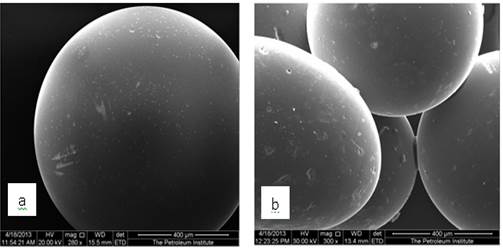
Figure2. SEM analysis of a) before and b) after adsorption studies
4.3 Heavy metal ions present in Lean amine samples
The major heavy metal ions present in amine samples [Chromium (479 ppb), Iron (967.1 ppb), Lead (1009 ppb), Magnesium (75.29 ppb), Manganese (111.7 ppb), Cadmium (48.32 ppb), Strontium (26.81 ppb) and Titanium (31.77 ppb)] were detected using ICP-OES.
4.4 Equilibrium Adsorption studies
The isotherm models gave an indication of the interaction between the heavy metal ions from solution with the ion exchange resin and their distribution over ion exchange surface. The corresponding isotherm models are shown in Figure3 and parameters are shown in Table1. Based on the data fit, major heavy metal ions follow a Langmuir type monolayer adsorption. The Freundlich isotherm predicted the constant, n calculated from linear fits falls in the range of favourable adsorption (n>1).
|
|
|
|
|
|
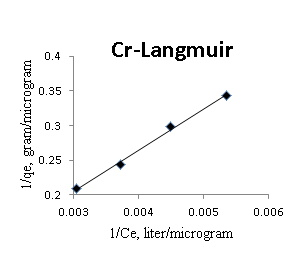
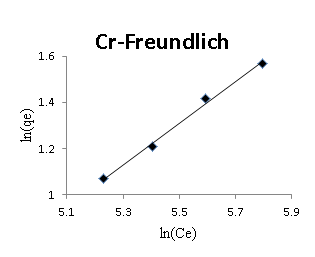
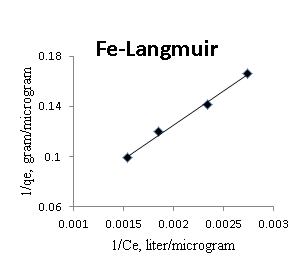
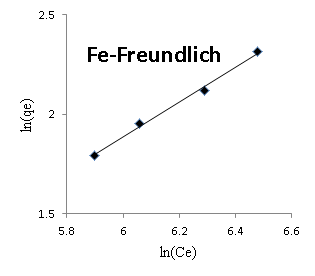
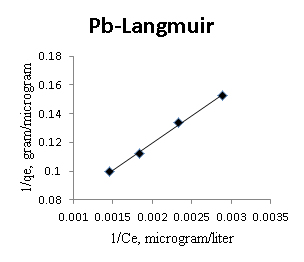
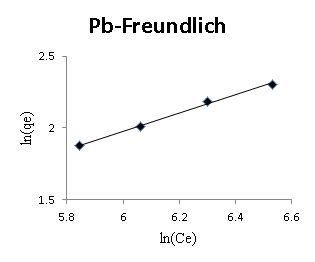
Figure3. Langmuir and Freundlich Isotherms for Chromium, Iron and Lead
Table1. Isotherm model parameters for the adsorption of heavy metal ions on ion exchange resin
Isotherm | Parameter | Chromium | Iron | Lead |
Langmuir | qmax (microgram/gram) kL (L/gram) R2 | 38.022 442.51 0.9951 | 59.88 307.63 0.9945 | 22.47 1181.9 0.9972 |
Freundlich | kF n R2 | 0.0264 1.112 0.9945 | 0.0352 1.146 0.9944 | 0.1618 1.579 0.9952 |
4.5 Continuous Ion Exchange experiment studies of heavy metal ions from lean amine solution
A practical application of the experimental breakthrough curves is the determination of the breakthrough time, which helps establish the optimum operating conditions of the ion exchange process. It was observed that the breakthrough time was 8hours for same bed volume of the packed bed.
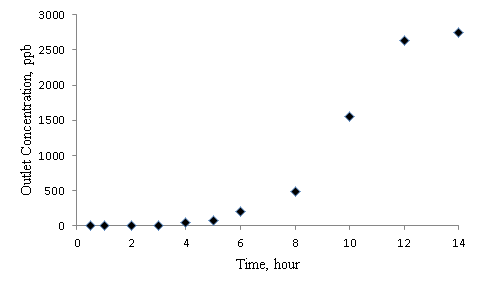
Figure4. The breakthrough curve for total heavy metal ions.
5. Conclusions
In this research, chitosan coated ion exchange adsorption was employed for efficient recovery of heavy metals from lean amine solution. Experimental tests were conducted to determine the equilibrium ion exchange capacities of the resins. Continuous adsorption experiment determined the breakthrough times of the ion exchange process and facilitates the process design by optimizing the operation conditions as useful to remove heavy metals from lean amine samples.
6. Acknowledgement
The authors are grateful to Gas Research Centre, The Petroleum Institute, Abu Dhabi for funding the projects. Sincere thanks to Mr. Alaa Abdul Aziz and Mr. Marwan Alawlqi, The Gasco, Habshan for their co-operation and support.
7. References
1. Hong, M., Shuang, Z., Chunxi, L., Liangshi, L., Removal of heat stable salts from aqueous solutions of N-methyldiethanolamine using a specially designed three-compartment configuration electrodialyzer, Journal of Membrane Science, 322, 436-440, 2008.
2. Burns, D., Gregory Jr., R.A., The UCARSEP: process for on-line removal of non-regenerable salts form amine units. In: Laurence Reid Gas Conditioning Conference, Norman, OK, 1995.
3. Cummings, A.L., Smith, G.D., Nelsen, D.K., Advances in amine reclaiming- why there's no excuse to operate a dirty amine system. In: Laurence Reid Gas Conditioning Conference, Dickinson TX, USA, 2007.
4. Cummings, A.L., Smith, G.D., Better alkanolamine system operations through chemical analysis. In: The Sulfur Recovery Symposium, Vail, CO, USA, 2010.
5. Audeh, C.A., Yan, T.Y., Clean-up of ethanolamine solution by treating with weak ion exchange resins. United States Patent No. 802,586. Mobil Oil Corporation, Fairfax, VA., 1994.
6. Langmuir, I., The adsorption of gases on plane surface of glass, mica and platinum, Journal of American Chemical Society, 40, 1361, 1916.
7. Freundlich, H.M., Over the adsorption in solution, Journal of Physical Chemistry, 57, 385-470, 1906.
See more of this Group/Topical: Separations Division