
 Google
 Yelp
 Facebook
 Twitter
 ChEnected
318986 From Fundamental Single Drop Analysis to the Description of Liquid/Liquid Dispersions - Part I: Coalescence
There are numerous applications in industry, where reactions and mass or energy transfer between two immiscible liquids are the major concerns. When trying to influence or predict the contact area one has to focus on the underlying principles that lead to the formation of the drops. The resulting drop size distributions (DSD) are thereby determined by drop breakage and coalescence. In order to predict the size distributions, both phenomena have to be understood and described properly. Although comprehensive scientific research identified a multitude of theoretical models describing both processes, the prediction of the DSD is only possible with restrictions when varying for example the power input, material and process parameters. Consequently, excessive and expensive experimental investigations are still necessary at different scales of process development. For example the design of extraction columns still requires pilot plants using high amounts of process liquids.
To reduce the amount of influencing factors of the whole process, it is necessary to reduce the problem to the fundamental behavior of single droplets. Therefore, the impact of influencing parameters for drop coalescence and breakup needs to be identified and quantified for each phenomenon separately. The gained knowledge of this microscopic behavior can be used to prove existing models and develop new ones. These models can either be semi-empirical or mechanistic. The obtained detailed models can be implemented into the framework of population balance equations (PBE), which includes separate kernels for drop breakage and coalescence. The PBE can be applied to describe the time dependent DSD in technical applications and therefore connects the microscopic to the macroscopic behavior of droplet swarms. The microscopically based modeling allows a determination of the model parameters using single drop experiments with only a small amount of liquid components in order to adapt the submodels to the present process.
This part is focused on the coalescence of two droplets and will discuss two characteristics of this phenomenon in detail: the influence of superimposed mass transfer on the coalescence probability and the coalescence inhibition due to electrostatic charge at high pH values.
The coalescence probability, which quantifies if two droplets coalesce or repulse each other after collision, is quantified systematically using single drop experiments. Therefore, a newly developed test cell is used where a rising drop collides with a pendant one recorded by a high speed camera. The drop generation, detachment, collision and the triggered recording of the process is fully automated. This allows carrying out serial examinations of droplet collisions under different system conditions (varying e.g. drop sizes, mass transfer direction and intensity). As the coalescence and contact time (and consequently the coalescence probability) of drops have a broad variance, a significant number of experiments has to be conducted to provide a statistically solid data base. Analyzing the recorded images of the coalescence process, important quantities like coalescence probability, contact and coalescence time, relative velocity, momentum and deformation are evaluated. Conducting these experiments, the EFCE recommended model system toluene / acetone / water is used.
Analyzing the influence of drop size ratio on coalescence probability shows the same tendency which commonly used models predict. If two drops with the same size collide, the coalescence probability is the lowest and rises with a shift in drop size ratio. Increasing the rising distance and therefore the relative velocity between the drops decreases the coalescence probability. This finding is contradictive to the so called energy models in literature, which assume a higher coalescence probability with higher kinetic energy (corresponding to a higher relative velocity). As mass transfer is inherent in extraction and is known to have a significant impact on drop coalescence, its influence on the coalescence probability is investigated systematically. Introducing the transferring component acetone into the system shows that the coalescence behavior is changed significantly over a broad range of driving concentration differences. A transfer direction from dispersed to continuous phase (d → c) leads to a decrease in the contact time of two drops until they coalesce. This results in a significant increase of coalescence probability to a complete coalescence of all drops independent from the drop size ratio. Reversing the mass transfer direction (c → d) generally decreases the coalescence probability, although this effect seems to be outweighed at distinct drop size ratios. Apparently, the gathered knowledge of this microscopic behavior offers a basis for model validation and future model development describing the influence of superimposed mass transfer.
A coalescence inhibition caused by electrostatic interactions was found in experimental investigations in stirred toluene/water systems at constant ionic strength of 0.1 mol/L with pH values higher than 11. Two designated models were used to simulate the transient DSD in a stirred tank, showing that the influence of droplet charge due to a change in pH value or ion concentration cannot be predicted satisfactorily by existing models. This finding motivated a new mechanistic modeling approach implementing the DLVO theory into the PBE framework. For that reason the coalescence efficiency is separated in a hydrodynamic and an electrostatic part. Being independent from each other, the hydrodynamic part of the efficiency can be described by common models from literature, whereas the developed electrostatic part is based on the ratio of the repulsing force due to the overlap of the electrical double layers of two colliding drops to the attractive van der Waals force between them. This model is able to describe the hindered coalescence at high pH values and the transient and steady-state Sauter mean diameters of the DSD fit well with the experimental values. Further investigations will focus on single drop experiments with a systematic variation of ionic strength, pH and ionic species and zeta potential measurements. These examinations will build a basis for further model development.
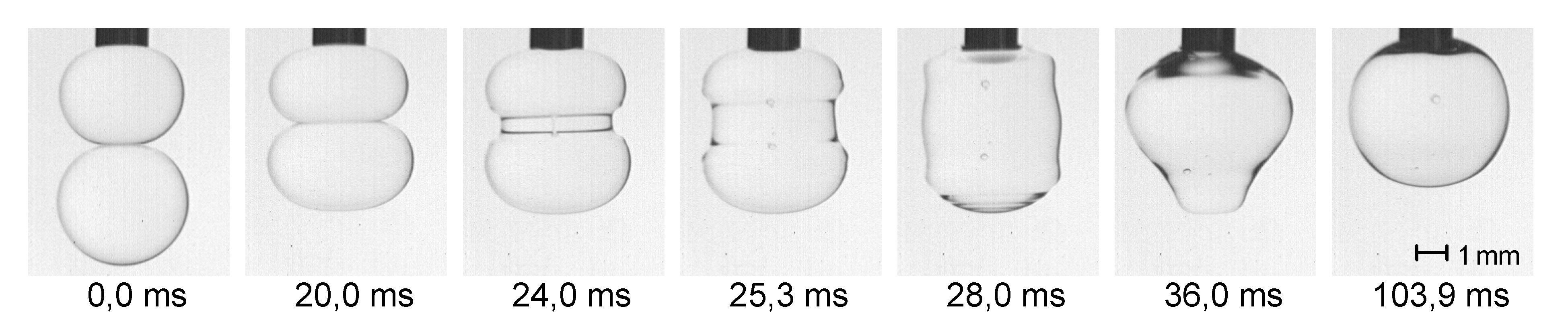
Fig. 1: Coalescence of two droplets
Partially founded by DFG project “Coalescence efficiency in binary systems” and DECHEMA “Max-Buchner-Forschungsstiftung”
See more of this Group/Topical: Separations Division