
 Google
 Yelp
 Facebook
 Twitter
 ChEnected
319034 Pyrolysis Kinetics of Anisole a Simple Lignin Model Compound
Pyrolysis Kinetics of Anisole a Simple Lignin Model Compound
Abstract
The thermal decomposition of lignin, one of the major components of biomass, is not well characterized and leads to formation of undesirable products that require substantial upgrading before using it as a drop-in fuel. An improved understanding of the underlying decomposition reactions of lignin could provide insight into process control conditions that could mitigate the formation of these undesirable products during the fast pyrolysis process to produce biofuels. Because the structure of lignin is so complex, model compounds are often utilized to gain insight into this underlying chemistry. The simplest model that can be employed to investigate the weak phenolic-carbon linkage in lignin is anisole (C6H5OCH3). Although several studies have been carried out to understand the decomposition of anisole, there are limited data available under fast pyrolysis process conditions. Furthermore, the existing models have not been able to predict the observed product formation. In this work, we present anisole thermal decomposition data that was collected under conditions that closely resemble fast pyrolysis (T=525-650°C, t ~0.9s, and P~0.8 atm) using a tubular flow reactor. These data were modeled using a mechanism that was developed by Pecullan et al.1 , but it was modified to include updated rate constants for the reactions involving the o-methylcyclohexadienone potential energy surface that were derived from electronic structure calculations.
The stationary points and transition states located on this PES were calculated using the CBS-QB3 level of theory using Gaussian 03.2 To improve the accuracy of the DfH298, S298, and Cp values, low frequency vibrational modes that resemble torsions around single bonds are treated as hindered internal rotors; the hindrance potentials were calculated at the B3LYP/6-31G(d) level of theory via relaxed surface scans. The electronic energy of each species was converted to its heat of formation using the atomization method. High-pressure rate coefficients were calculated using canonical transition state theory. These high pressure rate constants were used to obtain apparent pressure and temperature dependent rate constants using Quantum-Rice-Ramsperger-Kassel theory with a modified strong collision approximation.3 This mechanism was used to model the data collected here as well as previously published data; the simulations were performed using the ChemKin-Pro software package.4
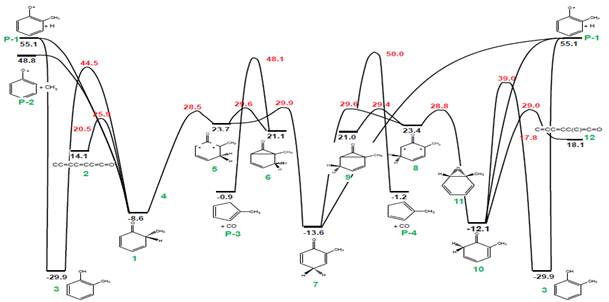
Figure 1. Potential Energy Surface for o-methyl cyclohexadienone (units: kcal mol -1)
A simplified version of o-MecyHDOE potential energy surface calculated at the CBS-QB3 level of theory is shown in Figure 1. The barrier for isomerization to form o-cresol (3) is predicted to be ~53 kcal mol-1, while those to form the two other methyl cyclohexadienone isomers (7 and 10) are much lower (~41 and ~43 kcal mol-1). Note that these latter isomerization reactions proceeds through a diradical intermediate, which can eliminate CO to form 1- and 2-methyl cyclopentadiene (P3 and P4). The overall barriers for the formation of these two species are ~57 and ~63 kcal mol-1, respectively. The barrier to form 1-methyl cyclopentadiene is comparable to that for ortho-cresol formation, suggesting that these channels might be of comparable importance. The surface also contains several reaction pathways to methyl phenoxy plus H products (P1). Although these reactions are ~6 kcal mol-1 higher in energy than the entrance channel (P2), these dissociation reactions are entropically favored when compared to isomerization. These channels are potentially important since these H atoms can add to methyl phenoxy radical to directly form o-cresol or they can add to phenoxy radical to form phenol.
The potential energy surface determined in this work has some important differences compared to the one originally estimated by Pecullan et al.1 (Note that at the time that the Pecullan et al. mechanism was assembled, high level electronic structure calculations were generally not feasible for systems of this size. Thus, this PES and the corresponding high pressure rate constants were estimated in analogy to other similar reactions.) The CBS-QB3 barrier for ortho-cresol formation is ~14 kcal mol-1 higher in energy, while those for methylcyclopentadiene formation are at least 25 kcal mol-1 higher in energy. We find that o-methyl cyclohexadienone reacts to form the 1- and 2-methyl cyclopentadiene isomers, while Pecullan's analysis predicts the formation of the 5-methyl cyclopentadiene isomer.
Incorporation of these rate constants leads to improved predictions for many of the observed products. Selected comparisons are shown in Fig. 2. Although this updated mechanism is an improvement, it is clear that further progress is needed. Current efforts are focused on extending the type of analysis described here to other reactions that occur during anisole pyrolysis.
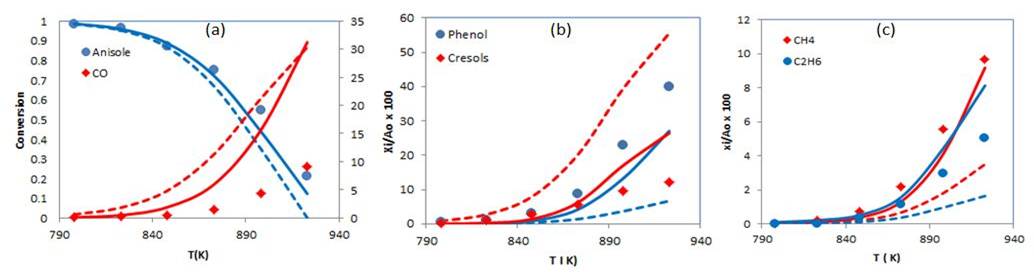
Figure 2. Comparisons of anisole pyrolysis products distribution data with model predictions where solid lines indicate the updated model and the dashed lines indicate the Pecullan model.
References
- Pecullan, M,; Brezinsky, K,; and Glassman, I, J. Phys Chem A., 1997, 101, 3305 – 3316.
- Frisch, M. J.; Trucks, G. W.; Schlegel, H. B.; Scuseria, G. E.; Robb, M. A. et al. Gaussian 03, Revision A. 1, Gaussian, Inc: Pittsburgh, PA, 2003.
3. Chang, A. Y.; Bozzelli, J. W.; Dean, A. M., Z. Phys. Chem. 2000, 214, 1533-68
4. ChemKin-Pro, Reaction Design, San Diego, 2008
See more of this Group/Topical: Energy and Transport Processes