
 Google
 Yelp
 Facebook
 Twitter
 ChEnected
319327 Metal-Based Reactive Materials With Biocidal Reaction Products
Reactive materials with biocidal combustion products capable of inactivating aerosolized microorganisms have been developed recently. The focus was on additives to conventional energetic formulations involving halogens, known to have strong biocidal properties. Materials developed to date can be classified into three main groups: metal-based fuels, oxidizers, and thermites (metal fuel and oxidizer compositions) with at least one component producing biocidal combustion products. In addition to generating the desired combustion products, reactive material components must be stable and compatible with common binders to endure conventional processing routine. Furthermore, insensitivity to spark, impact, friction, and other common ignition stimuli is also desired for material handling.
Our work has focused on incorporating halogens or halogen containing compounds in aluminum. Powders containing up to 20 wt % of iodine with compositions of Al-I2 [1], Al-B-I2 [1], and Al-CHI3 have been developed and tested. In this talk, efforts aimed at developing new metal-based components with a substantially increased halogen content will be discussed.
The main challenge is to stabilize the halogen in a reactive metal matrix, so that the material can be handled and formulated as a regular metal fuel, e.g., aluminum powder, commonly added in energetic formulations. The approach taken in this study is based on mechanical alloying (or ball milling) starting metal powder and a halogen-containing material to produce a stable composite powder. Previous work showed that cryo-milling was necessary to stabilize iodine in aluminum matrix. Milling at room temperature could be used to stabilize iodine in a binary Al-B composite. However, the amount of iodine that could be stabilized could not exceed 20 wt %. Thus, new material compositions need to be explored to produce materials with greater halogen concentrations.
To select most promising halogen-containing starting components, properties of different metal halides were surveyed ranking them based on the maximum enthalpy, DH, required to convert the halide into the most stable metal oxide and oxidized halogen. This enthalpy is taken per mole of halogen. The results are shown in Fig. 1 where the estimated reaction enthalpy is plotted vs. weight % of the respective halide that should be added to aluminum in order to prepare a reactive material with 40 wt. % of halogen. The 40 wt % benchmark doubling the presently achieved content of iodine in the Al-based powders serves as a target halogen content for the new reactive materials. In Fig. 1, the most desired compositions would have the greatest negative reaction enthalpy and the lowest wt. % of metal halide (allowing their encapsulation into aluminum matrix); thus, they would be represented by symbols located at the lower left portions of the plots, shown separately for chlorine, bromine and iodine. It is clear that the iodine-containing materials are most favorable energetically. Among all materials considered, only a few could be selected taking into account their toxicity, stability, and cost. In particular, TiI4 is selected for initial experiments. Because SiI4 is not readily available commercially, ball-milling elemental iodine with Si and Al is also of interest. In addition, a chlorine-containing starting material, NbCl5 was selected to evaluate the effect of chlorine as a biocidal fuel additive. Due to the interest in stabilizing these metal-halides in the aluminum matrix, composite particles may need to be coated with polymers such as paraffin wax and/or Teflon.
Preparation, characterization, and testing of several new halogen-containing Al-based fuels will be discussed. Both stability and oxidation mechanisms of the prepared materials are assessed using thermal gravimetry performed, respectively in inert and oxidizing gas environments. Materials are further characterized using x-ray diffraction and electron microscopy. Ignition of the prepared powders is studied by coating them onto an electrically heated filament. Combustion dynamics of the prepared powders is tested by feeding them into a hydrocarbon flame and measuring intensities and durations of the emission pulses produced by particles.
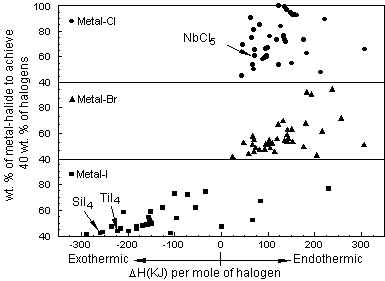
Figure 1: Survey of metal-halide oxidation enthalpies
Reference
[1] E.L. Dreizin et al., Int. J. of Energ. Mater. Chem. Propul., 10, p 297 (2011) ADDIN EN.REFLIST
See more of this Group/Topical: Particle Technology Forum