
 Google
 Yelp
 Facebook
 Twitter
 ChEnected
320061 Simulation of Electrochemical Double-Layer Capacitors Based On Carbon Nanotube Forests
Simulation of Electrochemical Double-layer Capacitors based on Carbon Nanotube Forests
Xinli You, Peixi Zhu, and Lawrence R. Pratt
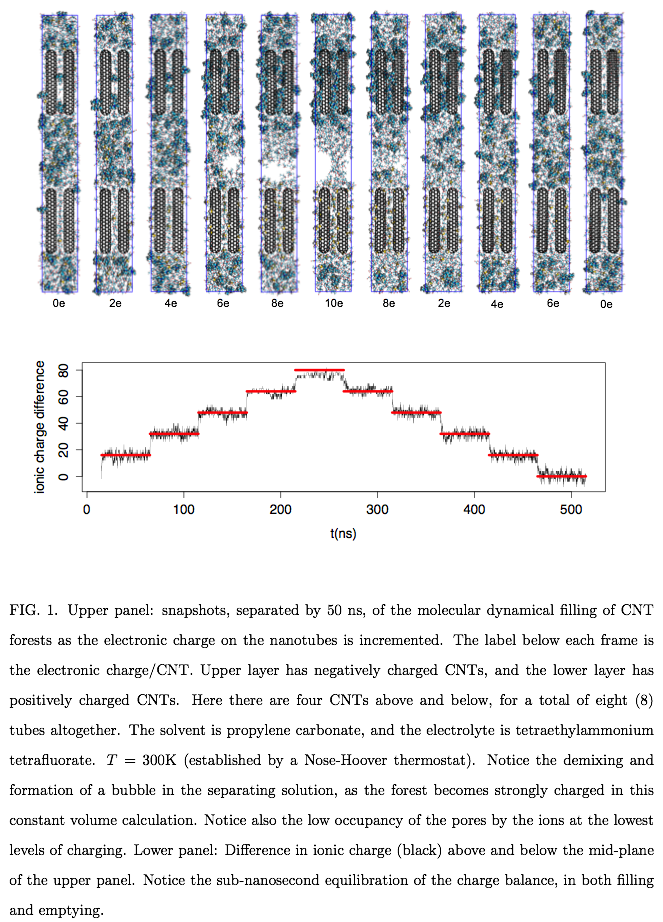
Abstract Unique properties of nanomaterials, and specifically of Carbon nanotube (CNT) forests based electrochemical double-layer capacitors (EDLCs), arise from their large surface areas.1 In recent studies, we exhaustively studied propylene carbonate as a solvent for EDLCs, reported experimental and molecular simulation results on PC interfaces. PC wets graphite with a contact angle of 31° at ambient conditions.2 Molecular dynamics simulations agree with this contact angle after 40% reduction of the strength of graphite-C atom Lennard-Jones interactions with the solvent. This validation paves the way to direct simulation of dynamical filling and performance of CNT-based EDLCs. Here, we present all-atom molecular dynamics simulations of electrochemical double-layer capacitors based on CNT forests with propylene carbonate tetraethylammonium-tetrafluoroborate (PC:TEA-BF4) solutions. Preliminary results are showed in FIG. 1. We explicit characterizations of the charging and discharging process, including electrolyte composition in the pores, the rates that charging responses equilibrate, and the possibility of bubble formation. Also, we consider the pore size dependence of EDLC characteristics and the structural stability of CNT forests.
1 L. Yang, et al., J. Am. Chem. Soc. 131, 12373-12376 (2009): "Molecular simulation of electric double-layer capacitors based on carbon nanotube forests."
2 X. You, et al., J. Chem. Phys. 138, 114708 (2013): "Interfaces of propylene carbonate."
See more of this Group/Topical: Engineering Sciences and Fundamentals