
 Google
 Yelp
 Facebook
 Twitter
 ChEnected
320333 UF/NF Based Processes for Wastewater Treatment and Recovery of Process Water and Tannins in the Cork Industry
Cork has a large range of applications in many activity areas and cork industry is a very important industrial sector in Mediterranean countries. Portugal, with only 30 percent of the world's cork oak forests, accounts for more than half of the world's cork production. Prior to industrial uses, cork planks are subjected to a boiling treatment that makes the planks softer and at the same time removes undesirable compounds from the cork. Although this treatment is essential to the quality of the final products, this process consumes a large amount of water and generates a highly pollutant wastewater which is rich in tannins, sugars and salts [1]. In fact, the pollutant charge is directly related to tannins content (Fig. 1) and therefore the approach followed in this work aims not only to address the treatment of these wastewaters but also to recover the tannins, as they can constitute an asset in the tanning industry.
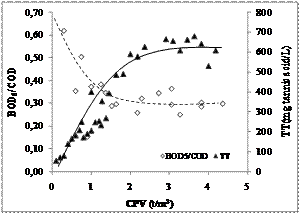
Fig. 1. Variation of Biodegradability (BOD5/COD) and Total Tannins (TT) with the amount of cork processed in the boiling tanks (CPV, t/m3).
Membrane processes, namely ultrafiltration (UF) and nanofiltration (NF), are playing a crucial role for the development of sustainable and cleaner processes in industries that are water-intensive users, like cork processing industries [2, 3, 4, 5].
In this work two goals are envisaged: i) water recycling (NF permeates) and ii) by-products recovery (through the production of tannin-rich concentrates) that can be used by the tanning industry. The achievement of these goals leads to the minimization of water consumption and wastewater discharge in the cork processing industry.
Ultrafiltration and nanofiltration experiments were carried out in spiral wound pilot plants with 2 m2 of surface area. A 5 kDa polyethersulfone ultrafiltration membrane and a DS5 nanofiltration membrane were used. Total recirculation mode experiments were carried out in order to define the permeation optimal operation conditions (transmembrane pressure and feed flow rate). Three different concentrate mode experiments were carried out envisaging the tannin concentration by i) UF, by ii) NF and by an iii) UF/NF sequence. The UF/NF performance was assessed in terms of permeation flux and tannin content variation with the concentration factor. The NF permeate presents low organic content enabling its reuse as process water in the boiling tanks. The tanning power of the three tannin concentrates (UF, NF and UF/NF) was assessed (used as is and with mimosa tannin extracts) through the quantification of the temperature of contraction (Tc), Resistance to the extension of flower, Resistance to light and Tensile strength and elongation at break. These results indicated a high tanning capacity of cork extracts concentrated by ultrafiltration and nanofiltration, when used together with mimosa extracts. The good results achieved will allow significant reductions in the mimosa extract dosage. Even when tannin concentrates are used alone in the tanning process, the resulting skin is already showing a reasonable degree of stabilization. In conclusion, the tannins present in the boiling water of cork planks when subjected to concentration by UF and NF membranes can produce concentrates that have the technical feasibility for application in the Tannin industry.
[1] - “Cork Industry Wastewater Characterization: assessment of the biodegradability, reuse and of the relationship between BOD, COD and Tannins with TOC”, Ana Santos, Marisa Bernardo, Carla Vespeira, Paula Cantinho, Miguel Minhalma, Journal of Water Reuse and Desalination, 2 (1) (2012) 33-39.
[2] – “Flocculation/flotation/ultrafiltration integrated process for the treatment of cork processing wastewaters”, Miguel Minhalma e Maria Norberta de Pinho, Environmental Science and Technology, 35 (2001) 4916-4921.
[3] - “Nanofiltration of cork wastewaters and their possible use in leather industry as tanning agents”, Vítor Geraldes, Miguel Minhalma, Maria N de Pinho, S A Anil, Hasan Özgünay, Behzat O Bitlisli, Özcan Saric, Polish Journal of Environmental Studies, 18 (3) (2009) 353-357.
[4] - “Cork Processing Wastewater Treatment/Valorisation by Nanofiltration”, J. Oliveira, M. Nunes, P. Santos, P. Cantinho, M. Minhalma, Desalination and Water Treatment, 11 (2009) 224-228.
[5] - "Cork industry wastewater partition by ultra/nanofiltration: a biodegradation and valorisation study”, M. Bernardo, A. Santos, P. Cantinho, M. Minhalma, Water Research, 45 (2011) 904-912.
See more of this Group/Topical: Separations Division