
 Google
 Yelp
 Facebook
 Twitter
 ChEnected
320718 A Dual-Membrane Airlift Reactor for Cyclohexanone Ammoximation Reaction Over TS-1
Cyclohexanone oxime is one of the most important intermediate products of caprolactam which was used to produce Nylon-61,2. The coupling technology of reaction and ceramic membrane separation had been employed to realize in situ product removal3. Previous researches adopted cyclohexanone, ammonia gas and hydrogen peroxide to be interactants, tert-butanol as a solvent, to run one-step synthesis of oxime along with TS-14 in the split-membrane reactor. A large amount of tert-butanol was needed to recycle in the current process, which resulted in an increase of subsequent separation energy consumption. Without any solvents, it upsets the mass transfer of reactants to the pore system leading to low activity. In addition, concentration polarization and membrane pollution could affect stability of membrane separation process in long-term simultaneous reaction and separation processes.
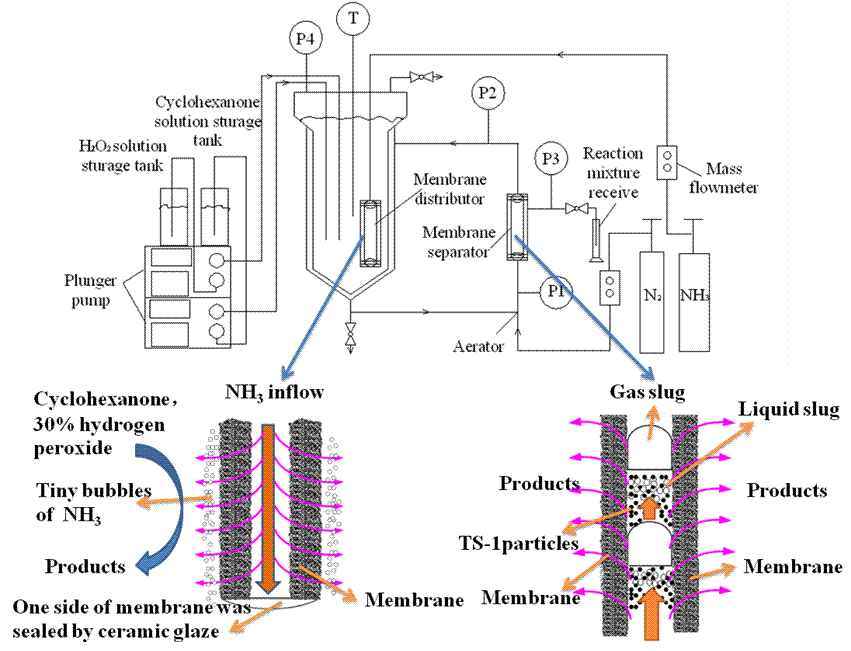
In order to cope with difficulties mentioned above, a noval dual-membrane airlift reactor with a ceramic outer-membrane as a reactant ammonia distributor and another ceramic inner-membrane as a TS-1 separator was developed for the cyclohexanone ammoximation reaction over TS-1 without any solvents, as shown in Figure 1. Ammonia gas was dispersed into the reaction system through a ceramic outer-membrane. Another tubular porous ceramic membrane was employed as a membrane separator for in situ separation of catalysts from the products. Aeration was introduced to form two-phase flow on membrane surface, overcoming concentration polarization, increasing the shear force and local mixing velocity and controlling of membrane fouling caused by long-term consecutive reaction. To investigate the feasibility of the consecutive reaction in this new proposed dual-membrane reactor, the effect of membrane distributor, influence of aeration on membrane fouling, and optimal operation conditions were further studied.
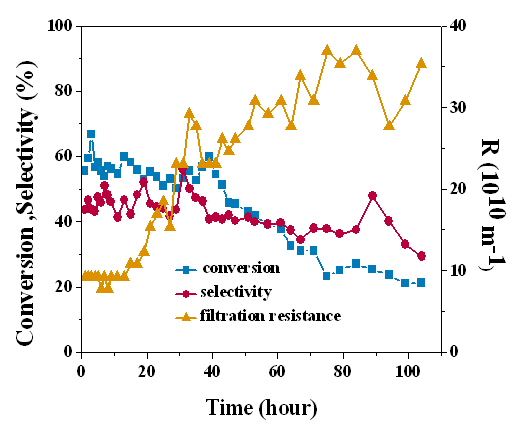
It was interested to find that the introduction of membrane distribution could increase the selectivity by 34.6%, because many tiny ammonia bubbles could be produced with a membrane distributor to strengthen the mix of gas phase and organic phase. Membrane for separation could effectively prevent TS-1 passing micropores to realize the coupling reaction and separation. Aeration had little effect on conversion and selectivity, but had positive on controlling resistant. The conversion, selectivity, and membrane resistance are all closely related to the operation conditions. The optimum operating conditions were that residence time, pressure, temperature and catalyst concentration were 100 min, 0.3 MPa, 343 K and 30-35 g/L respectively, the molar ratio of cyclohexanone, ammonia and hydrogen peroxide was 1:1.59:1.2. On these conditions, the convertion of 87% and selectivity of 76% were obtained in continuous reaction process of 25h. Due to serious membrane fouling,the catalyst concentration was reduced to 10 g/L to inspect continuous cultivation stability of 100h. The reaction stability decreased with time while the membrane resistance increased, as shown in Figure 2. The experiments gave the further direction of investigation on the separation process stability.
|
|
Figure1. Diagram of a novel dual-membrane airlift reactor system
| Figure 2. Stability of the continuous reaction and membrane separation process.
|
References
1. Thomas JM, Raja R. Design of a "green" one-step catalytic production of epsilon-caprolactam (precursor of nylon-6). Proceedings of the National Academy of Sciences of the United States of America. Sep 2005;102(39):13732-13736.
2. Mokaya R, Poliakoff M. Chemistry - A cleaner way to nylon? Nature. 2005;437(7063):1243-1244.
3. Lu C, Chen R, Xing W, Jin W, Xu N. A submerged membrane reactor for continuous phenol hydroxylation over TS-1. Aiche J. 2008;54(7):1842-1849.
4. Yip ACK, Hu X. Formulation of Reaction Kinetics for Cyclohexanone Ammoximation Catalyzed by a Clay-Based Titanium Silicalite-1 Composite in a Semibatch Process. Ind. Eng. Chem. Res. 2011;50(24):13703-13710.
Acknowledgments
Financial supports from the National Natural Science Foundation of China (No. 21125629), the National Basic Research Program (No.2009CB623406), the National High-Tech Research and Development Program of China (2012AA03A606). ADDIN EN.REFLIST
See more of this Group/Topical: Catalysis and Reaction Engineering Division